
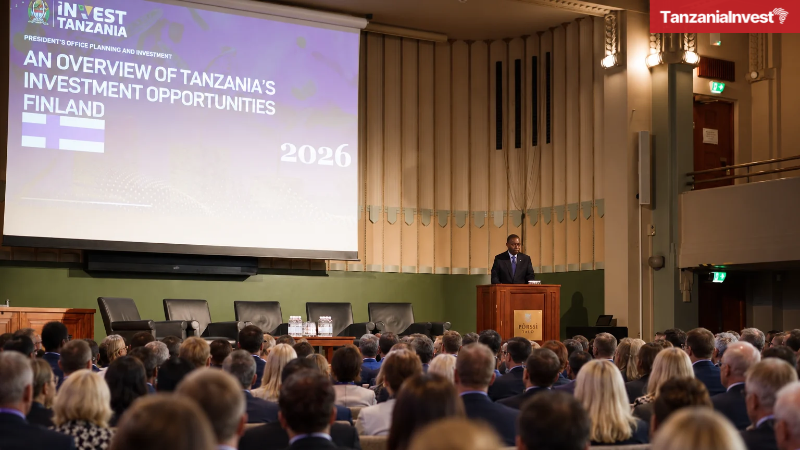
The EU-Tanzania roadshow opened in Helsinki on 28 September 2026, with the EU and Finland signalling their intent to invest in Tanzania’s critical minerals and digital economy, backed by a new EUR 156 million EU package.
Finnish financiers Finnvera and Finnfund confirmed they are open to Tanzanian deals, while Tanzania offered European companies entry into graphite, nickel and rare earths processing, as well as into data centres, submarine cables and broadband, backed by TZS 7 trillion in planned public spending.
The roadshow is part of the EU-Tanzania Investment and Business Forum 2026-2027, an initiative of the Delegation of the European Union to Tanzania held under the theme “EU-Tanzania Partnership: Turning Potential into Prosperity”.

The first phase comprises roadshows in Helsinki, Finland, on 28-29 September, in Emilia-Romagna, Italy, on 1-2 October, and in The Hague, the Netherlands, on 5-6 October 2026, with a second, high-level phase to be held in Dar es Salaam in early 2027.
At a private sector briefing in Dar es Salaam on 18 August 2026, Tanzania and the EU presented a national pipeline of 68 projects worth USD 30.1 billion for the roadshows, of which USD 29.1 billion remains investable.
The Finnish leg, hosted at Pörssitalo in Helsinki, is organised by the Ministry for Foreign Affairs of Finland, the Finnish Institute of Public Management (HAUS) and Mining Finland, and focuses on digitalisation and critical raw materials.
Table of Contents
- Opening Session: EUR 156 Million EU Package and Europe’s Need for Battery Minerals
- Entry Points for European and Finnish Investors: Mineral Processing, Mining Equipment and Services, Data Centres and Submarine Cables
- Mainland Incentives: Former Gold Mine Converted into Mineral Processing Zone
- Zanzibar: Telecom Gateway PPP and USD 2.5 Million Digital Hub Offered in Fumba Special Economic Zone
- Digital Economy: Kilimanjaro One Submarine Cable, Data Centres, Broadband Expansion and Device Manufacturing Open to Investors
- Critical Minerals: Exploration, Processing, Smelting and Refining Open to Investors, with Offtake and Power as Key Conditions
- Kabanga Nickel Advances as Tanzania Seeks Partners in Technician Training, Resource Modelling and ESG Systems
- How to Access EU and Finnish Financing: EFSD+ Guarantees, Finnfund Investment, and Finnvera Export Credit
- Next Stages: Site Visits, Italy, the Netherlands and the 2027 Dar es Salaam Forum
Opening Session: EUR 156 Million EU Package and Europe’s Need for Battery Minerals
The Political State Secretary of Finland, Pasi Rajala, opened the event by noting that Finland and Tanzania have had diplomatic relations for 60 years, evolving from development cooperation into a broader partnership now focused on digitalisation and minerals.
Rajala stated that European companies are seeking reliable, diversified partnerships and more resilient supply chains, describing Tanzania as well placed to play a central role in that effort.

The Head of Cooperation at the EU Delegation to Tanzania, Marc Stalmans, said the European Commission approved a new EUR 156 million action package for Tanzania on 23 July 2026, aimed at establishing a renewed economic partnership.
“We are here because we all believe that now is the right time for increased investment in Tanzania,” Stalmans said.
He explained that Europe requires graphite, nickel, copper, lithium and cobalt to achieve greater strategic autonomy in battery production, and that these minerals are abundant in Tanzania.
Stalmans added that the EU offers guarantees, blending mechanisms, grants, and loans under its Global Gateway initiative to support private investment in Tanzania.
The Deputy Minister of State in the President’s Office for Planning and Investment, Dr. Pius Stephen Chaya, presented Tanzania Development Vision 2050 as the framework for private sector-led growth, listing minerals, ICT, energy, agriculture, manufacturing, infrastructure and tourism as priority sectors.
He noted that investors can use foreign direct investment, joint ventures, public-private partnerships (PPPs), technology agreements or blended financing structures to enter the Tanzanian market.
“Our ambition is to convert investment conversations into actual projects, actual factories, actual businesses, actual jobs, and actual economic value,” Chaya stated.
Entry Points for European and Finnish Investors: Mineral Processing, Mining Equipment and Services, Data Centres and Submarine Cables
The Tanzanian government presented critical minerals as a step-by-step value chain rather than a mining equity play, allowing European investors to enter through shared infrastructure, processing, power and water, logistics, testing and certification, and ESG and traceability systems.
Tanzanian officials said existing nickel and graphite mines need partners to process their output locally, and that minerals from neighbouring Congo and Zambia can also be processed in Tanzania’s special economic zones.
Officials noted that most critical minerals projects in Tanzania are currently held by Chinese and other Asian companies, and that local mining companies have been turning to Chinese and Korean financiers to fund construction.
For Finnish companies, the most direct opening lies in equipment and technology supply, since both Finland’s export credit agency Finnvera and development finance institution Finnfund require a Finnish economic interest in the projects they back.
Speakers identified specific service gaps in accredited resource modelling for JORC and NI 43-101 reporting, international certification of Tanzanian mining technicians, and the ESG and traceability systems that European buyers require.
In the digital economy, projects offered to investors include the Kilimanjaro One submarine cable, data centres, a telecommunications gateway PPP in Zanzibar, and a digital device manufacturing facility.
Mainland Incentives: Former Gold Mine Converted into Mineral Processing Zone
The Director General of the Tanzania Investment and Special Economic Zones Authority (TISEZA), Gilead Teri, said the authority has a dedicated desk officer for Finnish investors who coordinates licensing, permits and registration with all relevant agencies through its One Stop Facilitation Centre.
Teri explained that the former Barrick Buzwagi gold mine in Kahama, a 1,333-hectare site that previously employed 4,000 staff, has been converted into a Special Economic Zone (SEZ) dedicated to mineral processing.
The Buzwagi SEZ has existing power, water and housing infrastructure, a direct rail connection to the Port of Dar es Salaam, and a site allocation already secured by the Kabanga Nickel project.
Teri stressed that operations within SEZs benefit from a 10-year corporate tax exemption on exported processed minerals, and investments above USD 50 million can negotiate customised incentive packages.
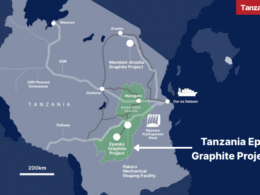
The TISEZA presentation listed critical minerals pipeline projects seeking funding and offtake partners, including EcoGraf’s (ASX: EGR) Epanko graphite mine in Morogoro, with initial output of about 73,000 tonnes of concentrate per year, and a EUR 60 million graphite shaping facility at Ifakara.
The pipeline also includes Lifezone Metals’ (NYSE: LZM) Kabanga nickel-copper-cobalt project, Helium One Global’s (AIM: HE1) Southern Rukwa helium project and the Panda Hill niobium project near Mbeya.
The presentation noted that EIB Global signed cooperation agreements in 2026 with EcoGraf and Andrada Mining (AIM: ATM) to support early-stage graphite and lithium projects in Tanzania and Namibia.
In the digital sector, Teri said typical projects range between USD 5 million and USD 25 million, while the TISEZA deck lists 25 digital pipeline entries, including subsea cable, data centre, government cloud and Zanzibar smart metering projects.
Download the full TISEZA presentation
Zanzibar: Telecom Gateway PPP and USD 2.5 Million Digital Hub Offered in Fumba Special Economic Zone
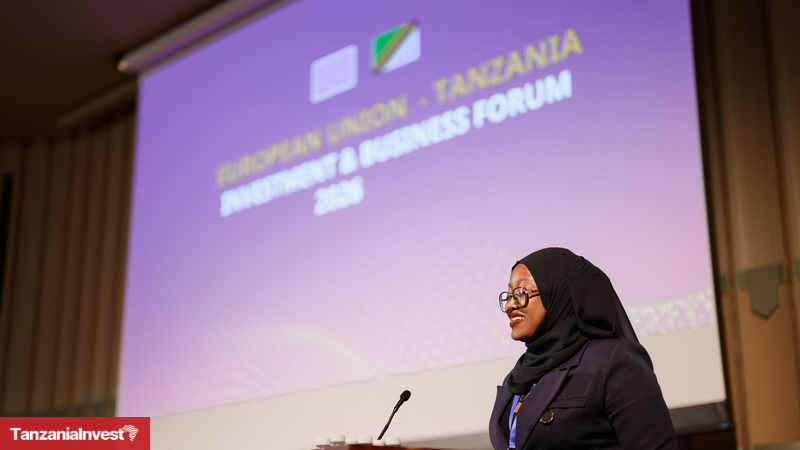
The Investment Promotion and Marketing Manager of the Zanzibar Investment Promotion Authority (ZIPA), Farida Mohamed, said Zanzibar has recorded 650 investment projects worth USD 7.2 billion since 2021, creating more than 35,500 jobs.
Of these, 279 projects worth USD 2.8 billion and generating 16,948 jobs originate from EU member states, while 25 registered PPP projects carry a combined investment cost of USD 1.3 billion.
Mohamed presented two digital projects in the Fumba SEZ: an international telecommunication gateway under a PPP model with a completed feasibility study, and a digital hub estimated at USD 2.5 million at concept note stage.
Zanzibar allows 100% foreign ownership and offers VAT and import duty exemptions on capital goods, corporate tax holidays of five to ten years and land leases of 33 to 99 years, with applications processed online through the Zanzibar Investment Electronic Window (ZIEW).
Digital Economy: Kilimanjaro One Submarine Cable, Data Centres, Broadband Expansion and Device Manufacturing Open to Investors
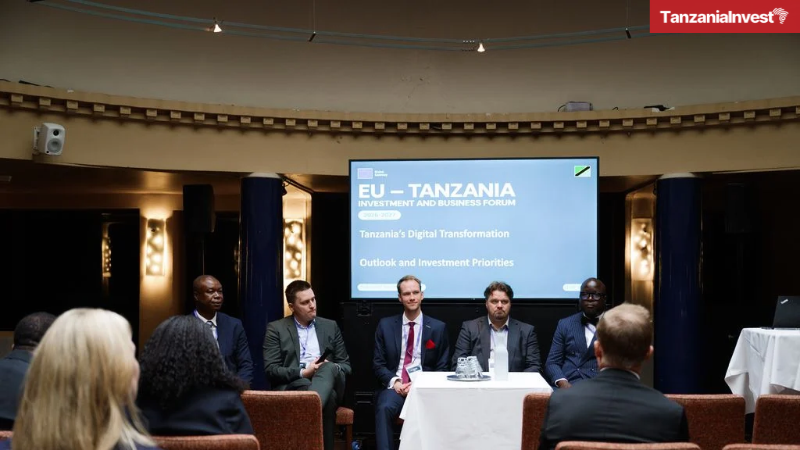
The Director General of the ICT Commission, Dr. Nkundwe Moses Mwasaga, opened the digital transformation breakout session with a presentation on Tanzania’s ICT outlook and investment priorities.
The presentation showed that the National ICT Broadband Backbone has reached 13,820 km of a planned 16,280 km, or 85% of the network, connecting all mainland regions, Zanzibar and 109 of 139 districts.
As of December 2025, mobile network population coverage stood at 93.9% for 3G, 94.2% for 4G and 30.1% for 5G.
According to the presentation, the government plans to mobilise TZS 7.0 trillion for broadband and data centre development by 2031.
The combined ICT and telecommunications market is estimated at more than USD 2 billion, with a projected compound annual growth rate of 6.27% through 2031, while the data centre and storage market is projected to grow by 20% a year between 2024 and 2030.
Active mobile money subscriptions rose from 60.76 million in 2024 to 75.78 million in 2025, while mobile money transactions increased from 46.49 million to 97.53 million and their value from TZS 1,210.24 billion to TZS 3,181.24 billion.
Projects presented to investors include the FTTX broadband expansion, the Kilimanjaro One submarine cable system, a digital devices and personal computer manufacturing facility, the Tanzania Digital Technology and Innovation Park and the Smart Learning Tanzania smart classrooms programme.
Registered ICT projects benefit from corporate tax holidays, zero-rated import duties on ICT infrastructure and machinery, and deferred VAT on project inputs, with ready-to-invest sites available at the Bagamoyo Eco Maritime City.
Download the full ICT Commission presentation
In the second digital session, the Associate Director of ICT Systems at the Ministry of Communication and Information Technology, Dr. Angelina Misso, presented market data as of June 2026 showing 117 million telecommunications subscriptions, 62.8 million internet subscriptions and more than 87 million mobile money accounts.
The ministry’s figures put internet subscription penetration at 89.7% and smartphone penetration at 44.74%, with quarterly internet data traffic of 1,041 petabytes, up 11.65% quarter-on-quarter.
Misso’s presentation outlined the Jamii Stack, the government’s digital public infrastructure, which comprises the Jamii Namba digital identity system, the Jamii Malipo e-payments platform, the Jamii Data governance layer and Jamii AI, a Swahili large language model.
The ministry identified investment opportunities in digital device manufacturing and assembly, national data centres and government cloud, last-mile broadband connectivity, artificial intelligence and data-driven solutions, and digital payments.
Download the full Ministry of Communication and Information Technology presentation
Critical Minerals: Exploration, Processing, Smelting and Refining Open to Investors, with Offtake and Power as Key Conditions
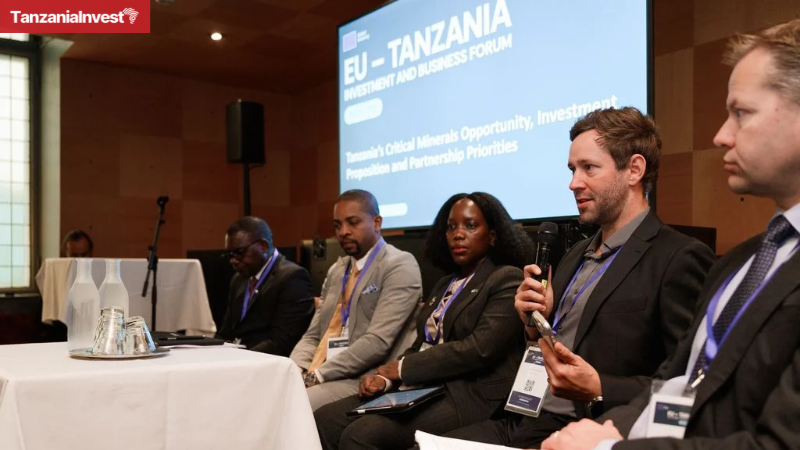
The Chief Executive Officer of the Geological Survey of Tanzania (GST), Ally Samaje, reported that the mineral sector contributed 10.3% of GDP in 2025 and accounts for more than 50% of national export earnings.
Samaje explained that Tanzania plans to raise high-resolution airborne geophysical survey coverage from 16% to 50% by 2030, prioritising areas with critical mineral potential, and geochemical coverage from 24% to 50%.
He added that total installed power capacity is approximately 4,600 MW against national peak demand of about 2,000 MW, following completion of the 2,115 MW Julius Nyerere Hydropower Project.
In the panel that followed, Samaje identified securing offtake arrangements at an early stage as a key challenge for critical minerals projects, noting that developers often advance projects without assured buyers.
The Director of Private Investment at the President’s Office for Planning and Investment, Andrew Mahiga, said electricity is one of the biggest challenges because many projects are located in remote areas not connected to the national grid.
Mahiga advised investors to “engage the state utility for electricity early in your project,” noting that many developers pay for transmission lines and substations under cost-sharing agreements and offset the cost against future electricity bills.
He added that large projects may run 50 to 100 trucks a day, and recommended similar early cost-sharing discussions with the Tanzania National Roads Agency (TANROADS).
The Director of Integrated Solutions at Metso (Nasdaq Helsinki: METSO), Chris Cruickshank, said the company is willing to guarantee performance from a single piece of equipment up to a full plant, which can support project financing arrangements.
The Commissioner for Local Content at the Mining Commission, Dr. Theresia Numbi, called on investors to include processing, beneficiation and laboratories in their mine plans and to arrive with a local content investment plan from the outset.
“Tanzania should not be a place where we only receive equipment while knowledge remains offshore,” Numbi said.
Download the full Geological Survey of Tanzania presentation
Kabanga Nickel Advances as Tanzania Seeks Partners in Technician Training, Resource Modelling and ESG Systems
The Business Development Manager of Lifezone Metals, Luke Peter, said the Kabanga feasibility study published last year outlines an initial 18-year mine life, and cited active government participation through the 16% free-carried interest as a key factor in the project’s progress.
The Executive Secretary of the Tanzania Chamber of Mines, Benjamin Mchwampaka, said many member companies struggle to finance the move from feasibility to construction, and urged local financial institutions to syndicate loans for medium and large projects.
Mchwampaka noted that technicians trained at the Integrated Mining Technical Training (IMTT) facility in Moshi lack international certification, which currently prevents them from performing some specialised jobs.
The Project Manager at the Geological Survey of Finland (GTK), Heli Kivisaari, said an EU-funded GTK project is expanding the IMTT programme from maintenance skills into drilling and blasting.
The Director of Environmental and Social Impact Assessment at the National Environment Management Council (NEMC), Lilian Lukambuzi, stated that ESG, environmental compliance and traceability can become commercial differentiators as European buyers require evidence of sustainable supply chains.
The Chief Geologist and Site Manager of EcoGraf, David Drabble, said the company is finalising a community and environmental programme in Mahenge with Germany’s DEG, and identified the lack of accredited JORC and NI 43-101 resource modellers as a key skills gap in Tanzania.
How to Access EU and Finnish Financing: EFSD+ Guarantees, Finnfund Investment, and Finnvera Export Credit
Pierre Canova, of the External Action Guarantees Unit at the European Commission’s Directorate-General for International Partnerships (DG INTPA), presented the European Fund for Sustainable Development Plus (EFSD+) guarantees, including a window of up to EUR 26.5 billion for the European Investment Bank (EIB).
Canova explained that Tanzanian businesses can access these instruments by partnering with an EU company or financing through an EU development finance institution, with joint proposals submitted through a “Team National” of member state institutions to the Global Gateway Investment Hub.
DG INTPA evaluates submitted projects and notifies a decision within one month, with eligible projects receiving grants, loans, equity or guarantees alongside political and technical support.
The Head of EU and Finnish Partnerships at Finnfund, Patrik Bredbacka, said the Finnish development finance institution’s Africa Connected digital programme has grown from a EUR 100 million guarantee into a global EUR 302 million guarantee programme, with more than EUR 400 million invested in subsea cables, data centres, fibre and towers.
Bredbacka added that Finnfund invests only in private companies and works with European technology providers such as Nokia wherever possible.
The Senior Adviser at Finnvera, Jarkko Haapiainen, said Finnvera’s total guarantee commitments exceed EUR 26 billion, but Sub-Saharan Africa represents only EUR 0.4 billion, or 2% of the portfolio.
“Tanzania is currently classified as Category 6 out of 7,” Haapiainen stated, noting that the risk rating affects premium pricing but that Finnvera’s country policy remains open to sovereign, corporate and bank buyers in Tanzania.
He explained that Finnvera’s export credit guarantees can cover up to 95% of a commercial bank loan, with a 15% buyer down payment and repayment periods of 10 to 15 years, and advised companies to contact Finnvera as early as possible.
The Chief Executive Officer of the Tanzania Private Sector Federation (TPSF), Deogratius Massawe, closed the day by inviting a Finnish business delegation to Tanzania to inspect sites and negotiate incentive packages.
Following the financing session, the programme allocated the afternoon to meetings between Tanzanian and European businesses, government representatives, and financial institutions, with B2B, B2G, and B2F matchmaking.

Next Stages: Site Visits, Italy, the Netherlands and the 2027 Dar es Salaam Forum
The second day of the Helsinki leg, on 29 September 2026, is dedicated to site visits to Finnish mining operations and digital and technology companies, giving the Tanzanian delegation a direct view of Finland’s mining, processing and digital capabilities.
The roadshow then moves to the Cesena Fiera Congress Centre in Emilia-Romagna, Italy, on 1-2 October 2026, focusing on agri-food, agricultural mechanisation and digital innovation.
The third leg will take place in The Hague, the Netherlands, on 5-6 October 2026, organised jointly with Belgium and including a visit to Antwerp.
The roadshows will be followed by the EU-Tanzania Investment and Business Forum in Dar es Salaam in early 2027, tentatively scheduled for 5 and 6 February 2027, just before the Mining Indaba conference in South Africa.
Want to know more about Mining in Tanzania? Our free overview of the Tanzania Business and Investment Guide 2026 covers Mining, plus key sectors and investment opportunities. The complete 141-page edition includes policies, taxation, key regulations, full macroeconomic data, and sources, and is also available at no cost upon completion of a short form.
Download Free OverviewGet the Full Edition for Free