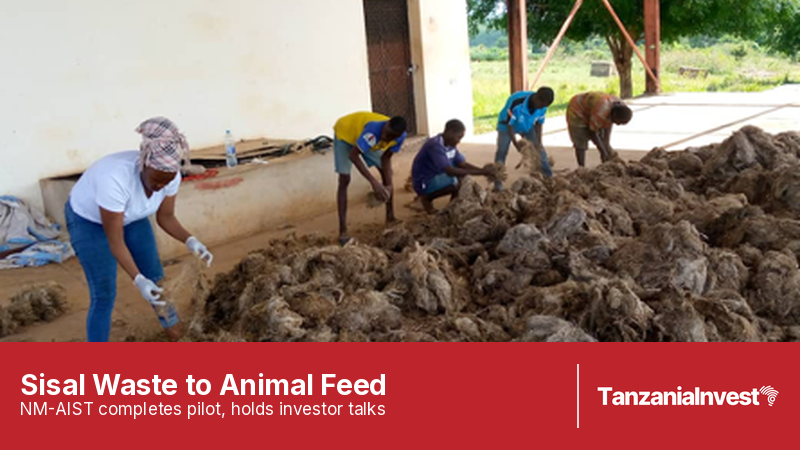
The Nelson Mandela African Institution of Science and Technology (NM-AIST) is holding investor talks after piloting a method that converts sisal waste into animal feed and organic fertiliser.
The institution reported the development on 16 November 2026, identifying African Fibers Tanzania Limited’s Ubena Estate in Chalinze as the pilot site.
The process uses black soldier fly larvae to consume treated sisal-processing residues, producing larvae for feed and an organic residue known as frass for fertiliser.
NM-AIST reports that one gram of black soldier fly eggs can process about four kilogrammes of sisal waste, producing about two kilogrammes of larvae and two kilogrammes of frass.
NM-AIST reports that the larvae meal contained 46.2% crude protein and 14.2% crude fat, compared with 33.9% protein for larvae fed traditional food waste under the comparison conditions.
The institution identifies sisal processors, poultry farmers, animal-feed manufacturers, and agricultural enterprises as potential users of the technology.
It disclosed that it was negotiating with potential investors to explore further development and commercialisation and invited collaboration with processors, feed manufacturers, agricultural enterprises, and development partners.
An earlier peer-reviewed study by Konyo, Machunda, Liliane Pasape and Mshandete, published in Recycling on 23 December 2022, reported 53% crude protein and 4% crude fat in sun-dried larvae reared on pre-treated sisal waste.
In that experiment, 3,000 grams of dried, pre-treated waste yielded 336 grams of wet larvae, compared with 244 grams from the same quantity of fruit waste, and the researchers reported a 52% reduction in waste.
The study required pre-treatment because fresh sisal-processing waste is acidic, using drying, sieving, decomposition and neutralisation before rearing the insects.
NM-AIST estimates that usable fibre accounts for about 4% of the sisal leaf, leaving most of the material as residue.
Want to know more about Agriculture in Tanzania? Our free overview of the Tanzania Business and Investment Guide 2026 covers Agriculture, plus key sectors and investment opportunities. The complete 141-page edition includes policies, taxation, key regulations, full macroeconomic data, and sources, and is also available at no cost upon completion of a short form.
Download Free OverviewGet the Full Edition for Free