
Tanzania has established its first sovereign sustainable finance framework to raise funding for environmental and social investments.
The Ministry of Finance announced the framework in November 2026, covering green, social, sustainability, and other environmental, social, and governance (ESG) thematic bonds, Sukuk, loans, and debt instruments.
The framework allows the ministry, acting for the government, local government authorities or state-owned entities to finance or refinance eligible expenditure, including blue, gender and nature-related investments.

It identifies 10 green categories covering sustainable natural resources and land use, biodiversity conservation, renewable energy, green buildings, energy efficiency, water and wastewater, pollution control, clean transport, climate adaptation and the circular economy.
The six social categories cover economic empowerment, affordable basic infrastructure, affordable housing, employment generation, essential services and food security, with eligibility requirements identifying the intended beneficiaries.
Eligible investments include solar and wind power, qualifying hydropower and geothermal projects, electricity storage, grid integration, electrified railways, zero-emission vehicles, irrigation, forest restoration, water systems, healthcare, education and small-business support.
Project criteria include at least a 30% energy-efficiency improvement for building renovations and at least a 10% reduction in water losses or leakage for relevant water infrastructure investments.
The exclusions cover fossil-fuel-linked projects, nuclear energy, deforestation, weapons, gambling, alcohol and tobacco production, illegal activities and projects violating human or community rights.

Eligible spending can include capital and operating expenditure, subsidies, research, training and tax incentives, within a window extending three fiscal years before issuance and two fiscal years from issuance.
Funds may reach private entities indirectly through sector ministries, while co-financed projects qualify only for the government’s share and projects previously financed by multilateral financial institutions are excluded to prevent double counting.
Implementing ministries, local authorities and government agencies will propose projects and register them in the National Public Investment Management Information System under the National Planning Commission (NPC).
The NPC will assess alignment with national priorities, environmental and social safeguards, procurement requirements, financial viability, fiscal affordability and implementation readiness before submitting approved projects to the Ministry of Finance.
The framework requires environmental certification and impact assessment through the National Environment Management Council, with financing approval subject to the applicable budget and borrowing laws.
Net proceeds will enter the Consolidated Fund and be earmarked and tracked in a Sustainable Finance Register, with unallocated balances held in cash or cash equivalents under the ministry’s cash-management policies.
If an allocated project becomes ineligible or is withdrawn, its proceeds must be reassigned as soon as practicable and within 12 months, while annual reviews will check project eligibility and allocations.
Allocation and impact reports must be published within one year of issuance and annually until full allocation, with information on financed categories, unallocated balances, refinancing and geographical distribution where feasible.
Impact indicators include renewable generation capacity, emissions avoided, water saved, housing units, jobs and beneficiaries of health, education and financial inclusion programmes, subject to available data.
The Ministry of Finance said S&P Global Ratings had provided a Second Party Opinion confirming alignment with the International Capital Market Association’s bond principles and sustainability guidelines and the Loan Market Association’s green and social loan principles.
The framework also provides for third-party verification of proceeds allocation, while Standard Chartered Bank acted as sole sustainability structuring bank.
The announcement establishes financing rules but does not set an issuance amount, coupon, maturity or subscription timetable.
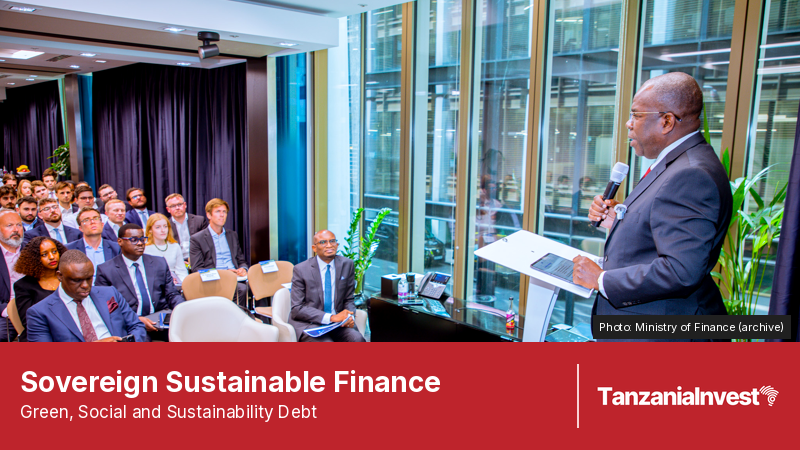
Finance Minister Ambassador Khamis Mussa Omar said the framework connects sovereign funding with national climate and social strategies to support infrastructure, clean energy and programmes improving livelihoods.
The framework supports Tanzania Development Vision 2050 and the United Nations Sustainable Development Goals, building on the Alternative Project Financing Strategy initiated in 2021 to broaden access to domestic and international capital.
Tanzania’s sustainable debt market already includes corporate instruments, such as the CRDB Bank Kijani green bond listed in Luxembourg in July 2025.
Want to know more about Capital Markets in Tanzania? Our upcoming Capital Markets Guide covers the Dar es Salaam Stock Exchange (DSE), listed companies, bonds, and private equity, plus the regulatory framework for investing in Tanzania’s capital markets.
Learn MoreWant to know more about the Capital Markets in Tanzania? Our free overview of the Tanzania Business and Investment Guide 2026 covers the Capital Markets, plus key sectors and investment opportunities. The complete 141-page edition includes policies, taxation, key regulations, full macroeconomic data, and sources, and is also available at no cost upon completion of a short form.
Download Free OverviewGet the Full Edition for Free