
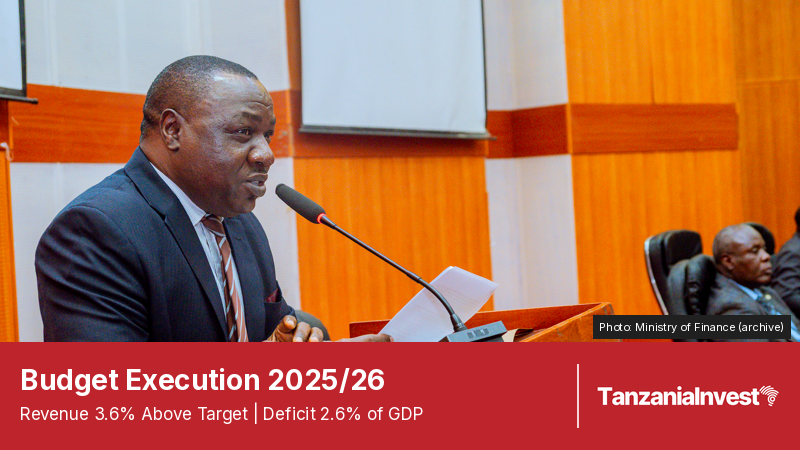
Tanzania’s budget execution report for 2025/26 shows domestic revenue exceeded target by 3.6%, while the fiscal deficit was 2.6% of gross domestic product (GDP).
The Ministry of Finance report, published on 17 November 2026, covers July 2025 to June 2026 and includes revenue collected on behalf of other institutions.
Domestic revenue, including local government authorities’ own-source collections, reached TZS 41,930.40 billion (± USD 15.84 billion), compared with a target of TZS 40,466.10 billion (± USD 15.29 billion).

This was 20.3% above the TZS 34,845.90 billion (± USD 13.17 billion) collected in 2024/25.
The Tanzania Revenue Authority (TRA) collections reached TZS 36,006.20 billion (± USD 13.60 billion), equivalent to 105.6% of target, while local government own-source collections were TZS 1,606.70 billion (± USD 607.0 million), or 95.6% of target and 11.8% above the previous year.
Corporate tax collections rose 36.5% to TZS 5,472.60 billion (± USD 2.07 billion), reaching 126.0% of target, while domestic sales taxes increased 9.2% to TZS 7,576.50 billion (± USD 2.86 billion) but achieved only 94.1% of target.
Non-tax revenue was TZS 5,744.50 billion (± USD 2.17 billion), up 24.5% but at 86.9% of target, while grants reached TZS 917.60 billion (± USD 346.7 million) against projected receipts of TZS 1,069.90 billion (± USD 404.2 million).
Total budget expenditure was TZS 55,551.90 billion (± USD 20.99 billion), or 98.3% of the TZS 56,490.25 billion (± USD 21.34 billion) annual target, and 12.5% above the previous year’s TZS 49,362.28 billion (± USD 18.65 billion).
Recurrent expenditure reached TZS 38,449.56 billion (± USD 14.53 billion) against a target of TZS 39,331.39 billion (± USD 14.86 billion), while development expenditure was TZS 17,102.33 billion (± USD 6.46 billion) against TZS 17,158.86 billion (± USD 6.48 billion), equivalent to 99.7% of plan.
Development spending was 11.0% above the TZS 15,402.72 billion (± USD 5.82 billion) recorded in 2024/25, with domestically financed development expenditure reaching 110% of target and externally financed expenditure reaching 77%.
The spending total includes TZS 7,200.50 billion (± USD 2.72 billion) in debt principal repayments and TZS 5,720.60 billion (± USD 2.16 billion) in interest payments, while verified arrears payments amounted to TZS 667.29 billion (± USD 252.1 million), mostly for construction works.
The reported fiscal deficit was below the 3.0% of GDP target, with domestic and foreign net financing equivalent to 1.5% and 1.1% of GDP respectively.
Total net financing was TZS 6,438.90 billion (± USD 2.43 billion) against a target of TZS 7,239.00 billion (± USD 2.74 billion), compared with TZS 6,810.10 billion (± USD 2.57 billion) in 2024/25.
Net domestic financing reached TZS 3,733.00 billion (± USD 1.41 billion), or 168.6% of target, while net foreign financing was TZS 2,705.90 billion (± USD 1.02 billion), or 53.9% of target.
Central government debt stood at TZS 117,384.01 billion (± USD 44.35 billion) at end-June 2026, up 7.26% from TZS 109,441.29 billion (± USD 41.35 billion) a year earlier.
Domestic debt accounted for 33.5%, at TZS 39,325.85 billion (± USD 14.86 billion), while external debt was TZS 78,058.16 billion (± USD 29.49 billion), or 66.5% of the total.
Treasury bonds accounted for 79.9% of domestic debt, while multilateral creditors held 70.42% of external debt, commercial creditors and export credit accounted for 24.31%, and bilateral creditors held 5.27%.
For calendar 2025, real GDP growth was 5.9%, compared with 5.6% in 2024 on the rebased 2019-price series, with financial and insurance activities expanding 15.7%, electricity 11.8% and mining and quarrying 9.4%.
Headline inflation averaged 3.6% in 2025/26, compared with 3.1% in 2024/25, and averaged 4.1% in the final quarter against 3.2% a year earlier.
Exports of goods and services increased 15.5% to USD 19,625 million, while imports rose 15.1% to USD 20,285.7 million, and the current account deficit widened to USD 2,370.4 million from USD 2,178.9 million.
Foreign reserves were USD 5,641.5 million in June 2026, down from USD 5,971.5 million a year earlier, providing 4.4 months of projected import cover.
Private-sector credit growth averaged 25.0% in the quarter ending June 2026, compared with 15.9% a year earlier, while the overall bank lending rate averaged 15.29% against 15.19%.
The shilling appreciated by an average of 3.1% against the US dollar over 2025/26, compared with a 4.25% depreciation in the preceding year.
The ministry attributed revenue performance to tax administration measures and stronger collections, while identifying missed remittances from public institutions and lower-than-targeted tourist numbers among the reasons for non-tax revenue shortfalls.
Parliament approved the 2025/26 national budget in June 2025, and the new report presents the full-year outturn rather than the partial-year collections reported during preparation of the following budget.
The ministry’s expenditure presentation includes principal repayments, so the headline spending total cannot be subtracted directly from revenue and grants to reproduce its reported fiscal deficit.
The report also includes first-quarter 2026 growth calculated at 2015 prices alongside annual figures rebased to 2019 prices, which use different statistical bases.
Want to know more about the Economy in Tanzania? Our free overview of the Tanzania Business and Investment Guide 2026 covers the Economy, plus key sectors and investment opportunities. The complete 141-page edition includes policies, taxation, key regulations, full macroeconomic data, and sources, and is also available at no cost upon completion of a short form.
Download Free OverviewGet the Full Edition for Free