


Tanzania Annual Inflation Decrease to 5.1% in October 2017

Tanzania Inflation October 2017

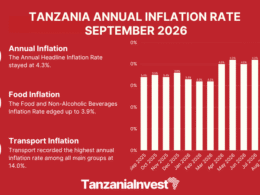
The National Bureau of Statistics of Tanzania (NBS) indicates that the Annual Headline Inflation Rate for the month of October 2017 has decreased to 5.1% from 5.3% recorded in September 2017.

NBS explains that the decrease is due to the speed of price change for commodities in the year ending October 2017 that has decreased compared to the speed of price change recorded in September 2017.

The overall index went up to 108.41 in October 2017 from 103.17 recorded in October 2016.

Tanzania Investment Guide 2026 Free Edition

Food and Non-Food Inflation Rates

Annual Inflation Rate for food consumed at home and away from home has decreased to 9.4% in October 2017 from 9.8% recorded in September 2017.

In addition, the 12-month index change for non-food products has slightly decreased to 3.0% in October 2017 from 3.1% recorded in September 2017.

Inflation Rate Excluding Food and Energy
The Annual Inflation Rate which excludes food and energy for the month of October 2017 has stagnated at 1.7% in October as it was recorded in September 2017.

Monthly Headline Inflation Rate
The Monthly Headline Inflation Rate for the month of October 2017 has decreased by 0.1% compared to an increase of 0.02% recorded in September 2017.

Tanzania Investment Guide 2026 Full Edition

The overall index has decreased to 108.41 in October 2017 from 108.48 recorded in September 2017.

The decrease of the overall index is mainly attributed to the price decrease of food items.

Some food items that contributed to such decrease include sorghum grain by 9.3%, round potatoes by 6.9%, sorghum flour by 5.5%, cooking bananas by 4.2%, cassava flour by 2.2%, vegetables by 1.7% and fresh fish by 1.4%.

Inflation East Africa 2017

Want to know more about the Economy in Tanzania? Our free overview of the Tanzania Business and Investment Guide 2026 covers the Economy, plus key sectors and investment opportunities. The complete 141-page edition includes policies, taxation, key regulations, full macroeconomic data, and sources.

Download Free OverviewGet the Full Guide
Related Posts
Tanzania Survey Foreign Liabilities 2024
Read More

Tanzania Foreign Liabilities Survey 2026 Targets Companies to Update Investment and Balance of Payments Data

The Bank of Tanzania (BOT), the National Bureau of Statistics (NBS), and the Tanzania Investment and Special Economic Zones Authority (TISEZA) have launched the 2026 Survey of Companies with Foreign Liabilities in Tanzania. The exercise will collect 2025 foreign investment and financial data between July and September 2026 to support national economic statistics and policymaking.
TRA Targets TZS 41.83 Trillion Revenue in 2026/2027
Read More

TRA Targets TZS 41.83 Trillion Revenue in 2026/2027

The Tanzania Revenue Authority (TRA) has adopted new strategies to reach a revenue collection target of TZS 41.830 trillion for the 2026/2027 financial year. The Authority collected TZS 37.96 trillion in 2025/2026, equivalent to 105% of its TZS 36.07 trillion target.
EU-Tanzania Investment & Business Forum 2026-2027
Read More

EU–Tanzania Investment and Business Forum 2026-2027 to Connect Investors and Businesses

The EU–Tanzania Investment and Business Forum 2026–2027 will connect European investors, Tanzanian businesses, and public institutions to develop new investment partnerships in key sectors, including agriculture, energy, minerals, and digital innovation. The initiative will begin with European roadshows in Helsinki, Finland (28–29 September 2026), Emilia-Romagna, Italy (1–2 October 2026), and The Hague, Netherlands (5–6 October 2026), followed by a high-level forum in Dar es Salaam in early 2027.
IMF Tanzania flag
Read More

IMF Approves USD 443.9 Million for Tanzania, Projects 6.2% GDP Growth Supported by Mining, Agriculture, and Tourism

The IMF Executive Board has approved an immediate disbursement of USD 443.9 million to Tanzania after completing the final reviews under the Extended Credit Facility and Resilience and Sustainability Facility programmes. The IMF said Tanzania maintained strong economic growth and macroeconomic stability while highlighting the need for continued reforms and fiscal consolidation.