

Tanzania tourism earnings rose 13% to USD 4,410.6 million in 2025 from USD 3,903.1 million in 2024, on 2,294,495 international arrivals, up 7.1% from 2,141,895, according to the 2025 International Visitors’ Exit Survey Report recently released by the Bank of Tanzania (BOT).
Average expenditure per person per night jumped 19.1% to USD 289 from USD 243, meaning the gain was driven more by yield than volume, i.e., Tanzania is monetising each visitor more effectively rather than simply adding headcount.
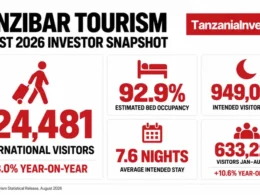
Zanzibar outperformed the mainland on earnings growth, with receipts up 19.3% to USD 1,190.8 million from USD 997.8 million, on 654,880 arrivals, up 9% from 601,006.

Average expenditure in Zanzibar rose 9% to USD 274 per person per night from USD 251.
Arrivals have more than tripled from the 2020 pandemic low of 621,000 and are 50% above the 2019 level of 1,527,000.
Tourism Earnings and Arrivals
Mainland Tanzania
Mainland earnings rose 13% to USD 4,410.6 million in 2025, from USD 3,903.1 million in 2024.
Arrivals grew 7.1% to 2,294,495, from 2,141,895 the year before.
Package tours accounted for 58.8% of mainland visitors in 2025, up from 56.3% in 2024, and generated 75.2% of total mainland earnings.

Zanzibar
Zanzibar earnings rose 19.3% to USD 1,190.8 million in 2025, from USD 997.8 million in 2024.
Arrivals grew 9% to 654,880, from 601,006 the year before.
Package tours accounted for 67.2% of Zanzibar visitors, up from 61.8% in 2024, but their share of earnings fell to 59.1% from 63.6%, as non-package spending grew faster than package spending.
Visitor Spending
Average expenditure per person per night rose to USD 289 on the mainland, up 19% from USD 243 in 2024, and to USD 274 in Zanzibar, up 9% from USD 251.
On the mainland, package tourists spent USD 479 per person per night, up from USD 416, while non-package tourists spent USD 203, up from USD 172.
In Zanzibar, package tourists spent USD 379 per person per night, down from USD 391, while non-package tourists spent USD 211, up from USD 185.
China was the highest-spending source market on the mainland, at USD 551 per person per night, up from USD 491 in 2024.
By activity, hunting tourists spent the most at USD 710.8 per person per night, up 54% from USD 460.1 in 2024, followed by cultural tourism at USD 537 and wildlife safaris at USD 452.
Bird watching recorded the lowest spend, at USD 105.6 per person per night.
Cash remained the dominant payment method, used by 87.0% of mainland visitors and 82.4% of Zanzibar visitors.
Source Markets
Mainland Tanzania
The United States was the largest source market for the mainland in 2025, accounting for 12.4% of visitors, followed by Italy at 11.8%, France at 7.0%, Kenya at 6.4% and the United Kingdom at 6.0%.
The Netherlands and India entered the top 15 source markets for the first time, replacing Australia and Burundi.
Zanzibar
Italy was the largest source market for Zanzibar, accounting for 18.8% of visitors, followed by France at 10.6%, the United Kingdom at 7.7%, the United States at 6.6% and Germany at 6.4%.
Visitor Profile and Travel Patterns
Leisure and holidays remained the dominant purpose of visit, accounting for 64.6% of mainland visitors and 92.9% of Zanzibar visitors.
Business travel made up 12.5% of mainland visitors, led by arrivals from Zambia and the Democratic Republic of Congo.
Visitors aged 25 to 44 dominated both circuits, accounting for 51.0% of mainland visitors and 54.7% of Zanzibar visitors.
The average length of stay fell by one night in both circuits, to 9 nights on the mainland and 6 nights in Zanzibar.
First-time visitors accounted for 62.4% of mainland arrivals and 77.9% of Zanzibar arrivals, with repeat visitors concentrated among neighbouring markets such as Kenya, Zambia, the DRC and Zimbabwe.
Travelling alone was the most common arrangement on the mainland, at 35.4% of visitors, while travelling with a spouse was most common in Zanzibar, at 36.8%.
Top Attractions
Ngorongoro was the most visited attraction in 2025, drawing 14.2% of visitors, followed by Serengeti at 13.1%, Stone Town at 11.6%, the beaches at 11.1% and Tarangire at 9.0%.
The combined share of these top five attractions fell to 58.9% from 62.6% in 2024, as visitors spread across a wider range of sites.
Want to know more about Tourism in Tanzania? Our free overview of the Tanzania Business and Investment Guide 2026 covers Tourism, plus key sectors and investment opportunities. The complete 141-page edition includes policies, taxation, key regulations, full macroeconomic data, and sources, and is also available at no cost upon completion of a short form.
Download Free OverviewGet the Full Edition for Free