

Tanzania Central Bank to Sustain Accommodative Monetary Policies in 2021

Bank of Tanzania Monetary Policy 2021

The Bank of Tanzania (BOT) has recently released its Annual Report 2019/2020 which covers, among others, annual economic developments in the country for the period ending June 2020.

In his foreword, the Bank’s Governor Prof. Florens Luoga recalls that in 2020, the BOT and the Governments took several measures to lessen or eliminate the possible negative impact of the Covid-19 pandemic on the Tanzanian economy.

The monetary policy measures introduced included lowering the statutory minimum reserve (SMR) requirement ratio by 100 basis points from 7.0% to 6.0% and cutting the discount rate by 200 basis points from 7% to 5.0%.

Tanzania Investment Guide 2026 Free Edition

Worthy mentioning, credit to the private sector continues to grow amidst softening short-term interest rates; and stable, profitable, and adequately capitalized banking sector, and Tanzania continues to be among the fastest-growing economies in sub-Saharan Africa, with a real GDP growth of 7.0% in 2019, and moderate inflation averaging 3.5% in 2019/20.

Prof. Luoga stresses that to preserve these gains in the economy, the BOT seeks to maintain an accommodative monetary policy stance in 2021 while ensuring inflation remains within a range of 3 to 5%.

Policy direction will also be geared towards smooth functioning and stability of the financial sector and exchange rate, as well as strong growth of credit to the private sector.

Equally important is working with other stakeholders to take forward efforts to advance and accelerate financial development geared at enhancing access to and usage of financial services, Governor Luoga concludes.

Tanzania Monetary Policies in 2019/20

Tanzania Investment Guide 2026 Full Edition

The conduct of monetary policy during 2019/20 remained accommodative in order to support the growth of credit to the private sector for supporting economic growth, while ensuring stability in money market interest rates.

This policy stance was strengthened by moderate inflation expectations and ongoing investments.

These measures were augmented by a reduction of haircuts on government securities pledged by banks for borrowing from the central bank window.

Want to know more about the Economy in Tanzania? Our free overview of the Tanzania Business and Investment Guide 2026 covers the Economy, plus key sectors and investment opportunities. The complete 141-page edition includes policies, taxation, key regulations, full macroeconomic data, and sources, and is also available at no cost upon completion of a short form.

Download Free OverviewGet the Full Edition for Free
Related Posts
Tanzania Investment Guide 2026 Free Edition
Read More

Free Tanzania Investment Guide Tops 10,000 Downloads from 109 Countries in the First Four Months

TanzaniaInvest's free Tanzania Business and Investment Guide 2026 has been downloaded more than 10,000 times across 109 countries since its 1 April 2026 launch, with Tanzania and the United States being the leading source markets. The pace is in line with TanzaniaInvest's annual objective of 30,000 downloads, and an updated edition with fresh economic data is planned in October 2026.
Samia Suluhu Hassan Angelina Ngalula Tanzania Vision 2050 implementation
Read More

Government and Private Sector Sign Joint Declaration to Implement Tanzania Vision 2050 and Accelerate Investment Growth

Tanzania's President Samia Suluhu Hassan has launched the implementation framework for Development Vision 2050, with the government and private sector signing a Joint Declaration to accelerate investment, industrialisation and economic transformation. The private sector is expected to lead about 70% of implementation over the next 25 years as Tanzania targets a USD 1 trillion economy by 2050.
TANZANIA ANNUAL INFLATION RATE JUNE 2026
Read More

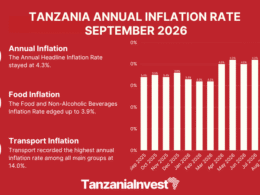
Tanzania Inflation Eases to 4.0% in June 2026 as Food Prices Cool but Transport Hits 13.6%

Tanzania's annual headline inflation eased to 4.0% in June 2026 from 4.2% in May, driven by a drop in food inflation to 4.1% from 5.6%, while transport prices continued to surge at 13.6% year-on-year as diesel, bus, taxi, and bodaboda fares recorded further increases. Core inflation rose to 3.7% from 3.4%, and the Services Index climbed to 5.4%, signaling broadening underlying price pressures, according to the National Bureau of Statistics.
Tanzania TISEZA Investments Projects Q1 2026 January-March
Read More

Tanzania Records USD 1.14 Billion in Investments in Q1 2026, China Leads FDI as SEZ Turnover Quadruples to USD 752 Million

The Tanzania Investment and Special Economic Zones Authority registered 182 investment projects worth USD 1.14 billion in Q1 2026, with EPZ and SEZ export turnover quadrupling year-on-year to USD 752 million as nine land agreements were signed across four Special Economic Zones. China led foreign direct investment at USD 227 million, and Chinese investors expressed interest in a proposed USD 500 million spent catalyst recycling plant described as potentially the first of its kind in Africa.