


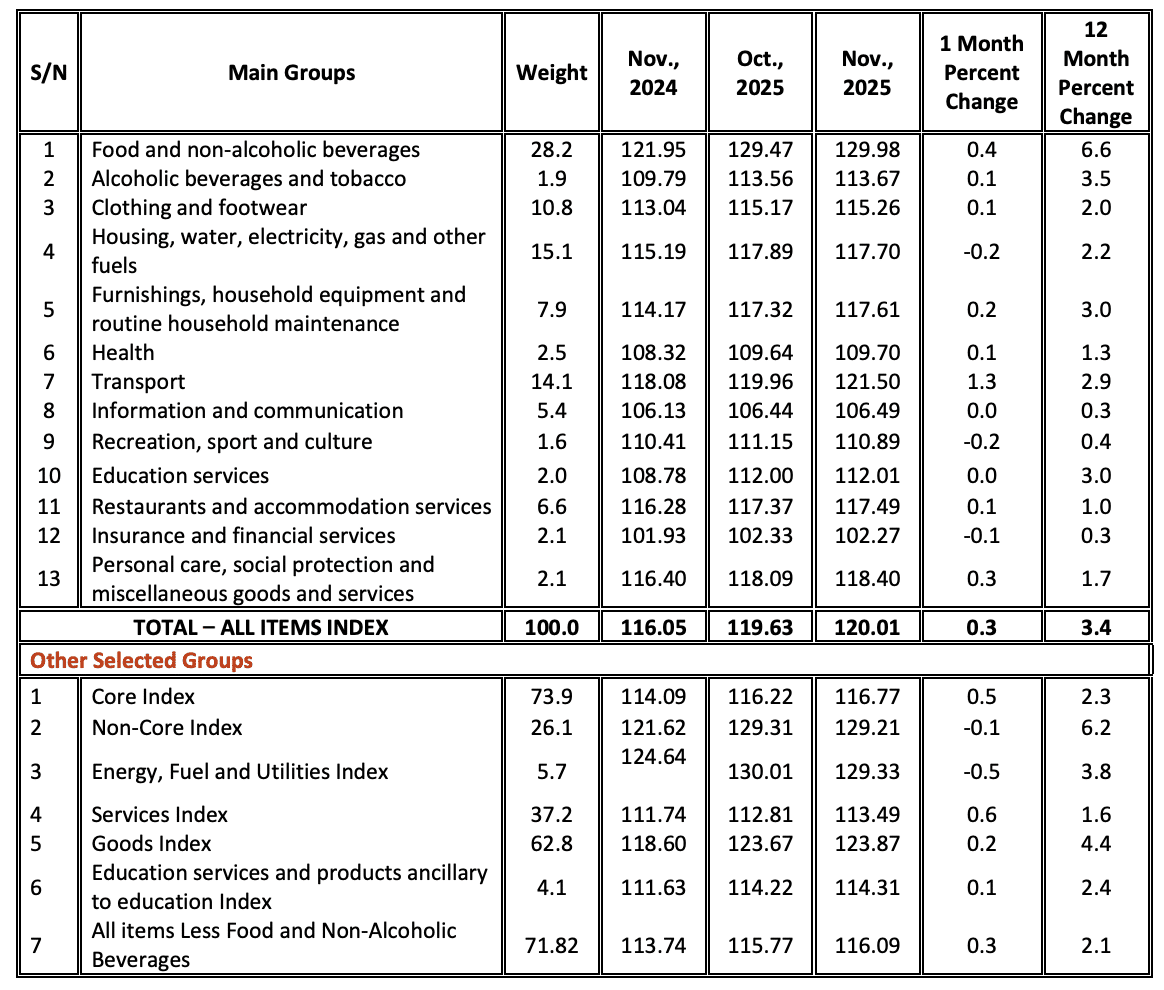
The National Bureau of Statistics of Tanzania (NBS) announced that the annual headline inflation rate for November 2025 declined to 3.4% from 3.5% recorded in October 2025.
The overall index increased from 116.05 in November 2024 to 120.01 in November 2025.
Food Inflation

The Food and Non-Alcoholic Beverages Inflation Rate for November 2025 has decreased to 6.6% from 7.4% percent in October 2025.
Non-Food Inflation
In contrast, the inflation rate for all items excluding food and non-alcoholic beverages for November 2025 has slightly increased to 2.1% from 1.9% recorded in October 2025.
Core Inflation
The Core Index excludes items with volatile prices, namely unprocessed food, energy, and utilities, except maize flour. By excluding these volatile items from the overall NCPI, policymakers obtain a more stable measure of inflation.

The Core Index comprises 297 items, accounting for 73.9% of the total NCPI weight. In November 2025, Core Inflation Rate increased to 2.3% from 2.1% that was recorded in October 2025.
Monthly Consumer Price Index October-November 2025
Between October 2025 and November 2025, the National Consumer Price Index increased from 119.63 to 120.01.
This increase in the overall index is mainly attributed to the increase of prices for some food and non-food items.
Food items contributing to an increase included: sorghum grains (by 3.6%); maize grains (by 5.9%); wheat flour (by 1.0%); sorghum flour (by 2.5%); maize flour (by 2.1%); bread and bakery products (by 3.5%); industrially bred live chicken (by 5.5%); beef meat (by 0.4%); goat meat (by 1.5%); poultry meat (by 0.3%); fresh fish (by 0.5%); dried sardines (by 1.1%); sunflower oil (by 0.8%); irish potatoes (by 3.1%); sweet potatoes (by 4.4%); fresh cassava (by 3.9%); dried lentils (by 1.5%) and dried peas (by 8.1%).
Non-food items contributing to an increase included: clothing materials (by 0.7%); garments for women (by 0.2%); footwear for children (by 1.0%); household furniture (by 0.6%) and accommodation services in hotels, lodges and guest houses (by 1.0%).
Changes in Tanzania National Consumer Price Indices (NCPI) for November 2025, (2020 = 100)
Want to know more about the Economy in Tanzania? Our free overview of the Tanzania Business and Investment Guide 2026 covers the Economy, plus key sectors and investment opportunities. The complete 141-page edition includes policies, taxation, key regulations, full macroeconomic data, and sources, and is also available at no cost upon completion of a short form.
Download Free OverviewGet the Full Edition for Free