


Latest data on inflation, money supply, interest rates, exchange rates, current account, exports and imports, provided by the Bank Of Tanzania (BOT).
Inflation
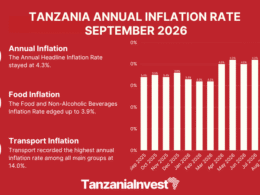
According to the latest Monthly Economic Review published by the Bank of Tanzania (BOT) for the month of June 2015, headline inflation increased to 6.1% in the year ending June 2015 from 5.3% in May 2015, mainly driven by food inflation.
Between May 2015 and June 2015, prices for all major food crops increased, except for rice. Beans recorded the highest increase in prices.

Money Supply
In June 2015, annual growth of extended broad money (M3) was 13.2% compared with 15.8% in June 2014 and 15.0 percent in May 2015. The slowdown in growth of M3 was attributed to a decline in the growth of Net Domestic Assets (NDA) of the banking system.
Banks’ Interest Rates
During June 2015, lending and deposit rates generally decreased. The overall lending rate eased to an average of 16.07% in June 2015 from 16.10% in May 2015, while overall time deposit rate averaged 8.89 percent compared with 9.01%.
Exchange Rate
In June 2015 the Tanzanian Shilling (TZS) depreciated against the US dollar by 6.4% to an average exchange rate of TZS 2,082.5 per US dollar from TZS 1,957.6 per US dollar in May 2015.
Current Account
During the year ending June 2015, current account balance narrowed to a deficit of USD 4,091.8 million, being 22.5% lower than the deficit in the corresponding period in 2014.
This development was largely driven by an increase in export of goods and services as well as a decrease in goods import bill.

Exports
The value of goods and services export increased by 9.4% to USD 9,398.5 million in the year ending June 2015 from the amount recorded in the corresponding period in 2014.
This development was largely explained by increase in travel receipts (tourism), traditional exports (coffee, cashew nuts and tobacco) and export of manufactured goods.
Imports
During the year ending June 2015, the value of import of goods and services was USD 13,370.1 million compared with USD 13,966.2 million in the corresponding period in 2014.
The decrease in imports was mostly driven by decrease in intermediate goods, particularly oil and fertilizers.
Oil imports declined by 27.2% to USD 3,062.8 million, following a fall in oil prices in the world market and relatively lower import volume than in the corresponding period in 2014.
Likewise, the share of oil import to the value of goods import declined to about 29% from 37% in the corresponding period in 2014.
Follow the link to access BOT Monthly Economic Review for June 2015: https://www.bot-tz.org/Publications/MonthlyEconomicReviews/MER%20JULY%202015.pdf
Want to know more about the Economy in Tanzania? Our free overview of the Tanzania Business and Investment Guide 2026 covers the Economy, plus key sectors and investment opportunities. The complete 141-page edition includes policies, taxation, key regulations, full macroeconomic data, and sources, and is also available at no cost upon completion of a short form.
Download Free OverviewGet the Full Edition for Free