



Tanzania and Mozambique have agreed to establish a Joint Economic Commission (JEC) to strengthen trade and investment cooperation between the two countries.
The agreement was reached on 8 May 2025 during official talks between President Samia Suluhu Hassan of Tanzania and President Daniel Francisco Chapo of Mozambique held at the State House in Dar es Salaam.
The two heads of state agreed to improve the business and investment climate between Tanzania and Mozambique by enabling small and medium enterprises to trade more easily under Simplified Trade Regimes (STRs).

They also agreed to strengthen cooperation in agriculture, which is the mainstay of both economies, with a focus on knowledge sharing and joint research, especially in the cashew sector, to benefit from global market prices and promote processed cashew exports.
In the energy sector, the presidents discussed Mozambique’s progress in natural gas and agreed to collaborate on opportunities within the blue economy, including fisheries, tourism, minerals, and maritime transport.
They also committed to enhancing cooperation in defense and security, especially in combating cross-border crime.
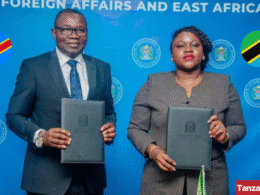
Following the discussions, President Samia and President Chapo witnessed the signing of two agreements: the establishment of a One Stop Border Post (OSBP) at the Mtambaswala-Negomano border to facilitate trade, and a prisoner exchange agreement.
In addition, four Memoranda of Understanding (MoUs) were signed covering cooperation in education, culture, drug control, and media collaboration between Tanzania Broadcasting Corporation (TBC) and Mozambique’s national broadcaster.

Speaking to the media, President Samia described President Chapo’s visit as a reaffirmation of the long-standing friendship and shared aspirations between Tanzania and Mozambique.
She emphasized that, while political and diplomatic relations remain strong, the current level of trade does not reflect the depth of historical ties between the two nations.
She announced the decision to form a JEC and to adopt the STR to address the imbalance in trade and unlock greater economic opportunities.
President Samia also highlighted the importance of improving transport and logistics infrastructure, especially along the shared border, to enhance economic collaboration.
She reiterated both countries’ commitment to fostering a more enabling business environment to support mutual economic growth.
President Chapo echoed the need to deepen economic and trade relations and called for continued efforts to develop infrastructure linking the two countries.
He also highlighted the need to review the bilateral air transport agreement to enable the national airlines of Tanzania and Mozambique to operate flights to major cities and to strengthen maritime transport.
President Chapo called for enhanced local border cooperation between regions of Ruvuma and Mtwara in Tanzania and Nyasa and Cabo Delgado in Mozambique.
He further announced that Mozambique will no longer be a partner in the Dkt. Salim Ahmed Salim Centre for Foreign Relations (CFR), having established its own institution, though experience sharing between the institutions will continue.
President Samia accepted President Chapo’s invitation to attend Mozambique’s 50th Independence Anniversary celebrations scheduled for 25 June 2025.
President Chapo’s visit to Tanzania concluded on 9 May 2025 with an official farewell ceremony at the State House in Dar es Salaam.
Want to know more about the Economy in Tanzania? Our free overview of the Tanzania Business and Investment Guide 2026 covers the Economy, plus key sectors and investment opportunities. The complete 141-page edition includes policies, taxation, key regulations, full macroeconomic data, and sources, and is also available at no cost upon completion of a short form.
Download Free OverviewGet the Full Edition for Free