On 19th July 2023, the Bank of Tanzania (BOT) released a working paper that identifies an optimal inflation threshold for the country’s economic growth.
The paper, titled “Re-Estimating Inflation Threshold Level for Tanzania,” was authored by Wilfred Mbowe and Hossana P. Mpango.
According to the research, low inflation is conducive to economic growth in Tanzania. However, the authors found that a 1% increase in inflation leads to an economic growth of 0.352% and identify an inflation threshold level of 7.0%.

Beyond this level, the total effect of inflation on growth is estimated at 0.3494%.
The authors recommend that the BOT considers inflation targets below 7.0% but above 3.0%.
“Low inflation is pro-growth,” the authors state in the paper. “However, an inflation threshold level of 7.0% has been identified, beyond which the total effect of inflation on growth is estimated at 0.3494%.”
This recommendation is made in the context of monetary policy formulation to continue supporting economic growth.
The Bank of Tanzania is responsible for formulating and implementing monetary policy. The bank’s primary objective is to maintain price stability conducive to economic development.

The Bank of Tanzania has not yet made an official statement regarding the implementation of these recommendations.
Tanzania’s Inflation in 2023
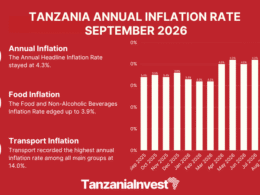
The annual Inflation in Tanzania eased in 2023, remaining below the target of 5.4% for 2022-2023.
The National Bureau of Statistics of Tanzania (NBS) revealed that the Annual Headline Inflation Rate for the month of June 2023 decreased to 3.6%.
Want to know more about the Economy in Tanzania? Our free overview of the Tanzania Business and Investment Guide 2026 covers the Economy, plus key sectors and investment opportunities. The complete 141-page edition includes policies, taxation, key regulations, full macroeconomic data, and sources, and is also available at no cost upon completion of a short form.
Download Free OverviewGet the Full Edition for Free