


The Monetary Policy Committee (MPC) of the Bank of Tanzania (BOT) held its 218th ordinary meeting on 31st January 2022, to review the conduct of monetary policy and recent economic developments.
The MPC was satisfied with the outcome of monetary policy and performance of the economy and approved the Bank to sustain accommodative monetary policy in supporting the recovery of the economy.
The decision to sustain the monetary policy stance was taken at the backdrop of expected low inflation of around 3-5%.

The adopted accommodative monetary policy to increase bank lending and lower interest rates bore the desired results, with private sector credit growth improving to 7.8% and 10% in November and December 2021, from less than 5% in March 2021, and was consistent with the target of 10.6 percent for 2021/22.
Mainland Tanzania Economy Q1-Q2-Q3 2021
The MPC observed that the GDP growth of Tanzania’s mainland economy was satisfactory, at 4.9% in the first three quarters of 2021.
The growth was driven by construction, agriculture, mining and quarrying, manufacturing and transport.
In addition, the external sector of the economy continued to recover from the effects of the Covid-19 pandemic, with a resumption in tourism.
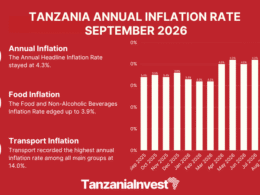
Inflation gradually increased to 4.2% in December 2021 from 3.8% in July 2021 due to supply-side factors but remained within the target of 3-5%.

Zanzibar Economy Q3 2021
The Zanzibar economy grew impressively by 8.8% in the third quarter of 2021, higher than the growth of 3.3% in the corresponding quarter of 2020, largely driven by the resumption of economic activities, particularly tourism.
Inflation edged up, driven by a rise in non-food prices, but was lower than the target of 5%.
Macroeconomic Targets for 2021/22
The MPC observed that, due to the recent satisfactory performance of the economy and
continuing recovery of the global economy, macroeconomic targets for 2021/22 set forth in the Monetary Policy Statement, issued in June 2021, will be achieved.
Want to know more about the Economy in Tanzania? Our free overview of the Tanzania Business and Investment Guide 2026 covers the Economy, plus key sectors and investment opportunities. The complete 141-page edition includes policies, taxation, key regulations, full macroeconomic data, and sources, and is also available at no cost upon completion of a short form.
Download Free OverviewGet the Full Edition for Free