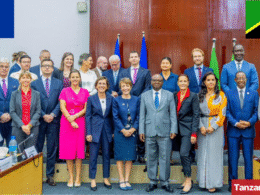



On 4th May 2026, the Tanzania Investments and Special Economic Zones Authority (TISEZA) hosted the Tanzania-Kenya Business Forum in Dar es Salaam, bringing public and private sector leaders to advance economic integration between the two countries.
The forum focused on positioning Tanzania and Kenya as a unified investment destination, with discussions highlighting private sector leadership, infrastructure development, digital transformation, and trade facilitation as key pillars for regional growth.
Several panel discussions emphasized the need to shift from traditional trade relations to a single commercial system that enables the two economies to complement rather than compete with each other in attracting global capital.

Panel 1 on Private Sector Leadership and a Single Commercial System called for businesses to take a bold lead in driving integration, noting that commercial incentives driven by economies of scale are more impactful than fiscal incentives such as tax breaks.
Participants also addressed key challenges, including mistrust between the two nations and the high cost of capital, which continues to limit business expansion and investment.
Panel 2 on Infrastructure, Energy, and Connectivity explored reducing logistics and energy costs through regional cooperation, with a focus on Standard Gauge Railway (SGR) interoperability through harmonized systems, unified standards, and seamless e-documentation for cross-border operations.
Discussions highlighted Tanzania’s potential as a regional energy hub due to its natural gas and uranium resources, alongside the need for power interconnectors to ensure affordability and reliability for industries.
Proposals were also made to introduce electric vehicle charging infrastructure along transport corridors and to amend laws to allow greater private sector participation in railway operations and terminal management.

Panel 3 on Financial Systems, Fintech, and the Digital Economy focused on leveraging Kenya’s leadership in fintech and Tanzania’s growing digital adoption to create a unified digital ecosystem, including facilitating cross-border payments and e-commerce.
Panel 4 on Agri-business, Agro-processing, and Standards emphasized value addition, structured value chains, and the elimination of non-tariff barriers such as double testing of goods.
Participants called for mutual recognition of standards between the Tanzania Bureau of Standards (TBS) and the Kenya Bureau of Standards (KEBS), alongside increased use of digital agriculture tools, improved cold chain logistics, and the adoption of quality-based pricing in sectors such as dairy.
The forum also witnessed the signing of a memorandum of understanding between the Kenya National Chamber of Commerce and Industry (KNCCI), Zanzibar National Chamber of Commerce (ZNCC), and Tanzania National Chamber of Commerce (TNCC) to strengthen the business environment and promote cross-border investment.
Speaking at the event, Tanzania’s Minister of State for Planning and Investment, Professor Kitila Mkumbo, highlighted that Tanzania and Kenya have a combined market of 120 million people and a GDP of between USD 200 billion and USD 230 billion.
Mkumbo stated that Tanzania has 44 million acres of arable land, of which only 33% is currently cultivated, and called for leveraging comparative advantages, positioning Tanzania as a production hub and Kenya as a leader in agro-processing, fintech, and renewable energy.
He added that the East African economy targets reaching USD 10 trillion by 2050, with Tanzania contributing USD 1 trillion.
During his presentation, the Executive Director of TISEZA, Gilead Teri, reported that Tanzania recorded 911 investment projects worth USD 9.3 billion in 2024 and 927 projects valued at USD 12 billion in 2025.
Teri promoted the Bagamoyo Special Economic Zone, a 9,800-hectare industrial area linked to a deep-water port, and highlighted incentives including a 10-year corporate tax exemption and a 33-year lease fee waiver for investors commissioning factories within 12 months.
He added that Tanzania aims to become the largest economy in East Africa by 2030.
On his part, the CEO of Invest Kenya, John Mwendwa, said that bilateral trade between Tanzania and Kenya has reached USD 1 billion.
He added that Kenya is a digital hub leading in fintech and AI startup funding, and outlined plans to mobilize between USD 43 billion and USD 50 billion through the National Infrastructure Fund, targeting aviation, energy, and road projects.
He added that Kenya offers a “plug-and-play” investment environment with no restrictions on foreign ownership or profit repatriation.
In his address, the Permanent Secretary of State for Planning and Investment, Dr Fred Msemwa, said that the forum aimed to generate practical insights and catalyze real business partnerships rather than remain a platform for dialogue.
On his part, Dr Eric Ruto, the President of the Kenya National Chamber of Commerce (KNCC), stated that 500 Kenyan companies have invested USD 1.7 billion in Tanzania, creating 60,000 jobs.
He proposed transitioning from a “One-Stop Border” to a “Non-Stop Border” model using pre-screened cargo to eliminate delays, and called for a permanent bilateral business council to address non-tariff barriers.
On his part, the Chairman of Taifa Group, Rostam Aziz, stated that a single commercial system is necessary as governments face debt constraints and cannot solely finance large-scale infrastructure projects.
He noted that Tanzania will require 70,000 MW of power by 2050 to achieve developed economy status and proposed harmonizing capital markets and issuing joint bonds and IPOs to fund infrastructure.
On his part, the CEO of KCB Group, Paul Russo, called on the private sector to take the lead in addressing mistrust between the two countries, describing it as the “elephant in the room.”
He noted that regional diversification is critical for resilience, noting that KCB’s presence in seven markets helped shield it from economic pressures in Kenya in 2023.
Speaking at the event, Vincent Bruno Minja, the President of the Tanzania National Chamber of Commerce (TNCC), criticized regulatory inefficiencies, including double testing of goods by TBS and KEBS.
Minja called for free movement of investors, traders, and goods across the region and reiterated the vision of a USD 1 trillion Tanzanian economy by 2050, driven 70% by the private sector.
During his closing remarks, the President of Kenya, H.E William Ruto, called for harmonization of telecommunications, stating that calls between Tanzania and Kenya should be treated as local rather than international to reflect regional integration.
On her part, the President of Tanzania, H.E Samia Suluhu Hassan, said that the two countries have agreed to prioritize trade and investment cooperation and to eliminate non-tariff barriers within a defined timeline.
Want to know more about Trade in Tanzania? Our free overview of the Tanzania Business and Investment Guide 2026 covers Trade, plus key sectors and investment opportunities. The complete 141-page edition includes policies, taxation, key regulations, full macroeconomic data, and sources, and is also available at no cost upon completion of a short form.
Download Free OverviewGet the Full Edition for Free