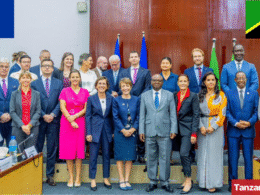



The Government of the United Republic of Tanzania and the Republic of Türkiye have signed two agreements for the Avoidance of Double Taxation and the Prevention of Fiscal Evasion with respect to Taxes on Income (DTA), a move expected to accelerate cross-border investment and trade between the two countries.
The signing ceremony took place in Dar es Salaam, with Tanzania’s Minister of Finance, Hon. Ambassador Khamis Mussa Omar (MP), and the Ambassador of Türkiye to Tanzania, Dr. Bekir Gezer, signing on behalf of their respective governments.
This is the 13th DTA signed by Tanzania with foreign nations, of which nine are in place.

The agreement is designed to boost investor confidence by eliminating the risk of income being taxed twice across the two jurisdictions.
Minister Omar stated that DTAs, when combined with Bilateral Investment Treaties (BITs), serve as a key driver of economic growth by strengthening investment and trade flows.
He noted that although Tanzania and Türkiye have had a Bilateral Investment Treaty in place since 2011, the absence of a DTA had remained a gap that has now been closed, sending a clear signal to Turkish investors that Tanzania is open for business.
Bilateral trade between the two countries reached USD 281.68 million following President Dr. Samia Suluhu Hassan’s official visit to Türkiye in 2024, with Türkiye accounting for the larger share of exports.
Minister Omar added that the Government continues to improve the business environment through reforms including streamlined business registration, digitalization of tax and customs systems, and updates to land, labor, and commercial dispute resolution laws.

He noted that these efforts have positioned Tanzania among the leading destinations for investment in Sub-Saharan Africa.
“Studies show that countries with robust double taxation agreements attract significantly higher levels of Foreign Direct Investment (FDI), placing Tanzania in a strong position to attract capital from Türkiye and other nations,” said Minister Omar.
Speaking at the event, the Deputy Permanent Secretary of the Ministry of Foreign Affairs and East African Cooperation, Hon. Ambassador Said Shaib Mussa, said that the signing operationalizes the bilateral cooperation framework agreed in 2025, following President Samia’s historic visit to Türkiye in 2024.
“The main goal is to translate political agreements into tangible outcomes by establishing a joint trade and investment roadmap worth USD 1 billion, and following this signing a Joint Commission meeting will review implementation, identify new priority areas, and strengthen cooperation in strategic sectors such as industry, agriculture, tourism, energy, and human resource development,” said Ambassador Mussa.
Ambassador Gezer said the agreements will further strengthen diplomatic and economic cooperation between the two nations.
Tanzania–Türkiye Diplomatic and Economic Ties
Bilateral trade between Tanzania and Türkiye reached USD 281.68 million, as reported by the Tanzanian Ministry of Finance, with Türkiye recording a surplus driven by exports of manufactured goods.
According to UN COMTRADE data, Türkiye’s exports to Tanzania reached USD 317.72 million in 2022, while Türkiye’s imports from Tanzania stood at USD 66.99 million in 2024.
Türkiye’s main exports to Tanzania include machinery and mechanical appliances, iron and steel products, electrical equipment, motor vehicles and parts, plastics, textiles and apparel, and processed food products.
Tanzania’s exports to Türkiye are concentrated in raw agricultural commodities and minerals, including sesame seeds, tobacco, cotton, pulses, oilseeds, raw hides and skins, and gold.
As of April 2024, Turkish companies had implemented 14 projects in Tanzania with a cumulative value of USD 6.4 billion, ranking Tanzania third in Africa and first in Sub-Saharan Africa for Turkish contractors.
Türkiye’s total infrastructure investment in East Africa stands at USD 4.5 billion, with Tanzania receiving close to USD 2 billion, the largest share alongside Ethiopia.
The single largest Turkish-funded project in Tanzania is the Standard Gauge Railway (SGR), backed by a USD 1.9 billion loan from the Export Credit Bank of Türkiye (Türk Eximbank) and built by Turkish contractor Yapı Merkezi.
Want to know more about Trade in Tanzania? Our free overview of the Tanzania Business and Investment Guide 2026 covers Trade, plus key sectors and investment opportunities. The complete 141-page edition includes policies, taxation, key regulations, full macroeconomic data, and sources, and is also available at no cost upon completion of a short form.
Download Free OverviewGet the Full Edition for Free