


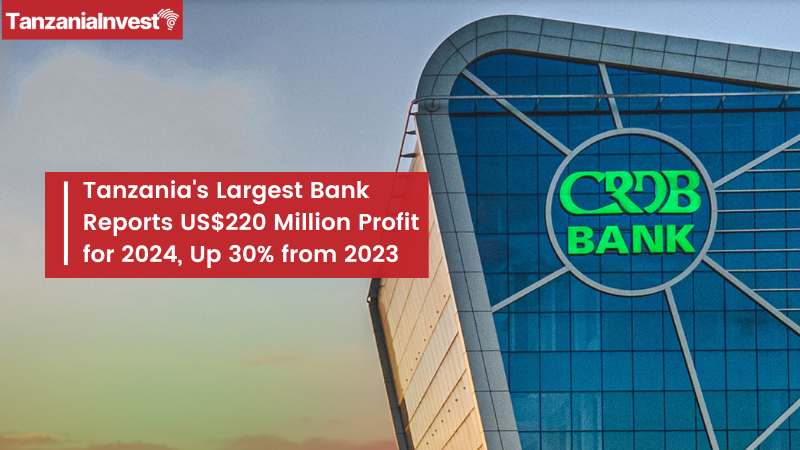
CRDB Bank, Tanzania’s largest bank by assets, has announced its financial results for the year ending December 31, 2024. The Group achieved a net income of TZS 550.8 billion, reflecting a substantial 30% increase from the TZS 422.8 billion reported in 2023.
The Bank alone recorded a net income of TZS 529.2 billion in 2024, marking a 29% rise compared to TZS 408.6 billion in 2023.
Key Financial Highlights
The 2024 financial results reveal significant growth across key metrics for both the Group and the Bank compared to 2023:
- Net Interest Income:
- Group: TZS 1,102.5 billion, up 30% from TZS 845.3 billion in 2023.
- Bank: TZS 1,026.5 billion, up 28% from TZS 801.2 billion in 2023.
- Non-Interest Income:
- Group: TZS 511.1 billion, a 14% increase from TZS 448.0 billion in 2023.
- Bank: TZS 491.7 billion, up 11% from TZS 441.5 billion in 2023.
- Non-Interest Expenses:
- Group: TZS 736.7 billion, up 15% from TZS 640.5 billion in 2023.
- Bank: TZS 674.8 billion, up 11% from TZS 606.2 billion in 2023.
- Total Comprehensive Income:
- Group: TZS 530.2 billion, a 40% increase from TZS 379.8 billion in 2023.
- Bank: TZS 520.8 billion, a 39% increase from TZS 374.4 billion in 2023.
Financial Position Highlights
As of December 31, 2024, CRDB Bank’s financial position showed significant year-on-year growth compared to 2023:
- Total Assets:
- Group: TZS 16,590.6 billion, up 14% from TZS 14,544.2 billion in 2023.
- Bank: TZS 15,662.0 billion, up 15% from TZS 13,639.0 billion in 2023.
- Customer Deposits:
- Group: TZS 10,833.0 billion, up 13% from TZS 9,564.3 billion in 2023.
- Bank: TZS 10,118.2 billion, up 14% from TZS 8,870.6 billion in 2023.
- Shareholders’ Funds:
- Group: TZS 2,175.2 billion, up 9% from TZS 2,000.4 billion in 2023.
- Bank: TZS 2,075.5 billion, up 8% from TZS 1,927.3 billion in 2023.
Selected Financial Indicators
- Shareholders’ Funds to Total Assets:
- Group: 13.1%, compared to 13.8% in 2023.
- Bank: 13.3%, compared to 14.1% in 2023.
- Non-Performing Loans to Total Gross Loans:
- Group: 2.9%, compared to 2.6% in 2023.
- Bank: 2.9%, compared to 2.7% in 2023.
- Loans and Advances to Total Assets:
- Group: 62.5%, compared to 62.2% in 2023.
- Bank: 63.9%, compared to 63.3% in 2023.
- Deposits Growth:
- Group: 13%, up from 6% in 2023.
- Bank: 14%, up from 7% in 2023.
- Assets Growth:
- Group: 14%, up from 12% in 2023.
- Bank: 15%, up from 13% in 2023.
Abdulmajid Nsekela, CEO of CRDB Bank, attributed the strong performance to the successful implementation of the bank’s medium-term strategy for 2023-2027.
This strategy emphasizes expanding the bank’s services and promoting financial inclusion, particularly for micro, small, and medium enterprises (MSMEs), agriculture, youth, and women across East Africa.
He highlighted that the bank’s investments in digital solutions and efforts to enhance operational efficiency were key drivers of this growth.
Additionally, the CEO noted that CRDB’s regional expansion efforts have further strengthened its market position and influence in East Africa.
About CRDB Bank
CRDB Bank is the largest bank in Tanzania by assets and operates in other East African countries, including Burundi and the Democratic Republic of Congo (DRC).
The bank offers a wide range of financial services, including corporate and retail banking, investment banking, and digital banking solutions.
The Group’s new Medium-Term Strategy (MTS) for 2023-2027 aims to strengthen its business model and organizational structure to ensure long-term performance and value creation.
This led in 2024 to focus on optimizing the balance sheet by creating business value from the base, expanding the offering for agribusiness to tap into more commercial crops, and continuing to strengthen partnerships to support our syndication services and trade finance
operations.
Want to know more about Banking in Tanzania? Our free overview of the Tanzania Business and Investment Guide 2026 covers Banking, plus key sectors and investment opportunities. The complete 141-page edition includes policies, taxation, key regulations, full macroeconomic data, and sources, and is also available at no cost upon completion of a short form.
Download Free OverviewGet the Full Edition for Free