


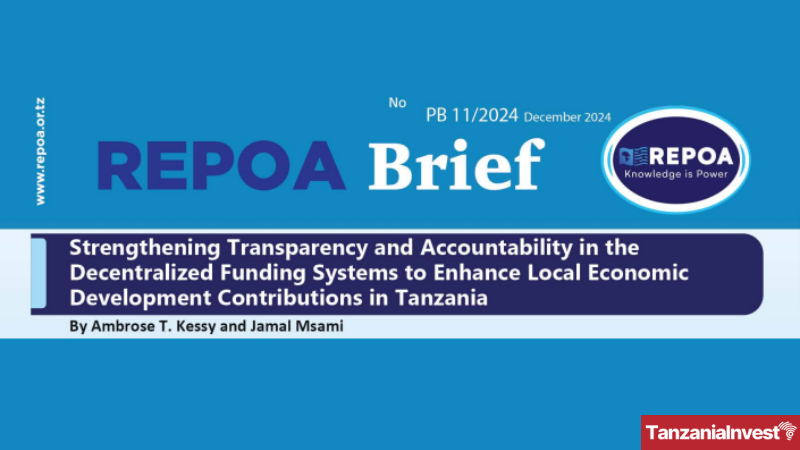
REPOA has released a new research brief titled ‘Strengthening Transparency and Accountability in the Decentralized Funding Systems in Tanzania to Enhance Local Economic Development Contributions in Tanzania’, authored by Ambrose T. Kessy and Jamal Msami.
The study examines critical financial governance issues in Tanzania’s Local Economic Development (LED) framework and provides policy recommendations to enhance transparency, efficiency, and accountability.
As part of a strategic effort to expand investor outreach, TanzaniaInvest is republishing this study to highlight its critical insights for policymakers, investors, and the public. Through its partnership with REPOA, TanzaniaInvest is increasing the visibility of REPOA’s research and reports, ensuring broader access to crucial economic data that supports informed decision-making.

The research identifies several challenges hindering the success of LED projects, including ineffective financial management, delays in fund disbursement, lack of trained financial personnel, and weak financial oversight in key regions like Kigoma, Mwanza, and Mtwara.
These issues result in stalled projects, cost overruns, and misallocations that undermine economic progress at the local level.
Despite these challenges, the study highlights best practices that have improved financial accountability in some areas. Dar es Salaam and Dodoma, for instance, have successfully introduced digital accounting systems that enhance real-time expenditure tracking, reducing errors and increasing financial transparency.
Additionally, participatory budgeting in Dodoma has allowed communities to be directly involved in financial planning, ensuring that resources are allocated to projects that align with local development needs.
To address the existing challenges, the study recommends the introduction of mandatory financial audits, increased public disclosure of LED financial records, targeted capacity-building initiatives for financial officers, and a more decentralized approach to fund disbursement.

By granting Local Government Authorities (LGAs) greater autonomy in managing LED funds, the central government can reduce bureaucratic delays and improve the efficiency of project implementation.
The study applied a mixed-methods approach, surveying 1,708 respondents from multiple Tanzanian regions, covering both urban and rural districts to assess how socio-economic factors impact LED funding.
For more details, access the full study here: https://www.repoa.or.tz/?publication=strengthening-transparency-and-accountability-in-the-decentralized-funding-systems-to-enhance-local-economic-development-contributions-in-tanzania
Want to know more about Finance in Tanzania? Our free overview of the Tanzania Business and Investment Guide 2026 covers Finance, plus key sectors and investment opportunities. The complete 141-page edition includes policies, taxation, key regulations, full macroeconomic data, and sources, and is also available at no cost upon completion of a short form.
Download Free OverviewGet the Full Edition for Free