

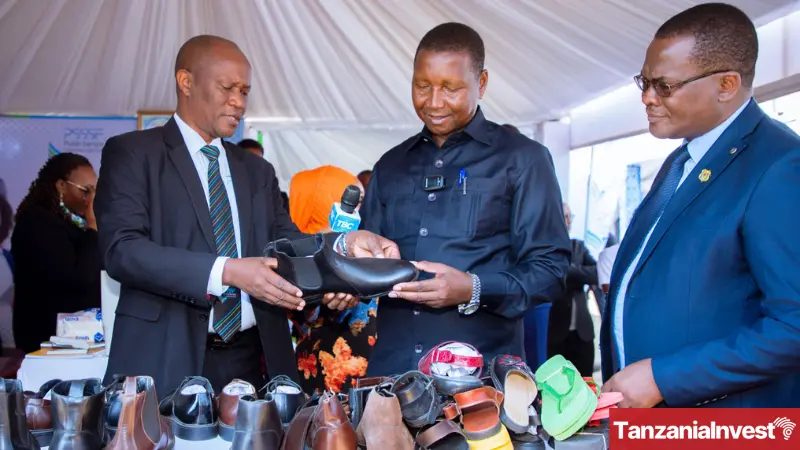
The Tanzanian government has announced plans to invest TZS 133.31 billion in the small and medium enterprise (SME) sector to provide capital, entrepreneurship training, access to financial services, research on the financial sector, and increase the use of ICT in finance.
The announcement was made by the Minister of Education, Science, and Technology, Prof. Adolf Mkenda, on behalf of the Minister of Finance, Dr. Mwigulu Lameck Nchemba, during the opening of the Fourth National Financial Services Week in Mbeya.
The event, themed “Financial Education, the Foundation of Economic Development,” took place recently at the Ruanda-Nzovwe grounds in Mbeya city.

Prof. Mkenda stated that this initiative is part of the Third National Development Plan 2021/22-2025/26, with financial institutions and service providers as key stakeholders.
He urged financial service providers to fulfill their responsibilities in line with this plan, as well as the Financial Sector Development Master Plan 2021/22-2029/2030 and the Five-Year National Financial Education Plan (2019/20-2025/26).
Prof. Mkenda also highlighted the Ministry of Finance’s collaboration with financial sector stakeholders in providing financial education.
From May to September 2024, they reached over 32,000 citizens across 12 regions and 65 districts.
Additionally, a new curriculum incorporating financial education for secondary school students from Form One to Form Four has been introduced, making finance and entrepreneurship subjects compulsory.

Tanzania SMEs
Tanzania’s SME sector consists of over 3 million enterprises. SMEs contribute 27-35% of Tanzania’s overall GDP. About 90% or more of businesses in Tanzania are SMEs. They employ more than 5 million people in Tanzania.
Most SMEs in Tanzania are in the agricultural sector. Over half of SMEs are owned by women. The sector is dominated by micro and small enterprises, with very few medium-sized firms. About 98% are micro enterprises employing less than 5 people. Around 66% of micro and small enterprises have an annual turnover of less than USD 2,000.
Tanzanian SMEs face limited access to finance and credit. They also struggle to secure bank loans due to high interest rates, insufficient collateral, short repayment terms, and limited loan information.
The Tanzanian government has implemented various policies and initiatives for SMEs, recognizing their crucial role in the country’s economic development.
Want to know more about Finance in Tanzania? Our free overview of the Tanzania Business and Investment Guide 2026 covers Finance, plus key sectors and investment opportunities. The complete 141-page edition includes policies, taxation, key regulations, full macroeconomic data, and sources, and is also available at no cost upon completion of a short form.
Download Free OverviewGet the Full Edition for Free