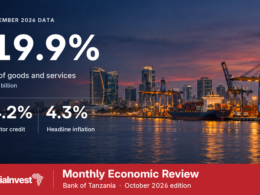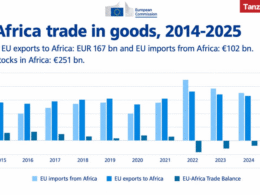



The Bank of Tanzania (BOT) Monthly Economic Review of October 2018 indicates that the country’s overall balance of payments was a deficit of USD 276.4 million in the year ending September 2018 compared to a surplus of USD 1,810.2 million in the year ending September 2017, partly driven by widening of the current account deficit.
The current account deficit widened to USD 2,159.0 million in the year ending September 2018 from USD 1,192.5 million in the year ending September 2017, largely accounted by an increase in imports, particularly transport equipment and building and construction.
Export value of goods and services was USD 8,669.1 million compared with USD 8,741.3 million recorded in the year ending September 2017 mainly due to a decline in export of non-traditional goods.
Traditional exports increased by 32.7% to USD 1,108.2 million, owing largely to the high export value of cashew nuts, cloves, cotton, sisal, and tea.
Import bill for goods and services increased to USD 10,323.7 million in the year ending September 2018 compared with USD 9,421.2 million in the year ending September 2017.
All categories of imports went up, with a notable increase in capital goods, particularly, transport equipment and building and construction.
Service account recorded a surplus of USD 1,719.0 million in the year ending September 2018 compared with a surplus of USD 1,865.2 million in the year ending September 2017.
Earning from service rose to USD 3,963.9 million from USD 3,824.1 million, driven by transport and travel receipts.
Travel receipts, which is dominated by tourism, increased to USD 2,360.1 million from USD 2,261.4 million, owing to a rise in the number of tourist arrivals.
Transport receipt increased by 12.6% to USD 1,247.0 million because of increase int he volume of transit goods to and from neighboring countries particularly Zambia, DRC, and Burundi, following the improvement of operations at the Dar es Salaam port including removal of Value Added Tax on auxiliary services of transit cargo and reduced roadblocks
Want to know more about Trade in Tanzania? Our free overview of the Tanzania Business and Investment Guide 2026 covers Trade, plus key sectors and investment opportunities. The complete 141-page edition includes policies, taxation, key regulations, full macroeconomic data, and sources, and is also available at no cost upon completion of a short form.
Download Free OverviewGet the Full Edition for Free