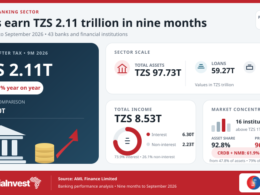
The privately owned leader in the Tanzania banking sector, the Cooperative and Rural Development Bank (CRDB), has recently released its financial records and has officially announced that, as of December 2008, it had recorded an increase in the number of customer deposits from Tshs 1.11 during the previous quarter to trillion to Tshs 1.27 trillion, as of December 2008.
The issuance of this information is in keeping with the country’s Banking and Financial Institutions Act (BFIA) on mandatory disclosure.
In addition, the CRDB has also posted an increase in the overall net profit for last year, Tshs 39.134 billion, up from Tshs 37.325 billion for the year ending December 31, 2007.

The CRDB has also indicated that their total assets increased as well from Tshs 1.304 trillion, as of September 30 last year, to the most current estimate of Tshs 1.449 trillion.
During the last quarter, the bank’s portfolio for loans and advances reached a total Tshs 836.8 billion, which is an increase from the previous quarter’s record of Tshs 793.54 billion.
The CRDB Bank Plc was established in July 1996 as a successor to the former Cooperative and Rural Development Bank (CRDB), which was a completely government-owned bank.
The transition from a state-owned bank to a privately-owned bank came as a result of the liberalization of the banking industry in Tanzania.
In 1991, the Government shifted its policy and began to separate itself from its interests in the banking sector.

This, along with the enactment of the Banking and Financial Institutions Act (BFIA) encouraged the recapitalization of the CRDB in order for it to meet the levels that were required under the BFIA.
Today, the CRDB is one of Tanzania’s top private commercial banks and is owned by more than 11,000 shareholders, including individuals (37%), cooperatives (14%), companies (10.2%), DANIDA Investment Fund (30%) and parastatals (8.8%).
Currently, the CRDB is in the process of listing on the Dar es Salaam Stock Exchange (DSE).
At the same time, the Dar es Salaam Community Bank (DCB), another local commercial bank, posted slightly reduced profits last year, from Tshs 1.339 billion in 2007 to Tshs 1.321 billion in 2008.
However, in spite of the recorded reduction in their overall profits, the DCB did see an increase in the number of customer deposits as well as an increase in the total number of bank assets bank, based on the numbers registered for the quarter ending September 2008.
Want to know more about Banking in Tanzania? Our free overview of the Tanzania Business and Investment Guide 2026 covers Banking, plus key sectors and investment opportunities. The complete 141-page edition includes policies, taxation, key regulations, full macroeconomic data, and sources, and is also available at no cost upon completion of a short form.
Download Free OverviewGet the Full Edition for Free