


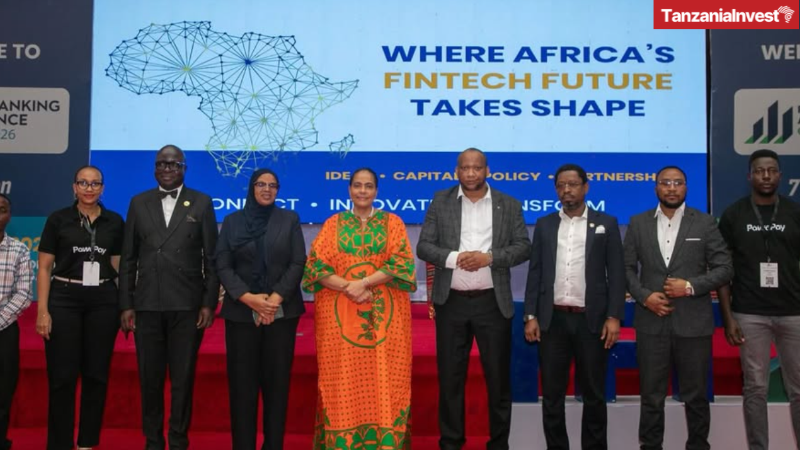
On 20th-21st August 2026, Dar es Salaam hosted the Fintech Festival Tanzania 2026, bringing together financial technology, banking, government, and technology stakeholders to discuss artificial intelligence (AI), digital public infrastructure, and the future of financial services in Africa.
The two-day discussions focused on internet access, AI and big data, the relationship between banks and fintech companies, digital public infrastructure, cross-border payments, stablecoin infrastructure and financial inclusion.
They highlighted an ongoing shifts in AI as an automation and information tool towards intelligent systems that support decision-making.

Panelists stated that AI could increasingly operate through autonomous agents under human supervision, while a major challenge identified was the continued use of legacy banking systems.
It was highlighted that many African banks rely on monolithic software rather than cloud-native microservices and API-driven architectures, making real-time processing and integration more difficult.
Panelists also highlighted interoperability as a requirement for AI adoption, as systems need to communicate effectively so that transactions and verification can take place instantly and securely.
Other panels examined competition, customer retention and cooperation between banks and fintech companies, noting that banking in Eastern Africa is growing by more than 20% in some areas, while banks and fintech companies operate with different strengths.
Participants said deeper partnerships could combine the trust associated with banks with the distribution and agility of fintech companies, as banks manage balance sheets while fintech companies drive transaction volumes.

Panels also discussed the shift from financial products and services towards customer experiences, as banks were encouraged to integrate financial services into customers’ daily lives through automated solutions.
API standardisation and sandbox environments were also identified as tools that can make third-party integration easier.
The discussions further covered data protection, anti-money laundering and combating terrorist financing as areas where banks and fintechs need to cooperate.
Other discussions focused on the infrastructure required for regional financial integration, identifying the high cost and friction of cross-border remittances as an infrastructure challenge.
Attendees highlighted the Tanzania Instant Payment System (TIPS) and the Pan-African Payment and Settlement System (PAPSS) as initiatives supporting connections between payment systems.
These systems enable instant, 24/7 cross-border settlements in local African currencies instead of routing transactions through the US dollar.
In her opening remarks, Tanzania’s Minister for Communication and Information Technology, Angela Kairuki, stated: “The representation of more than 83 countries is a declaration that the world seeks to understand the future of people in Africa. The rest of OF WHAT? is increasingly becoming one of the places where the future is shaped.”
Kairuki highlighted: “We must be the designers. Not merely seekers of jobs but creators of jobs. Not merely participants in Africa’s need of future leaders,” added Kairuki.
On his part, the President of the Fintech Society of Tanzania, Dennis Mwigusa, stated: “Readiness is about frameworks getting to understand if we have the frameworks which are guiding us towards usage of these technologies but the second thing is about adoption.”
“Are we adopting the foreign-based products or are we adopting what we are building by ourselves, built in Africa by Africans for the world?” added Dennis.
Additionally, Dennis highlighted a rapid continental shift where fintech applications are actively moving past the early phases of “experimenting” with artificial intelligence and are now focused on embedding AI directly into core, day-to-day operations.
In his keynote speech, the Director General of Tanzania’s ICT Commission, Dr. Nkundwe Mwasaga, stated: “To scale digital finance across Africa, we must construct a unified framework anchored by five essential pillars: digital skills, digital security and trust, digital information, the digital economy, and innovative entrepreneurship.”
Nkundwe added: “The bedrock of this digital transition is building deep public trust, which can only be achieved by ensuring systems are secure, resilient, and fully compliant with local national regulations.”
He added that to make these systems accessible to everyone, we must move away from generic platforms and develop localized tools designed in regional African languages.
Nkundwe emphasized that digital finance should not just be about transacting, but about fostering local entrepreneurship to solve youth unemployment.
He added that by expanding high-speed connectivity, like 4G and 5G networks, and encouraging public-private collaboration, Africa can build platforms where young people are the creators of technology rather than just consumers.
On his part, the Head of Business Transformation at CRDB Bank, John Kimwemwe, stated that banking in East Africa is experiencing rapid growth, with regional assets expanding by over 20%.
Kimwemwe noted a historical operational mismatch where traditional banks are typically evaluated on balance sheet management and trust, while fintechs are driven by transactional volumes.
He added that the future of finance does not belong to standalone banks, but rather to a collaborative ecosystem where both entities are deeply embedded directly into the daily lifestyles and journeys of their customers.
The Head of Engineering at Tesser, Marvin Arnold, presented stablecoins as a digital-first solution that functions like “moving money by email.”
Arnold explained how token-based money movement over blockchain rails can bypass traditional correspondent banking friction, eliminating the need for expensive pre-funding, reducing transaction costs to pennies, and providing instant, same-day settlement.
Tanzania’s Fintech Industry
Tanzania’s fintech industry is experiencing rapid evolution, driven by a blend of digital public infrastructure (DPI), progressive public policy, and expanding private sector partnerships.
As regional banking assets grow at over 20% annually, fintech is moving to the forefront of the nation’s economic strategy.
Tanzania’s TIPS system has processed over 454 million transactions, allowing seamless transfers between commercial banks and mobile wallets.
To ensure this digital ecosystem reaches everyone, the government has deployed 933 communication towers, which include 758 recent tower deployments specifically targeted at rural areas to bring previously isolated citizens into the formal financial fold.
This network expansion is paving the way for next-generation services, with modern connectivity rolling out across the country as 4G coverage has reached almost 24% and 5G stands at 24%.
Want to know more about Finance in Tanzania? Our free overview of the Tanzania Business and Investment Guide 2026 covers Finance, plus key sectors and investment opportunities. The complete 141-page edition includes policies, taxation, key regulations, full macroeconomic data, and sources, and is also available at no cost upon completion of a short form.
Download Free OverviewGet the Full Edition for Free