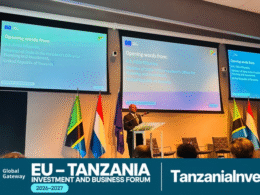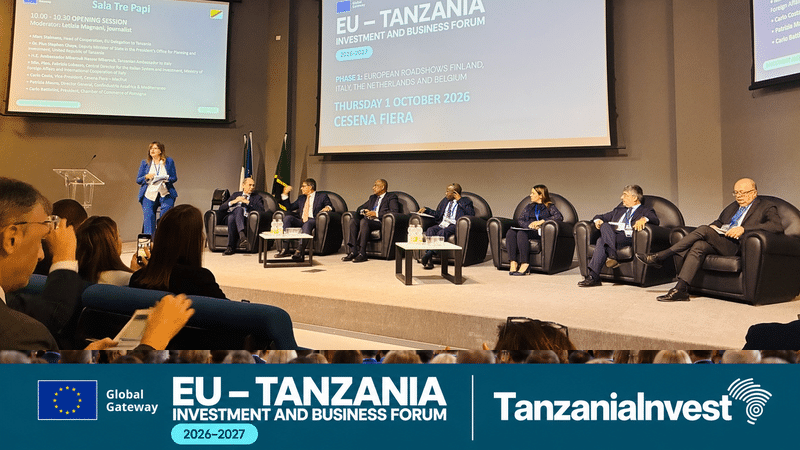
The EU-Tanzania roadshow closed on 6 October 2026 at the Port of Antwerp-Bruges, where Tanzania invited European terminal operators, rail operators, and digital providers into its ports and railways.
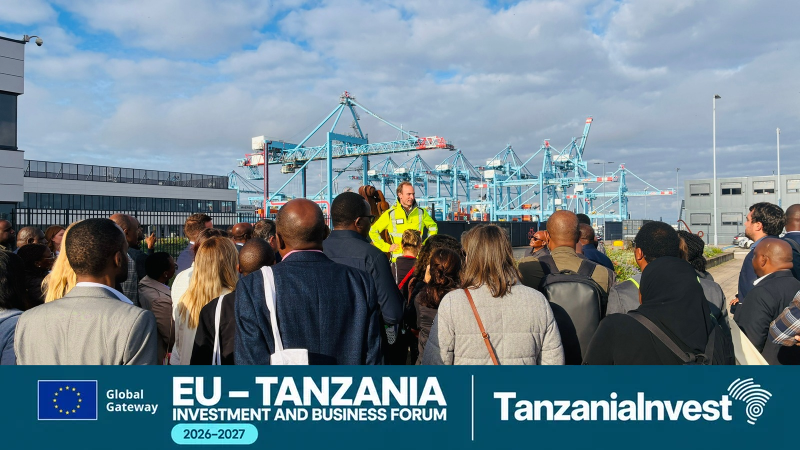
The site visits were the second day of The Hague leg and the last day of the EU-Tanzania Investment and Business Forum 2026-2027 roadshows in Europe, with the delegation split into three tracks, port logistics, agriculture, and critical minerals, all starting at APM Terminals in Rotterdam.
Table of Contents
- Port Logistics Track: Dar es Salaam Climbs the Global Port Ranking as Antwerp Hosts the Final Session
- APM Terminals: A Benchmark for Port Automation
- Opening Session: EU to Co-Finance the Dar es Salaam Port Expansion
- Minister Mkumbo: Turning Ports Into Economic Infrastructure
- Tanzania Ports Authority: Terminal Operators, EPC Contractors, and Digital Transformation
- Tanzania Railway Corporation: Opportunities in Port-Rail Connectivity
- Global Gateway and Team Belgium Investment Hub: Faster Screening for Company Projects
- Private Sector: Polytra, Sarens, Vecturis, and GEOxyz Share Their Plans in Tanzania
- Closing Remarks: Enabel Calls for Speed
- Agriculture and Critical Minerals Tracks: Seeds, Organic Trade, Mining Equipment, and Metals Logistics
- Next Step: EU-Tanzania Investment and Business Forum in Dar es Salaam
Port Logistics Track: Dar es Salaam Climbs the Global Port Ranking as Antwerp Hosts the Final Session
APM Terminals: A Benchmark for Port Automation
The day opened at APM Terminals at Maasvlakte Rotterdam, a container terminal operator active at 60 locations worldwide, where the delegation had the chance to witness how fully automated ports work.

Opening Session: EU to Co-Finance the Dar es Salaam Port Expansion
The logistics track, led by the Minister of State in the President’s Office for Planning and Investment, Hon. Prof. Kitila Mkumbo, continued to the Port of Antwerp-Bruges in Belgium, where Mario Lievens, Director of Port of Antwerp-Bruges International, opened the session with fresh results from Tanzania.
He reported that the port of Dar es Salaam has climbed in one year from 360th to 255th place in the World Bank’s Container Port Performance Index, with vessel turnaround cut from 10 to 30 days to 3 to 6 days, crediting the Government’s decision to change the port’s governance model and bring in private operators.
Virginie de Ruyt, Head of the Eastern and Central Africa Unit at the European Commission’s Directorate-General for International Partnerships, announced that the EU will contribute to the expansion of Dar es Salaam port together with the European Investment Bank (EIB) and the World Bank, noting that the EIB has received a formal financing request and that the Commission is looking at a grant to leverage the loan.
She added that the EU, Enabel (the Belgian agency for international cooperation), and the Port of Antwerp-Bruges are already implementing the T-GATE project with the Tanzania Ports Authority (TPA) on port performance, trade facilitation, and low-carbon transport, and that the EU has started promising negotiations on the standard gauge railway (SGR), which could open further rail opportunities for European operators.
De Ruyt recalled that in April, an export credit facility backed by the export credit agencies of Italy, Sweden, and Poland provided USD 1.3 billion for SGR Lots 3 and 4, and acknowledged that the EU needs to be faster in its processes.

Ambassador Filip Vanden Bulcke, acting Director-General for Geoeconomics and Economic Diplomacy at Belgium’s Federal Public Service Foreign Affairs, noted that Port of Antwerp-Bruges International has been working with TPA on port management, logistics and operational performance, building on 70 years of diplomatic relations and more than 40 years of development partnership.
Tanzania’s Ambassador to the EU and Belgium, Jestas Nyamanga, reported that EU-Tanzania trade rose from about EUR 1.3 billion in 2021 to EUR 2 billion in 2024/25, that EU imports from Tanzania grew from EUR 457 million to EUR 755 million between 2021 and 2024, and that Tanzanian exports to Belgium rose from EUR 123 million in 2020 to EUR 300 million last year.
He added that Belgian tourist arrivals in Tanzania increased from about 7,000 four years ago to 18,000 last year, and that Brussels Airlines launched a direct Brussels-Kilimanjaro service in June.
Minister Mkumbo: Turning Ports Into Economic Infrastructure
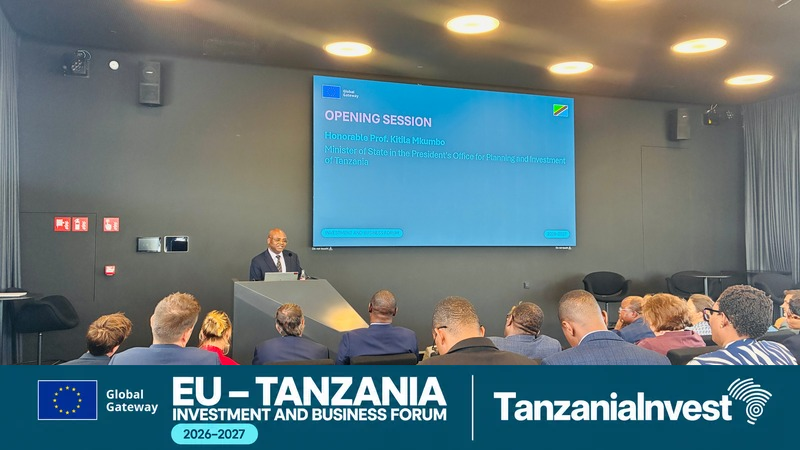
Minister Mkumbo explained that integrated logistics is the biggest driver of Vision 2050, and that the Government wants to turn the ports of Dar es Salaam, Tanga, and Mtwara from transport infrastructure into economic infrastructure.
The aim is for Dar es Salaam to become an export port for value-added and manufactured goods, not only for raw materials, while the new Bagamoyo port is planned as an integrated port next to an industrial park designed for a thousand factories.
He recalled that Tanzania learned a great deal from the Port of Antwerp when it privatised port operations, and that TPA staff still train in Antwerp regularly.
Mkumbo described the visit as a listening exercise, asking Belgian companies already in Tanzania what the Government should improve to attract more investors, and he stressed that growth, projected at 6.3% this year, must translate into better livelihoods through trade and investment.
Later in the session, he explained that the TAZARA railway to Zambia, which serves the DRC, Zambia, Rwanda, and Burundi, is being upgraded, and that by 2031 the SGR and TAZARA should connect the East African region, with the SGR designed to reach the DRC.
Tanzania Ports Authority: Terminal Operators, EPC Contractors, and Digital Transformation
Alessandro Trevisan, Programme Manager for Infrastructure at the EU Delegation to Tanzania, introduced a panel with the Tanzania Ports Authority (TPA) and the Tanzania Railway Corporation (TRC), noting opportunities for European companies across infrastructure financing, engineering, equipment, port and rail operations, digital solutions and logistics services.
Dr. Baraka Mdima, Deputy Director General of TPA, outlined two priorities, capacity and connectivity, with the expansion of Dar es Salaam port, improvements at Mtwara and Tanga, and in the long term the new Bagamoyo port.
He identified three entry points for European companies: as terminal operators, as EPC contractors and advisers, and in digital transformation, since the ports still run on semi-automated systems.
Mdima named landside connectivity as the biggest constraint, with cargo needing to leave the port faster by road and rail towards factories and neighbouring countries.
Asked by Ali Rajpar of Seaforth Shipping East Africa whether the new terminal operator had delivered the promised equipment upgrades, he replied that it had, with more than 16 rubber-tyred gantry cranes, 5 ship-to-shore cranes and new digital systems behind the port’s improvement.
Tanzania Railway Corporation: Opportunities in Port-Rail Connectivity
Nzeyimana Dyegula, Director of Planning and Investment at TRC, explained that Tanzania is building about 2,000 km of SGR, with contractors including Yapı Merkezi from Turkey and Chinese companies, and that Lots 5, 6 and 7 are under way with the African Development Bank (AfDB) as lead arranger of financing.
She pointed to port-rail connectivity as the main opportunity for European companies, since freight currently travels on the SGR to Dodoma and is then transshipped to the metre gauge railway towards Kigoma and Mwanza, serving the DRC, Burundi, Rwanda and Uganda, which adds costs that new intermodal facilities and container depots aim to reduce.
Rail, including TAZARA, carries only 2% of the freight leaving Dar es Salaam port, and Dyegula asked European companies for digital logistics solutions, noting that TRC cannot yet track most of its rolling stock, especially wagons crossing into Uganda and soon Burundi.
Tanzania enacted an Open Access Act in 2023, and its regulations are in place, but a network statement, prepared with World Bank support, must be completed before TRC issues a request for proposals to private operators, preferably port operators.
The metre gauge railway will remain as a buffer and feeder to the SGR, with the World Bank funding its rehabilitation, including USD 150 million recently signed for the Dar es Salaam-Isaka section after the EIB withdrew at the last minute.
On specific projects, Dyegula noted that the Malindi yard has a pre-feasibility study and is moving to detailed design and full feasibility before TRC seeks investors, that the Kwala dry port is linked only by the metre gauge for now, with an SGR connection being worked on, and that new locomotives will be procured this financial year with TPA support.
The line to Burundi runs from Uvinza to Musongati under a signed contract, and it will continue to Burundi and the DRC.
Global Gateway and Team Belgium Investment Hub: Faster Screening for Company Projects
Marc Stalmans, Head of Cooperation at the EU Delegation to Tanzania, recalled the EUR 156 million set of actions decided at the end of July and described Tanzania as a possible test case for Global Gateway in Africa, pointing out that the European Investment Bank (EIB) counts Tanzania among its top five countries in Sub-Saharan Africa and that it is only the sixth African country where KfW can lend.
De Ruyt explained that the EU is moving from grants towards guarantees, de-risking and equity, with projects screened first by member states, and cited a Kenyan-Swedish electric vehicle joint venture that took more than a year to assemble about EUR 30 million of support.
She added that the EU wants to focus on sectors where European industry is competitive, naming railways and small hydropower as examples.
Eric Willemaers, Lead for Global Gateway at the Team Belgium Investment Hub, explained that Belgian companies enter through the regional agencies FIT, hub.brussels and AWEX, and that the hub mobilises Finexpo, Credendo, SFPI, Enabel and BIO, with the aim of completing the Belgian screening within three months before a project moves to the EU level.
He reported that one Belgian project proposal has already been forwarded to the EU and two more are close, while noting that the process still takes too much time.
Private Sector: Polytra, Sarens, Vecturis, and GEOxyz Share Their Plans in Tanzania
Amaury Luyckx, CEO of Polytra Group, explained that more than 70% of the group’s mineral exports from the Copperbelt go through Dar es Salaam, compared with 15% through Durban, 5% through Walvis Bay and 1% through Lobito, with 30,000 to 35,000 tonnes of copper and cobalt moved every month.
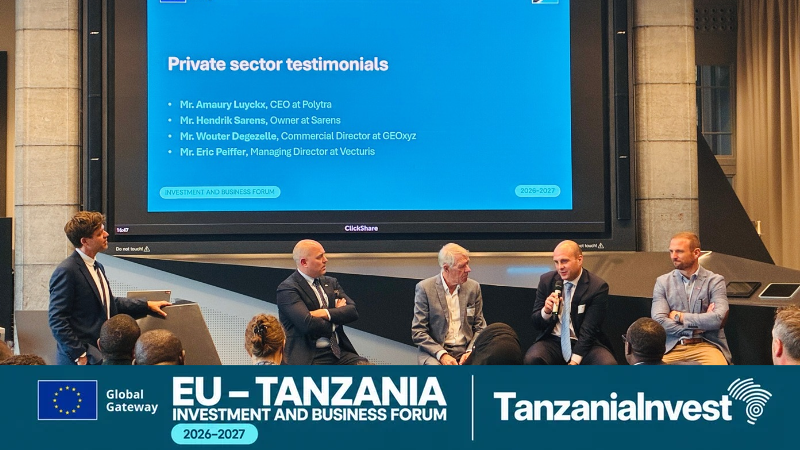
Polytra brought the first sulphur vessel into Dar es Salaam to balance the return flow, is looking at investing in its own rail capacity between the DRC and Zambia, and is positioning itself for a lithium project in eastern DRC expected to ship up to 1 million tonnes via Kigoma to Dar es Salaam.
Luyckx also noted that DRC copper output has risen to 3.15 million tonnes and could reach 6 million within three years, more than all regional ports combined can handle: “Dar es Salaam has been historically our biggest export port, and also one of the best running ports for us.”
Hendrik Sarens of Sarens, a heavy lifting and transport company active in Tanzania for about five years, noted that it installed the two new ship-to-shore cranes at Dar es Salaam port and hopes to start work next year on Kabanga Nickel, the East African Crude Oil Pipeline (EACOP), the Julius Nyerere hydropower plant and two wind turbines at Makambako, training its local operators at the Sarens Academy in South Africa.
Adrien Peiffer, Director at Vecturis, a railway operator and infrastructure manager active in Madagascar, the Lobito Corridor and Pakistan, offered its experience in designing open access regimes and network statements and in rolling stock tracking systems, recalling that Vecturis already operated in Tanzania in the early 2000s under a track access agreement with TRC.
He supported keeping both the SGR and the metre gauge, possibly with the SGR focused on passengers and the metre gauge on freight, and argued that Lobito competes only partly with Dar es Salaam, mainly for cargo up to Kolwezi.
Wouter Degezelle, Commercial Director at GEOxyz, a Belgian company collecting hydrographic, geophysical and geotechnical data for ports and inland waters, explained that the company recently opened an office in Korea and that Tanzania could host its next one, asking for better visibility of upcoming maritime projects.
Closing Remarks: Enabel Calls for Speed
Evelien Maschelein, Director Expertise and Think at Enabel, the Belgian development agency, highlighted the T-GATE project with TPA, the Tanzania Revenue Authority, Port of Antwerp-Bruges International, TradeMark Africa and UN-Habitat, and closed the roadshow with a call to act: “What are we waiting for? Just make a move, let’s speed the process up.”
Agriculture and Critical Minerals Tracks: Seeds, Organic Trade, Mining Equipment, and Metals Logistics
The agriculture track, led by the Deputy Minister of Agriculture, Hon. David Silinde, and the Deputy Permanent Secretary, Prof. Peter Lawrence Msoffe, visited Rijk Zwaan, a vegetable breeding company with two subsidiaries in the Arusha region employing around 500 people, and OTC Organics, an organic fruit and vegetable trader that is part of Dole plc (NYSE: DOLE), to explore how Tanzanian growers, including avocado producers, can reach organic export markets.
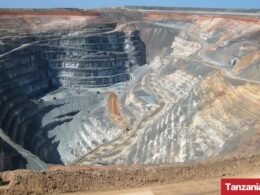
The critical minerals track, with the Ministry of Minerals, the Geological Survey of Tanzania, the Tanzania Chamber of Mines and TISEZA, visited IHC Mining, part of Royal IHC, which supplies mining and mineral processing equipment and works on tailings and water management, and C. Steinweg, a Rotterdam logistics group specialised in metals and minor metals that already employs about 150 people in Dar es Salaam.
Next Step: EU-Tanzania Investment and Business Forum in Dar es Salaam
The European roadshows in the EU will be followed by the EU-Tanzania Investment and Business Forum to be held in Dar es Salaam, planned for early 2027.
Want to know more about Agriculture in Tanzania? Our free overview of the Tanzania Business and Investment Guide 2026 covers Agriculture, plus key sectors and investment opportunities. The complete 141-page edition includes policies, taxation, key regulations, full macroeconomic data, and sources, and is also available at no cost upon completion of a short form.
Download Free OverviewGet the Full Edition for Free