

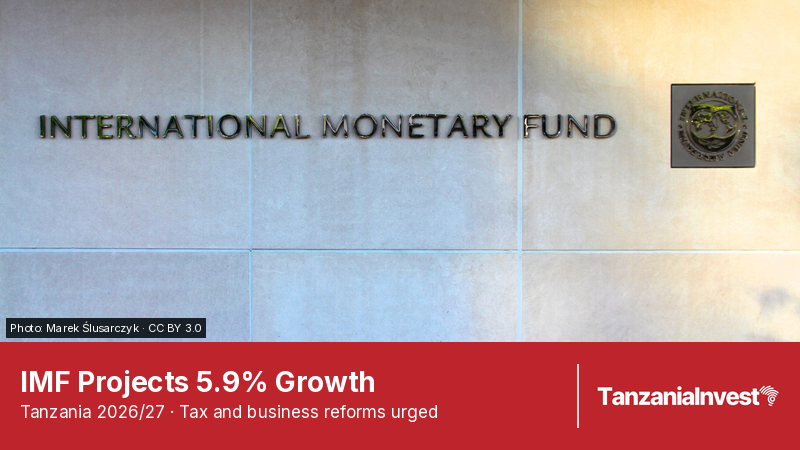
The International Monetary Fund (IMF) projects Tanzania’s economy to grow by 5.9% in the 2026/27 financial year following its 2026 Article IV mission.
The mission, led by Nicolas Blancher, visited Tanzania from 11 to 24 November 2026 and recommended reforms to expand private investment and employment, alongside higher spending on education, health and social protection.
It assessed the economy as resilient to recent shocks, supported by improvements in macroeconomic policy frameworks and financial oversight, together with gold, manufacturing, agricultural and tourism exports.

Its concluding statement forecasts growth averaging 6% over the medium term, supported by mining, agriculture and tourism, with inflation remaining within the 3–5% target range.
The current account deficit is projected to widen to 2.9% of gross domestic product (GDP) in 2026/27, reflecting weaker gold prices and still elevated oil prices, before narrowing to about 2.6% by 2030/31.
The mission identified downside risks from a prolonged Middle East war, disruptions to trade and travel, tighter global financing conditions and declining gold prices, which could weaken exports, government revenue and foreign exchange reserves.
Domestically, climate shocks could raise food and energy prices, while renewed social unrest or delays to reforms could affect investor confidence and tourism.
Fiscal Policy and Social Spending
The 2026/27 budget targets an overall fiscal deficit of 2.8% of GDP and an improvement of 0.2 percentage points of GDP in the domestic primary balance, while public debt remains at moderate risk of debt distress.

Priority social spending has stabilised at about 7% of GDP, but the mission found that allocations to education and health remain low relative to peers, against a backdrop of widening human capital gaps and rapid population growth.
It recommended financing additional social spending primarily through broader tax coverage, rationalised exemptions and preferential treatments, stronger tax compliance and customs controls, and improved taxpayer services, including timely value-added tax refunds.
Selective reprioritisation of public investment could also release resources while protecting infrastructure with a high impact on growth, with a prudent public debt anchor helping guide fiscal policy and preserve buffers against shocks.
The mission called for more complete fiscal reporting, including timely recording of transactions outside the treasury single account and capital transfers to state-owned enterprises, alongside better publication of domestic arrears and contingent liabilities and specific arrears-clearance plans.
It also recommended implementing the new public investment guidelines to improve project appraisal and procurement, and deepening the recently introduced Fiscal Risk Statement’s analysis of state-owned enterprises and public-private partnerships.
Monetary Policy, Gold Reserves and Banking
The mission recommended gradual monetary tightening, assessing that monetary conditions remained accommodative after the July policy-rate increase and that the economy’s output gap had closed, meaning activity had reached its estimated potential.
It said the Bank of Tanzania (BoT) should be ready to tighten further if external conditions deteriorate, while allowing greater exchange rate flexibility to absorb shocks and rebuild relatively low reserve buffers.
Foreign exchange interventions should address disorderly market conditions or market frictions, consistent with the IMF’s Integrated Policy Framework, rather than substitute for adjustments in macroeconomic policy.
Although domestic gold purchases have diversified reserves, the mission identified operational, valuation and balance-sheet risks and recommended regular publication of gold acquisitions, holdings and costs, supported by a full assessment of those risks.
It also advised considering the transfer of the gold programme’s operational and quasi-fiscal functions to a separate entity.
Further monetary framework reforms should deepen interbank and repurchase agreement markets, introduce a standing deposit facility and review the role of Treasury bills in liquidity management, building on improved alignment between the interbank cash market rate and the policy rate.
The mission welcomed the reduction in the statutory limit on central bank financing of the government but recommended further reductions, stronger safeguards against monetary financing, and limits on credit guarantees and special lending programmes to protect BoT’s financial autonomy.
It assessed the banking system as sound, supported by migration to Basel II/III standards and risk-based supervision, while calling for close monitoring of credit quality and concentration risks amid rapid lending growth and targeted macroprudential measures if excessive risk-taking emerges.
Remaining vulnerabilities in smaller banks, bank resolution procedures and crisis management arrangements also require attention, with the ongoing 2026 Financial Sector Stability Review expected to identify priorities for IMF capacity development support.
Business and Investment Reforms
The statement identifies weaknesses in the business environment as constraints on private investment and small and medium-sized enterprise (SME) development, noting that low-productivity sectors account for about 90% of jobs.
It recommends prioritised, sequenced and accountable implementation of the updated Blueprint for Regulatory Reforms, together with greater transparency and predictability in tax exemptions, incentives and reform plans.
Strengthening credit bureaus and implementing the Secured Transactions Act could improve access to finance, while digital payments, mobile money and deeper domestic capital markets could broaden financing options and reduce foreign exchange risks for domestic borrowers.
The mission also called for better public reporting on corruption outcomes and asset declarations, stronger oversight institutions, and improved oversight of financial integrity and the real estate sector.
It welcomed steps to open the domestic government bond market to foreign investors but advised avoiding restrictions on cross-border trade and investment that increase policy uncertainty.
Further energy-sector reforms and climate-resilient infrastructure remain priorities following reforms under the recently completed Resilience and Sustainability Facility arrangement, which the mission said had strengthened climate resilience and the capacity to attract public and private investment into new sectors.
Additional Obstacles to Businesses
At the concluding press conference on 24 November 2026, Blancher elaborated on the obstacles facing businesses, pointing to overlapping regulatory agencies and the fees they impose.
“It’s strikingly complicated and costly for business in Tanzania,” he said.
On tax policy, he said the unpublished Presidential Tax Reform Commission report had made it difficult to understand how that initiative fitted with the Medium-Term Revenue Strategy adopted in 2025 and the tax reforms businesses should expect over the next two to three years.
Asked about the relationship between economic growth and household living standards, Blancher said Tanzania’s growth had generated relatively few jobs and that sustainable employment creation would depend on private-sector and SME development.
He also cited restrictions introduced in 2025 on foreign ownership of some businesses as one of the issues affecting openness to cross-border investment, while noting that partnerships between banks and mobile money operators were helping expand financial access.
On fuel procurement, Blancher said discussions with private operators had raised concerns about pricing transparency under centralised arrangements, although those arrangements had maintained supplies without shortages.
He said discussions between the government and private sector pointed to a possible easing of centralisation over the coming months.
Blancher also said temporary fuel subsidies introduced earlier in 2026 had ended, and that the mission’s immediate inflation concerns increasingly involved food prices and imported fertiliser costs, alongside the effects of fuel prices on transport and food distribution.
He described the earlier subsidies as temporary and transparent but said their targeting could have been better.
On education, Blancher said the IMF’s focus was to identify fiscal resources, with sector specialists such as the World Bank better placed to advise on spending priorities.
“It is really hiring enough teachers, paying them well enough, procuring the school supplies that are needed, books again,” he said of needs identified in consultations with the education ministry and think tanks.
He also described access problems in remote areas, where children could face walks of 10 kilometres to reach school.
He added that limited resources and dependence on external funding at the Tanzania Social Action Fund (TASAF) created concerns as international financing weakened, while reduced external assistance also presented risks for health spending despite progress through the universal health initiative.
Asked about the economic effects of the political unrest in late 2025, Blancher said the direct disruption had lasted only a few days and that the mission had not identified a clear election-related slowdown in the longer-term data.
He said tourism had held up relatively well, although the subsequent Middle East war complicated efforts to distinguish the effects of different shocks.
Tanzania’s IMF Engagement
Article IV consultations are the IMF’s regular economic surveillance process, through which staff assess a member country’s economic developments and policies.
The latest consultation follows the completion of Tanzania’s final financing programme reviews in July 2026, when the Executive Board approved an immediate disbursement of about USD 443.9 million under the Extended Credit Facility and Resilience and Sustainability Facility arrangements.
The November concluding statement represents the mission’s preliminary findings, with a staff report to be prepared for Executive Board consideration and Blancher indicating that publication was expected in January 2027.
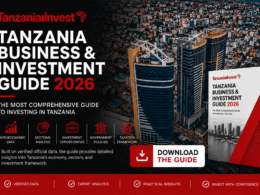
Want to know more about the Economy in Tanzania? Our free overview of the Tanzania Business and Investment Guide 2026 covers the Economy, plus key sectors and investment opportunities. The complete 141-page edition includes policies, taxation, key regulations, full macroeconomic data, and sources, and is also available at no cost upon completion of a short form.
Download Free OverviewGet the Full Edition for Free