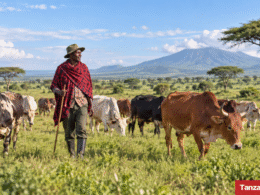


Businessman and philanthropist Lord David Sainsbury, Settlor of the Gatsby Charitable Foundation of UK, visited Tanzania to attend the workshop on cotton and textile development, organized by the Tanzania Gatsby Trust (TGT) on May 14th 2014 in Dar es Salaam.
The purpose of the workshop was to monitor the progress during 2013/14 of the cotton and textile project coordinated by the Tanzania Gatsby Trust, to increase cotton yield production in the country.
As explained by Lord Sainsbury when in exclusive conversation with TanzaniaInvest :”the cotton yield production in Tanzania is about 200kg per hectare, while the average for Africa is 400kg and good countries can get up to 1,000kg. In light of that I though we should be able to get up to 600kg in Tanzania if you get all the things that you need right: good seeds, good agriculture practces and a good pricing mechanism.”

According to the documents presented during the workshop to monitor the progress resulting from contract farming, in the Butiama district the in 2012/13, a total of 6,526 hectares were under cotton production, which yielded 3,281,362 tons. In 2013/14 the target was 8,100 hectares expected to yeald 16,200 tons of seed cotton.
The event saw the presence of Tanzania’s Minister for Agriculture Agriculture, Food Security and Cooperatives, Hon Christopher Chiza, who reminded that he global demand for lint is now growing at 3% per year.
Cotton is among the sub-sector of agribusiness in Tanzania with vast investment opportunities, as indicated by Tanzania’s President Kilwete during an exclusive interview with TanzaniaInvest: http://tanzaniainvest.com/economy/interviews/1109-president-jakaya-kikwete
Tanzania Gatsby Trust is registered as a charitable Trust in Tanzania for poverty alleviation by enabling hundreds of Small and Medium sized Enterprises(SMEs) to carry out productive and profitable enterprises.
The SMEs sector is estimated to contribute about 30% of the gross domestic product and about 30% of the labour force.

Want to know more about Agriculture in Tanzania? Our free overview of the Tanzania Business and Investment Guide 2026 covers Agriculture, plus key sectors and investment opportunities. The complete 141-page edition includes policies, taxation, key regulations, full macroeconomic data, and sources, and is also available at no cost upon completion of a short form.
Download Free OverviewGet the Full Edition for Free