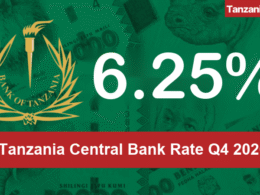




The Monetary Policy Committee (MPC) of the Central Bank of Tanzania (BOT) at its meeting on 3rd April 2024, increased the central bank rate (CBR) from 5.5% to 6% due to the macroeconomic forecast made in March 2024.
This is the bank’s second MPC since it began implementing monetary policy using interest rates
The MPC’s decision on the CBR stems from the requirement to increase the scope of monetary policy actions to contain the lingering inflationary pressures arising from global economic developments.

The new CBR of 6% will be applicable in the second quarter of 2024, which runs from April to June 2024, within the band of ±200 basis points.
Recent Economic Performance and Outlook
In addition, the MPC discussed global and domestic economic conditions in the first quarter of 2024 and the outlook for the remaining period of the year.
Global Economy
On global economic conditions, the MPC noted an improved performance in advanced and emerging market economies.
Output growth was better than in the preceding quarter, inflation continued to decline, and monetary and financial conditions moderated. The price of crude oil was stable, averaging USD 80 per barrel, but has recently increased slightly. The price of gold remained high at around USD 2,071 per troy ounce. The MPC expects these economic conditions to continue in the subsequent period of 2024. OPEC+ decision on oil production and geopolitical tensions might affect the outlook.

Domestic Economy
As for the domestic economic condition, the MPC noted with satisfaction the recent performance of the economy, despite facing external headwinds.
The outlook for economic performance in the remaining three quarters of 2024 is favorable. The performances and outlook are summarized as follows:
(i) The economy is estimated to have grown at 5.1% in 2023, an increase from 4.7% in the preceding year. In the first quarter of 2024, growth is estimated to be around 5.1%. The performance is underpinned by public investment, particularly in infrastructure, as part of the measures to facilitate private-sector business and investment. Private-sector investment also contributed to the estimated growth, because of the improving business environment in the country, as reflected by the high growth of credit to the private sector and the increase in foreign direct investment. Zanzibar’s economy also performed satisfactorily, with real GDP growth estimated to be more than 6% in 2023, mostly driven by tourism activity. Favorable economic conditions are expected to continue in subsequent quarters of 2024. The outlook is supported by an improving business environment, adequate rains in most parts of the country and continued recovery of global economy.
(ii) Inflation remained low and stable, averaging 3.0% in the first quarter of 2024. This is in line with the country’s target of not more than 5% and convergence criteria in regional economic blocs in which Tanzania is a member. The stability was due to prudent monetary policy and adequate domestic food supply. In Zanzibar, inflation eased converging to the medium-term target of 5%, mainly due to the moderation of both food and non-food prices. Inflation is expected to remain consistent with the target. The projection is bolstered by monetary policy and adequate food supply. The risk to the inflation outlook is moderate.
(iii) The implementation of monetary policy in the first quarter of 2024 succeeded in containing the 7-day interbank interest rate within the target band of 3.5-7.5%. Private sector credit growth remained strong, averaging 17%, the same as in the preceding quarter. Credit was mostly directed to agriculture, mining, transport and manufacturing activities. Demand for credit is expected to remain strong, attributable to improving business and
investment conditions.
(iv) Fiscal performance was satisfactory. In the quarter ending March 2024, revenue performance (both tax and non-tax) in Mainland Tanzania was about 95% of the target. In Zanzibar, domestic revenue surpassed the target by 6.4%, largely credited to improved revenue administration and compliance. Expenditure continued to be aligned with the available resources for both Mainland Tanzania and Zanzibar and public debt remained sustainable with moderate risk of debt distress.
(v) The current account balance continued to improve, attributable to moderate prices of imports and good performance in exports. In the year ending February 2024, the current account deficit narrowed to USD 2,701.4 million compared to USD 5,133.6 million in the corresponding period in 2023. In Zanzibar, the current account deficit also narrowed. The current account deficit is expected to continue to gradually improve, reaching 3.2% of GDP in the subsequent quarters. Foreign reserves remained high, at more than USD 5.3 billion as of the end of March 2024, equivalent to 4.4 months of projected imports. The exchange rate depreciated by 1.8% in the quarter ending March 2024 compared to 1.6% in the preceding quarter. The exchange rate depreciated relatively faster, driven by a seasonal decrease in foreign exchange flows, as well as global economic conditions. The MPC also discussed the challenge of the shortage of foreign exchange in the economy and observed that, the ongoing measures to increase the supply and reduce the demand for the US dollar are expected to stabilize the situation in the near future.
(vi) The financial sector was stable and resilient to short-term shocks with all indicators ranging within the desirable thresholds. The banking sector was liquid, profitable and adequately capitalized. The quality of banks’ assets was satisfactory, as reflected by a low non-performing loans ratio of 4.3%, which is within the acceptable level of not more than 5%.
Want to know more about Banking in Tanzania? Our free overview of the Tanzania Business and Investment Guide 2026 covers Banking, plus key sectors and investment opportunities. The complete 141-page edition includes policies, taxation, key regulations, full macroeconomic data, and sources, and is also available at no cost upon completion of a short form.
Download Free OverviewGet the Full Edition for Free