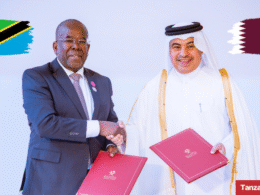



Mr Doto James, Permanent Secretary of the Ministry of Finance and Planning, and H.E. Roeland van de Geer, Head of the European Union Delegation to Tanzania and the East African Community, signed on 3rd March 3017 the Financing Agreement for a new budget support program worth EUR 205 million.
The Tanzania Economic and Fiscal Governance Programme will contribute to the effective implementation of the Second Five Year Development Plan (FYDP-II) of Tanzania (2016/2017-2020/2021), by providing direct financial support to the budget and ensuring that the necessary fiscal policies (i.e. policies in Domestic Revenue Mobilisation, Public Expenditure Management and Accountability of public funds) are adopted and followed-through.
The financing is part of EUR 626 million grant that the EU has allocated to Tanzania under the 11th European Development Fund (EDF) for the period 2014 – 2020 to support government budget as well as energy and sustainable agriculture sectors.

Two complementary measures to this budget support are part of this programme: support to the Tanzania Revenue Authority (TRA) in their tax modernisation programme and a facility to provide high-quality research to foster the policy dialogue on economic governance.
The funds will be disbursed in four yearly payments depending on progress made by the Government of Tanzania in the areas specified in the Financing Agreement.
Mr. Doto James said, “The support will play an important role in complementing domestic resources for financing priority expenditures under the 5-Year Development Project Phase II. The Government greatly values and appreciates European Union’s commitment to Budget Support and would like to encourage other Development Partners to re-consider use of the instrument in channeling their financial support. I re-affirm the 5th Phase Government’s steady commitment to sound and prudent economic and public financial management and accountability”.
H.E. van de Geer explained, “The Second Five Year Development Plan is intended to make Tanzania less of an agriculture-based economy and more of an industry-based economy. This requires substantial amounts of money and these financial resources will need to come from domestic taxes, financial markets, the private sector and development partners. The contract that will be signed here today, will help the Ministry of Finance and Planning to do exactly that; it will help the Ministry to achieve enhanced revenue mobilisation, improved accountability and greater efficiency in public expenditure.”
“We are fully aware of the considerable political and economic challenges that remain at present in Tanzania, and are committed to supporting the Government in facing them. It is felt that this Sector Reform Contract is best suited to assist Government in improving its economic and fiscal governance, and therefore achieve the progress it has set out for itself in the second Five Year Development Plan,” van de Geer concluded.

In November 2016, the EU announced it commitment to stronger relations with Tanzania and that there is room for increased European investments to the country, if a number of obstacles to doing business are efficiently tackled by the Government of Tanzania.
Want to know more about the Economy in Tanzania? Our free overview of the Tanzania Business and Investment Guide 2026 covers the Economy, plus key sectors and investment opportunities. The complete 141-page edition includes policies, taxation, key regulations, full macroeconomic data, and sources, and is also available at no cost upon completion of a short form.
Download Free OverviewGet the Full Edition for Free