


Tanzania’s Ministry of Health has tabled a TZS 1.8 trillion budget for the 2026/27 financial year, with TZS 1.15 trillion (64%) directed to development projects, including a drive to manufacture health products domestically and reach 80% self-sufficiency by 2030.
The budget was presented to the National Assembly by Minister of Health Mohamed O. Mchengerwa in May 2026 in Dodoma.
The 2026/27 allocation is broadly flat against the TZS 1.76 trillion approved for 2025/26.
The budget funds 11 strategic priorities spanning health financing, local pharmaceutical production, digital health systems and the expansion of specialist services.
Tanzania Health Budget 2026/27 Structure
The Ministry has requested Parliament to approve TZS 1,800,262,058,000 for the Ministry of Health and its institutions for the 2026/27 financial year.
Development expenditure accounts for TZS 1,148,025,187,000 (64%), with TZS 789,458,609,000 financed from domestic sources and TZS 358,566,578,000 from external sources.
Recurrent expenditure accounts for TZS 652,236,871,000 (36%), of which TZS 516,323,356,000 covers salaries for Ministry, hospital and institutional staff and TZS 135,913,515,000 covers other operational charges.
By March 2026, the Ministry had received 63% of the 2025/26 budget, with recurrent expenditure funded at 76% and development projects at 56%.
External financing from the Global Fund, the Global Alliance for Vaccines and Immunization (GAVI), the World Bank, the Health Basket Fund (HBF), the United Nations Children’s Fund (UNICEF) and the United Nations Population Fund (UNFPA) continued to support programmes covering HIV/AIDS, tuberculosis, malaria, immunisation, nutrition, safe blood and maternal and child health.
On the revenue side, the Ministry and its hospitals collected TZS 593.85 billion by March 2026 against a full-year target of TZS 819.98 billion, equivalent to 72.42% of the target.
For 2026/27, the Ministry projects revenue collection of TZS 747.20 billion, comprising TZS 76.20 billion from Ministry headquarters, TZS 165.80 billion from regional referral hospitals and TZS 505.20 billion from institutions and the national, specialised and zonal hospitals.
Tanzania Health Sector Performance to March 2026
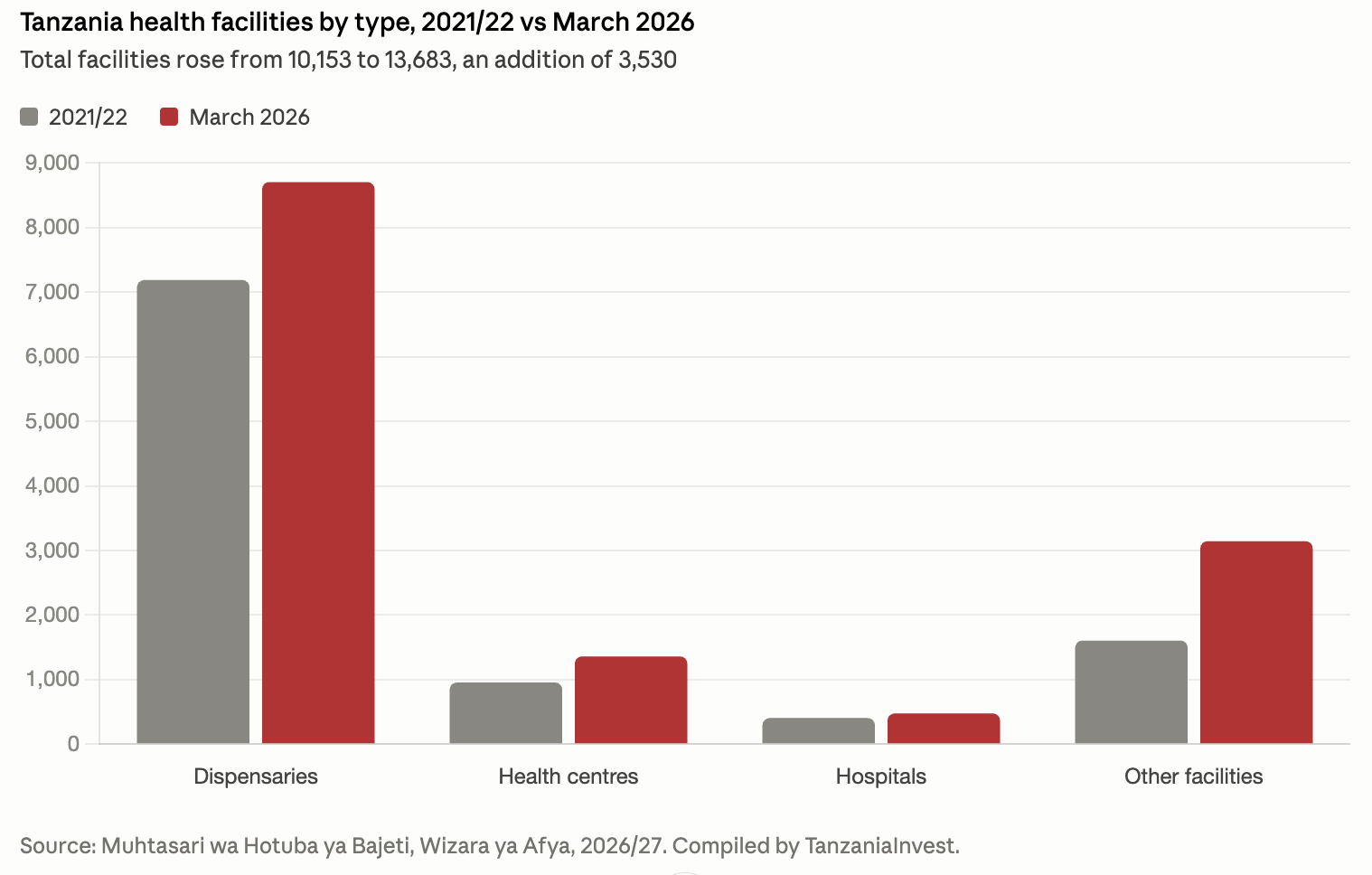
Health facilities increased from 10,153 in 2021/22 to 13,683 by March 2026, an addition of 3,530 facilities, comprising 8,706 dispensaries, 1,359 health centres, 475 hospitals and 3,143 other facilities.
The Government built 10 new regional referral hospitals, renovated 50 older hospitals, completed 980 dispensary structures, built 390 health centres and increased oxygen plants from 25 to 61.
Emergency Medicine Departments increased from 7 to 125 by March 2026, while patient beds rose 82% from 86,131 to 156,932 and intensive care unit beds in public facilities rose from 258 to 1,647.
The maternal mortality ratio fell from 556 deaths per 100,000 live births in 2016 to 104 in 2022, and the Government aims to cut maternal deaths by a further 50% by 2030.
Immunisation coverage rose to 96%, above the international target of 90%, with third-dose Pentavalent coverage reaching 3,186,979 children.
Health workers reached 182,430 after the recruitment of 53,633 specialists between 2021 and March 2026, with a further 9,039 staff hired on short-term contracts funded from internal revenue.
The Ministry installed diagnostic equipment worth TZS 241.6 billion, raising the number of magnetic resonance imaging (MRI) machines from 7 to 13, computed tomography (CT) scanners from 12 to 45, digital X-ray machines from 147 to 559 and ultrasound machines from 476 to 970.
A total of 36,996,862 patients were treated in 2025/26, comprising 35,260,883 outpatients and 1,735,979 inpatients, while specialist services reached 4,202,137 patients.
Specialist and super-specialist services attracted 26,770 patients from neighbouring countries, strengthening medical tourism and health diplomacy.
During 2025/26, 11 new pharmaceutical and medical device factories were established, and the Mloganzila Pharmaceutical and Medical Devices Special Economic Zone, a Bio-Equivalent Laboratory, and a partnership with Sartorius advanced the foundation for self-sufficiency.
The availability of 382 essential health products rose from 58% in 2021/22 to 88.8% by March 2026.
Health Sector Priorities for 2026/27
The 2026/27 budget supports 11 strategic priorities for the sector.
The priorities include improving the quality of health services to meet national, regional and international accreditation standards, and accelerating the establishment of a domestic health service accreditation body, with all referral facilities from regional to national level targeted for quality accreditation by 2030.
The Ministry will strengthen health information systems and expand the use of artificial intelligence, telemedicine, teleradiology and teleconsultation in service delivery.
The budget funds the recruitment of community health workers, including 8,000 new positions nationwide, alongside continued recruitment of health workers on permanent and contract terms.
The Ministry will expand specialist services at regional referral hospitals from 8 to 17, introduce 5 specialist services at council hospitals, and develop the East African Centre of Excellence for cardiovascular treatment, kidney transplants and bone marrow transplants, plus a new centre of excellence for oral and dental care.
Other priorities cover the prevention and control of communicable, non-communicable, epidemic and previously neglected diseases, the expansion of reproductive, maternal and child health services, the strengthening of mental health and rehabilitation services, the development of traditional and alternative medicine including a centre of excellence in Dodoma, and continued investment in health research, blood safety and the training of mid-level and specialist health professionals.
New Muhimbili National Hospital
The Government plans to build a new Muhimbili National Hospital within five years at a cost of TZS 1.2 trillion, following an assessment that found the existing hospital constrained by ageing infrastructure, scattered buildings, high running costs and limited room for modern specialist services.
Of the TZS 1.2 trillion, TZS 908.6 billion is a concessional loan and TZS 292 billion is the Government’s contribution through site preparation and exemptions on taxes, duties and levies.
A cost comparison against 16 projects in 15 countries found that the new 115,000 square metre hospital will cost USD 1,819 per square metre, against USD 3,000 to USD 7,000 per square metre in other countries, about 42% below the average.
On completion, the hospital will rise from a third-level to a fourth-level facility by international standards.
The Ministry has framed the project as a strategic economic investment expected to reduce overseas referrals, expand medical tourism, and attract investors, international organisations and skilled professionals.
Pharmaceutical Manufacturing and Health Product Self-Sufficiency
Following a directive to raise the country’s capacity to manufacture health products and reach 80% self-sufficiency by 2030, the Ministry will continue supporting the Pharmaceutical Investment Acceleration Taskforce (PIAT) to coordinate and fast-track investment in new health product factories.
The Ministry will invite domestic and foreign investors to build pharmaceutical and medical device factories, offering access to land and supporting infrastructure to reduce import dependence.
The budget funds construction of a modern pharmaceutical research laboratory and the purchase of equipment to support investment in domestic drug factories.
The Tanzania Pharmaceutical Industries (TPI) plant in Arusha is being revived to produce antiretroviral drugs for HIV treatment.
The Ministry will require the Medical Stores Department (MSD) to buy locally manufactured drugs that meet Tanzania Medicines and Medical Devices Authority (TMDA) standards before procuring from abroad.
Universal Health Insurance and Health Financing
President Samia Suluhu Hassan signed the Universal Health Insurance law, with member registration starting officially in January 2026.
By March 2026, the Government had disbursed TZS 48.8 billion under the scheme, reaching 172,297 households and enrolling 463,228 citizens from low-income households.
The Ministry will continue registering citizens from both low-income and higher-income households, expanding community education on health insurance, and strengthening cooperation with the private sector in health financing.
The Ministry will also strengthen health financing from domestic revenue sources to make the funding of health services more sustainable.
Want to know more about the Economy in Tanzania? Our free Tanzania Business and Investment Guide 2026 covers the Economy, plus regulations, key sectors, and investment opportunities—all in one place.
Download Free Guide


