Tanzania Annual Inflation Declines

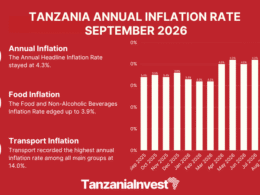
According to the Tanzania National Bureau of Statistic the annual rate of inflation in June 2012 went down from 18.2% to 17.4% in the last 12 months, mainly due to the dropping price of rice.

Likewise the food and hotel inflation index slightly dropped to 22.9% from 24.5% and the energy inflation index reduced to 20.5% from 21.2%. Non-food inflation stayed flat at 10.5%.

The National Bureau of Statistic also published the annual inflation rates of neighboring countries with Uganda and Burundi showing similar rate with 18%, and 17.3% respectively, while Kenya and Zambia economies performing better with an annual inflation rate of 10.05% and 6.7% respectively. 

Tanzania Investment Guide 2026 Free Edition

According to Dr William Mgimwa, Minister of Finance and Economic Affairs during a recent parliamentary session “The food basket is pushed up mainly by the demand of rice”. 

He also added that “Costs of production have been very high due to the dependence of furnace oil and diesel to generate electricity and the competition of the gas pipeline will reduce this dependence a great deal”. 

He stressed that the Government of Tanzania is committed to fighting inflation by reducing structural based costs (i.e. infrastructural costs) that constitute the main input expenses that push up inflation.


Want to know more about the Economy in Tanzania? Our free overview of the Tanzania Business and Investment Guide 2026 covers the Economy, plus key sectors and investment opportunities. The complete 141-page edition includes policies, taxation, key regulations, full macroeconomic data, and sources.

Download Free OverviewGet the Full Guide
Related Posts
IMF Tanzania flag
Read More

IMF Approves USD 443.9 Million for Tanzania, Projects 6.2% GDP Growth Supported by Mining, Agriculture, and Tourism

The IMF Executive Board has approved an immediate disbursement of USD 443.9 million to Tanzania after completing the final reviews under the Extended Credit Facility and Resilience and Sustainability Facility programmes. The IMF said Tanzania maintained strong economic growth and macroeconomic stability while highlighting the need for continued reforms and fiscal consolidation.
Tanzania-France Business Roundtable in Paris where TPSF and ICC signed a partnership
Read More

Tanzania’s Private Sector Foundation Joins the International Chamber of Commerce

The Tanzania Private Sector Foundation (TPSF) has become an official member of the International Chamber of Commerce (ICC) under a strategic partnership signed at the Tanzania-France Business Roundtable in Paris. TPSF will promote the ICC's trade, dispute-resolution and investment services in Tanzania and establish an ICC Tanzania National Committee, with an office to be launched within a year.
Central Bank of Tanzania BOT CBR Interest Rate Q3 2026
Read More

BOT Raises Tanzania Central Bank Rate to 6.25% for Q3 2026; GDP Growth Estimated at 6% in H1 2026, Driven by Agriculture, Construction, Mining, and Tourism

The Bank of Tanzania (BOT) released its Monetary Policy Committee Statement of July 2026, in which it indicates that the MPC decided to raise the Central Bank Rate (CBR) from 5.75% to 6.25% for the third quarter of 2026. The decision aims to contain inflation driven by high energy, fertilizer, and transportation costs linked to the geopolitical conflict in the Middle East.
Tanzania dividends state-owned companies 2025-2026 infographic
Read More

Tanzania State-Owned Companies’ Dividends Rise 30% to TZS 1.327 Trillion in 2025/26 FY, Twiga Minerals Leads with TZS 221.9 Billion

Tanzania state-owned companies' dividends in 2025/26 FY totaled TZS 1.327 trillion from 308 enterprises and minority-held companies, a 30% increase from TZS 1.028 trillion in 2025, though below the TZS 1.5 trillion target set by President Samia last year. Twiga Minerals Corporation led all dividend payers with TZS 221.9 billion, more than double its 2025 payout, while the Tanzania Ports Authority (TPA) topped Consolidated Fund contributors with TZS 205.5 billion.