


The World Bank (WB) recently released its Africa Country Policy and Institutional Assessment (CPIA) report for 2024, which covers the period from January to December 2023.
The report evaluates the quality of African countries’ policy and institutional framework and assesses how conducive these are to fostering sustainable growth, poverty reduction, and effective use of development assistance.
This year’s CPIA Africa report focuses on reforms across policy areas covered by the CPIA that support private sector growth and identifies policy trends in Sub-Saharan Africa that made a difference in supporting private sector development in 2023.

The report attributes a CPIA score to countries and regions. This is a composite rating that evaluates the quality of a country’s policies and institutions, particularly in relation to fostering sustainable growth, poverty reduction, and effective use of development assistance. The score ranges from 1 to 6, with 1 indicating low performance and 6 indicating high performance.
In 2023, the average CPIA score for IDA-eligible countries in Sub-Saharan Africa remained broadly like its 2022 level, at 3.1. However, more countries saw improvements in their overall scores compared to those that received downgrades, and fewer countries’ scores declined compared to the previous year’s CPIA assessment. Yet, the narrowing gap between Sub-Saharan Africa and the rest of the IDA countries has been undermined by the region’s much slower improvement in the governance cluster (cluster D, public sector management and institutions).
The scores for the individual criteria show that the largest differences between Sub-Saharan Africa and the overall IDA averages fall into two general categories: constitutional strength and the rule of law (property rights and rule-based governance and transparency, accountability, and corruption in the public sector) and financial oversight (financial sector, quality of budgetary and financial management, and debt policy and management).
Tanzania CIPA Score & Highlights
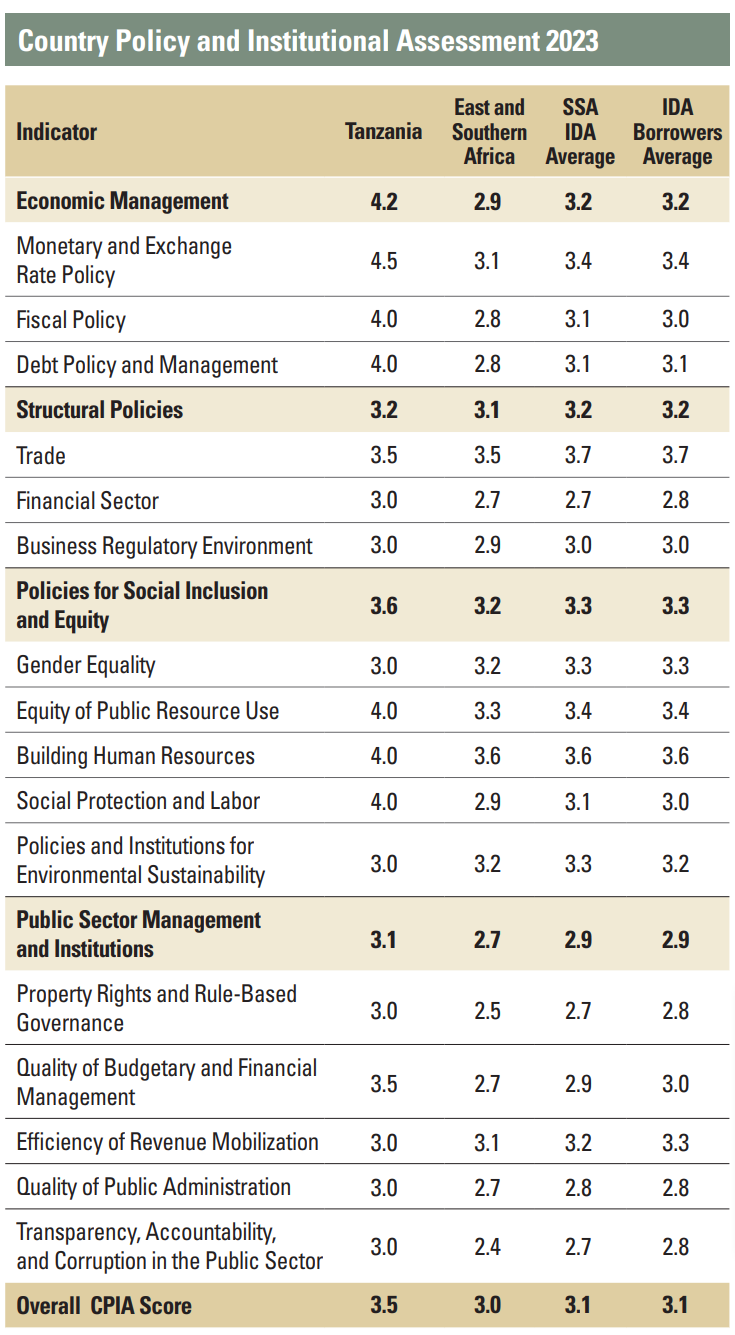
Tanzania CIPA Score
Tanzania received an overall CPIA score of 3.5 in 2023, unchanged from 2022. The East and Southern Africa region scored 3.0.

Tanzania excelled in Economic Management with a score of 4.2, including 4.5 for Monetary and Exchange Rate Policy.
Tanzania Highlights
- Tanzania revised its banking law and published regulations to support financial stability and resilience, including guidelines on climate-related risk management.
- There was a relatively strong performance in economic management owing to improvements in fiscal policy. The fiscal deficit was reduced through control of recurrent spending and increased tax revenues.
- Budgeting improved due to (i) improved aggregate expenditure deviations, (ii) increased adoption and use of the government-integrated financial management system, and (iii) the Arrears Management Strategy for public finance management and risks.
- Governance is a weak area, particularly accountability of the executive and the legal and judicial systems.
Want to know more about the Economy in Tanzania? Our free overview of the Tanzania Business and Investment Guide 2026 covers the Economy, plus key sectors and investment opportunities. The complete 141-page edition includes policies, taxation, key regulations, full macroeconomic data, and sources, and is also available at no cost upon completion of a short form.
Download Free OverviewGet the Full Edition for Free