Tanzanian Investment Bank Announces Large Scale Infrastructure Program

Tanzania Investment Bank (TIB) officially announced over the weekend its plans to begin investing in large-scale infrastructure projects such as railways, highways, energy, and communications to assist the government hasten development in Tanzania.

TIB underwent restructuring earlier this year to function not only as a corporate bank, but also as a development institution that addresses Tanzania’s development issues head-on.

TIB’s 2011 Annual Report projected that, “With the support of the Government, the bank will methodically expand in pursuit of financing infrastructure, agricultural processing, tourism and SME’s among other sectors, catalytic to the realization of the National economic goal of achieving middle income status by the year 2025.”

Tanzania Investment Guide 2026 Free Edition

Currently, the bank has the capacity to singularly finance local government infrastructure projects such as surveying, lang development, upgrades in agricultural markets, and small business development.

In this weekend’s announcement TIB Managing Director, Peter Noni, added that the bank has additional intentions to fight poverty in poor, rural areas from the grassroots level by enhancing financial capacities and sensitizing locals about the benefits of small loans.

He added that TIB has set aside TSH 379billion (about $235million USD) through its loan portfolio to specifically lend to individuals with little previous investment experience.

Want to know more about Banking in Tanzania? Our free overview of the Tanzania Business and Investment Guide 2026 covers Banking, plus key sectors and investment opportunities. The complete 141-page edition includes policies, taxation, key regulations, full macroeconomic data, and sources, and is also available at no cost upon completion of a short form.

Download Free OverviewGet the Full Edition for Free
Related Posts
Tanzania banking sector performance H1 2026
Read More

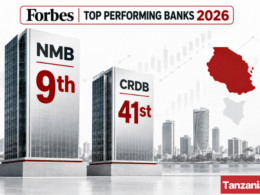
Tanzania Banking Sector H1 2026 Performance: Profit Up 13% to TZS 1.38 Trillion, Assets Reach TZS 91.3 Trillion

Tanzania's banking sector recorded net profit after tax of TZS 1.38 trillion in H1 2026, up 13% from H1 2025, on total assets of TZS 91.3 trillion. CRDB Bank Plc (DSE: CRDB) profit rose 20% to TZS 416.9 billion and NMB Bank Plc (DSE: NMB) reached TZS 405.8 billion, while eleven banks with assets above TZS 2 trillion held 84.4% of sector assets, with average ROE at 12.5% and NPL at 4.7%.
Axian Acquisition Letshego Bank Tanzania
Read More

Yas Owner Axian To Acquire 100% Of Tanzanian Lender Letshego Faidika Bank

Axian, the group behind Yas mobile operator, is acquiring 100% of Letshego Faidika Bank Tanzania, a licensed Tier II commercial bank, with the transaction now under review by the country's Fair Competition Commission. The deal forms part of Letshego Africa Holdings' disposal of its Ghana, Tanzania, Nigeria, Rwanda and Uganda subsidiaries agreed on 27 April 2026, and would add a banking licence to a group that already operates the country's second-largest mobile money service.
Central Bank of Tanzania BOT CBR Interest Rate Q3 2026
Read More

BOT Raises Tanzania Central Bank Rate to 6.25% for Q3 2026; GDP Growth Estimated at 6% in H1 2026, Driven by Agriculture, Construction, Mining, and Tourism

The Bank of Tanzania (BOT) released its Monetary Policy Committee Statement of July 2026, in which it indicates that the MPC decided to raise the Central Bank Rate (CBR) from 5.75% to 6.25% for the third quarter of 2026. The decision aims to contain inflation driven by high energy, fertilizer, and transportation costs linked to the geopolitical conflict in the Middle East.
Bank of Tanzania Financial Stability Index 2014-2025
Read More

Tanzania Banking Assets Up 23.8%, Capital Markets Up 35.1%, Social Security Up 21.4%, Insurance Up 6.8% in 2025

The Bank of Tanzania Financial Stability Report for 2025 shows banking sector total assets grew 23.8% to TZS 76,975 billion, private sector credit expanded 23.5% with mining up 30.1% and trade up 29.4%, and the non-performing loans ratio fell to 2.8%, the lowest in the East African Community. Total capital market investment rose 35.1% to TZS 63,096.4 billion, social security assets grew 21.4% to TZS 25,921 billion, insurance assets rose 6.8% to TZS 2,633.6 billion, and foreign reserves stood at USD 6,312 million covering 5.2 months of imports.