



The Bank of Tanzania (BOT) released its Monthly Economic Review-April 2023 which includes money and credit for the year ending March 2023.
Credit extended to the private sector recorded an annual growth of 22.9% in March 2023, higher than 13.4% in the corresponding period in 2022.
The growth was largely on account of improvements in the business environment, and supportive monetary and fiscal policies.

Disaggregation of credit by economic activities revealed that the agriculture sector continued to register the largest growth of credit backed by policy measures that were taken by BOT to promote cost-effective credit intermediation, coupled with ongoing interventions by the Government in supporting the sector.
Meanwhile, personal loans which consist of sole firms and individual undertakings continued to contribute a lion’s share in the overall growth of credit to the private sector, followed by agriculture, trade and manufacturing.
Interest rates
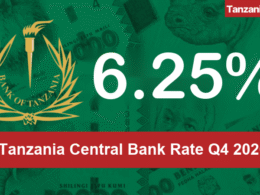
Interest rates charged by banks on loans remained broadly unchanged compared with rates registered in February 2023 and March 2022, with the overall lending rate averaging 15.83% in March 2023 compared with 15.96% in the preceding month, and 16.25% in the corresponding month in 2022.
Similarly, negotiated lending rates averaged 13.59%, down from 13.75% and 13.80% in February 2023 and March 2022, respectively.
Deposit rates declined, with the overall deposit rate averaging 6.78% in March 2023, compared with 7.18% in the preceding month and 7.02% in March 2022.

Negotiated deposit rates averaged 9.31%, slightly below 9.37% and 9.68% in February 2023 and March 2022, respectively.
Accordingly, the short-term interest rate spread increased.
Banks’ Performances
According to the analysis of The Citizen, in Q12023, the collective net profit of the top 13 banks in Tanzania, which make up more than 90% of the sector’s profitability, increased by 20% compared to the same period in 2022.
These banks registered net profits of TZS334.56 billion in the first 3 months of 2023 compared to TZS 278.29 billion recorded in Q1 2022.
In the first quarter of 2023, the 13 largest banks saw customers’ deposits reach TZS27.54 trillion, which is TZS944 billion more than TZS26.5 trillion deposited in Q1 in 2022.
The solid performances are attributed to the rise of digital financial services improved access to banking services, favourable legislature, positive economic outlooks and increasing confidence among customers.
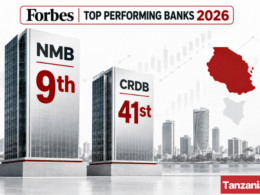
According to the Financial Statement for the Quarter Ended 31st March 2023 of CRDB Bank—the largest bank in Tanzania by total assets—its Net Income After Income Tax at the end of Q1 2023 increased by +11.7% from TZS84,750 million in Q1 2022 to TZS94,749 million.
Meanwhile, non-performing loans to total gross loans remained well under BOT’s 5% recommended threshold, remaining steady at 2.9% in Q1 2023 as in Q1 2022.
Similarly, NMB Bank, the second-largest bank in Tanzania, reported in its Financial Statement for the Quarter Ended 31st March 2023 that its net income after income tax at the end of Q1 2023 increased by +21.4% from TZS 100,460 million in Q1 2022 to TZS 122,040 million.
Meanwhile, non-performing loans to total gross loans fell to 3% in Q1 2023 from 3.1% in Q1 2022.
Want to know more about Banking in Tanzania? Our free overview of the Tanzania Business and Investment Guide 2026 covers Banking, plus key sectors and investment opportunities. The complete 141-page edition includes policies, taxation, key regulations, full macroeconomic data, and sources, and is also available at no cost upon completion of a short form.
Download Free OverviewGet the Full Edition for Free