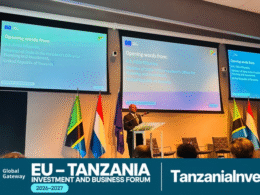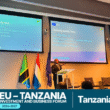
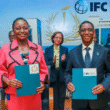

On 22 February 2022, Stanbic Bank Tanzania sponsored the Tanzania Mineral and Mining Investment Conference held at the Julius Nyerere International Convention Centre in Dar es Salaam, as part of the bank’s role to support conversations around initiatives to drive the growth of the mining sector.
We sat with Stanbic Bank Tanzania’s Corporate Banking Manager, Aboubakar Massinda to discuss the bank’s contribution to the mining sector and share his perspectives on the other elements that drive the sector’s growth and support the government vision to raise mining’s contribution to Tanzania’s GDP from the current 6.7% to 10% by 2025.
Stanbic Tanzania has been playing a critical role in supporting the country’s key sectors such as mining. What informed the bank’s decision to participate in this year’s Tanzania international Minerals and Mining Investment Conference?

One of our priorities for the bank this year is to increase our contribution towards the growth of the mining sector, hence our decision to sponsor the conference this year.
One of our priorities for the bank this year is to increase our contribution towards the growth of the mining sector.
In addition, Stanbic Bank Tanzania is a member of the Tanzania Chamber of Mines and this partnership allows us to be in the front and center of all matters related to mining in the country.
As leading experts in the mining sector from a banking perspective, we are keen to contribute to the dialogue that will shape policy and decisions in the mining sector.
What have you communicated to participants at the congress?
Mining is a key contributor to the country’s exports–gold alone is 41%-and with the other mineral commodities now coming on board such as graphite, nickel, niobium, and rare earth metals, this sector has more significance to the country’s overall growth.

Stanbic Bank is here to facilitate the growth of the mining sector by providing financing and advisory services.
Stanbic Bank is here to facilitate the growth of the mining sector by providing financing and advisory services.
We are hands-on to ensure we support key institutions and stakeholders in order to see this sector thrive and the country’s vision coming to fruition.
How does Stanbic take part in large mining projects in Tanzania? What is the role of Stanbic in the mining value chain?
Being a universal bank enables us to service a wide range of clients from individuals at a retail level to large corporates including mining sector stakeholders.
We have financed large mining companies that are investing in the country and facilitated funding arrangements for projects through local and international financiers and security agents.
We have financed large mining companies that are investing in the country.
Additionally, from a value-chain perspective, we look at the clients and projects in their entirety–the mining company, the contractors and suppliers, employees, and even off-takers of the end-product.
Our offering is always bespoke and cuts across the entire ecosystem of each unique operation.
How do you look at the entire mining sector in the country as a niche market for your banking products?
Unlike most industries, mining is quite specific in terms of its unique processes and different mining methods which in turn raise specific opportunities and challenges.
As a financial institution, we have to take distinctive approaches in ensuring we present the appropriate products which maximize opportunities and mitigate challenges.
In 2014 we decided to organize our teams into key sectors that drive growth with mining being one of them. This has allowed us to knit together a team that is fully dedicated to the sector from analyzing market trends, conducting continuous client engagements, building expertise in debt and equity capital markets, working capital, etc.
Additionally, with our parent (The Standard Bank of South Africa) being the biggest bank in Africa, Stanbic gets to leverage on learnings and best practices from other teams located in over 20 African countries such as South Africa, Ghana, and the DRC.
Our local, regional, and international expertise enables us to provide solutions to our clients which speak to their exact needs, putting them in the best position to succeed.
As an expert what can you recommend the state to do in order to speed up investment and growth in the mining industry?
Our Government has made great efforts to transform the sector and the results are vivid.
Investors are excited about our country, new licenses are being issued, existing mining companies are ramping up production, and most of all local companies and small-scale miners are more involved in the overall growth.
Investors are excited about our country, new licenses are being issued, existing mining companies are ramping up production.
We have seen the Ministry of Minerals, the Ministry of Finance, and the Mining Commission actively engage and work alongside stakeholders such as ourselves and our clients to ensure we are all aligned.
Continued stakeholder engagement would be the key recommendation, especially at the policy-making level as we look to take our country to new heights over the next few years.
Want to know more about Banking in Tanzania? Our free overview of the Tanzania Business and Investment Guide 2026 covers Banking, plus key sectors and investment opportunities. The complete 141-page edition includes policies, taxation, key regulations, full macroeconomic data, and sources, and is also available at no cost upon completion of a short form.
Download Free OverviewGet the Full Edition for Free