Oil
Tanzania's oil sector is anchored by the USD 5 billion East African Crude Oil Pipeline (EACOP), a 1,433 km cross-border project with a peak capacity of 246,000 bbls/day scheduled for completion by July 2026.
Tanzania has an active upstream exploration frontier and a fully import-dependent downstream market, positioning oil as both a regional transit opportunity and a domestic supply challenge.
While no commercial crude discoveries have yet been confirmed onshore or offshore, ongoing exploration programs and the country's role as the export outlet for Ugandan crude place oil at the center of Tanzania's regional energy strategy.
Contents
Upstream Oil Exploration
Tanzania covers a total area of 945,000 sq km, of which 534,000 sq km (56%) is covered by sedimentary basins attractive for oil and gas exploration[1].
Oil exploration in Tanzania began in the 1950s by multinational petroleum companies.
To date, about 140,000 line kilometers of 2D seismic and 39,217 sq km of 3D seismic data have been acquired across offshore, onshore, and interior rift basins.
A total of 96 wells has been drilled, providing vital geological information on subsurface structures with hydrocarbon potential.
No commercial oil discoveries have been confirmed so far.
However, ongoing research under the Eyasi Wembere strategic oil and gas exploration project in northern Tanzania has identified promising geological indicators.
Furthermore, Lake Tanganyika, part of the East African Rift System, shares geological characteristics with other East African basins, such as Lake Albert in Uganda and Kenya, where commercial oil has been discovered.
This similarity increases confidence in the lake's potential to host Tanzania's first commercial oil reserves.
Currently, 22 oil companies are undertaking exploration activities for oil and gas in Tanzania[2].
In 2025, the Government of Tanzania announced plans to allocate 26 new exploration blocks, of which 23 are in the deep offshore Indian Ocean, and 3 are onshore in Lake Tanganyika[3].
East African Crude Oil Pipeline (EACOP)
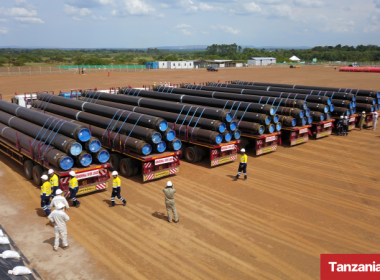
The EACOP pipeline is a major regional energy project designed to transport crude oil from Uganda's Lake Albert oilfields to the port of Tanga in Tanzania for global export.
Its shareholders are TotalEnergies (62%), Uganda National Oil Company Limited (UNOC, 15%), Tanzania Petroleum Development Corporation (TPDC, 15%), and China's CNOOC (8%).
Spanning 1,433 km, with 80% of its length within Tanzania, it will have a peak capacity of 246,000 bbls/day.
EACOP integrates advanced fiber-optic cables that can increase the capacity of local operators, supporting wider and faster internet connectivity in both Uganda and Tanzania.
The project represents a USD 5 billion investment aimed at enhancing Government revenue, improving logistics, facilitating skills and technology transfer, and strengthening the trade corridor between Uganda and Tanzania.
The project is expected to be completed by July 2026.
Midstream and Downstream Petroleum
Tanzania does not currently operate a commercial crude oil refinery and is a net importer of refined petroleum products.
Refined products such as petrol, diesel, jet fuel, kerosene, liquefied petroleum gas (LPG), and heavy fuel oil are imported through international competitive bidding under the Bulk Procurement System (BPS).
Importation of petroleum products reached 9.22 billion liters in the financial year 2023/2024[4].
These products are delivered by ship to the ports of Dar es Salaam, Tanga, and Mtwara, where they are stored in dedicated terminals with a total storage capacity of 1,637,222 cubic meters.
The Mtwara port serves the southern regions of Mtwara, Lindi, and Ruvuma; Tanga serves the northern regions of Tanga, Kilimanjaro, Arusha, and Manyara; and Dar es Salaam serves the remaining regions, including neighboring landlocked countries.
Oil Imports and Trade Balance
The oil import bill declined by 6.7% to USD 2,380.1 million due to the moderation of global oil prices.
This decline in the oil import bill contributed to easing pressure on Tanzania's external accounts.
By the end of December 2025, the stock of foreign exchange reserves strengthened significantly to USD 6,329 million, up from USD 5,546.9 million the previous year.
This level of reserves is sufficient to cover 4.9 months of projected imports, comfortably exceeding both the national target of 4 months and the EAC benchmark of 4.5 months.
Investment Opportunities in Oil
Upstream exploration presents a substantial frontier opportunity through the 26 new exploration blocks announced in 2025, comprising 23 deep offshore Indian Ocean blocks and 3 onshore blocks in Lake Tanganyika[3].
The geological similarity between Lake Tanganyika and Uganda's Lake Albert basin, where commercial oil has been discovered, positions the rift lake as a priority frontier for oil exploration investment.
The EACOP corridor unlocks opportunities across pipeline logistics, port handling at Tanga, ancillary services, technology transfer, and skills development linked to a USD 5 billion cross-border investment.
Downstream, the absence of a domestic crude oil refinery, combined with 9.22 billion liters of petroleum product imports in 2023/2024, signals a clear opening for refining capacity, terminal storage expansion beyond the existing 1,637,222 cubic meters, and distribution infrastructure serving both Tanzania and landlocked neighbors.
Ongoing 2D and 3D seismic coverage across 140,000 line kilometers and 39,217 sq km respectively, alongside 96 drilled wells, provides a solid geological data base to de-risk new entrant exploration commitments.
Last Update: May 2026
References
- https://www.scribd.com/document/842717248/Oil-and-Gas-Opportunities-in-Tanzania-Reviewed-by-Team (Guide reference #90)
- https://www.tiseza.go.tz/pages/oil-and-gas (Guide reference #91)
- https://www.pura.go.tz/news/26-petroleum-exploration-blocks-to-be-auctioned (Guide reference #92)
- https://www.ewura.go.tz/uploads/documents/en-1744206990-Petroleum%20Sub-Sector%20Performance%20Report%20FY%202023-24.%20pdf.pdf (Guide reference #93)
Want to know more about Oil in Tanzania? Our free overview of the Tanzania Business and Investment Guide 2026 covers Oil, plus key sectors and investment opportunities. The complete 141-page edition includes policies, taxation, key regulations, full macroeconomic data, and sources, and is also available at no cost upon completion of a short form.
Download Free OverviewGet the Full Edition for Free