Tanzania turns iPhone into Microscope

Scientists in Tanzania have turned an iPhone into a microscope and used it to diagnose intestinal worms in schoolchildren.

The microscope was made using an iPhone, flashlight, camera lens and double-sided adhesive tape, then used it to diagnose intestinal worms in approximately 200 students in Pemba Island off Tanzania’s eastern coast, CNN reported Saturday.

“To our knowledge, this is the first time the mobile phone microscope had been used in the field to diagnose intestinal parasitic infections” said Isaac Bogoch an internal Medical Specialist at Toronto General Hospital.
Tanzania Investment Guide 2026 Free Edition

Bogoch said the iPhone microscope had a 70 percent accuracy when compared to the results of a conventional laboratory microscope.

“The idea was to have a cheap solution in remote settings where equipment such as a microscope and electricity are not that easily available,” said Benjamin Speich, a corresponding author and scientist at the Swiss Tropical and Public Health Institute.

Scientists say they plan to work with the technology in Tanzania to make it more accurate.


Want to know more about Telecoms in Tanzania? Our free overview of the Tanzania Business and Investment Guide 2026 covers Telecoms, plus key sectors and investment opportunities. The complete 141-page edition includes policies, taxation, key regulations, full macroeconomic data, and sources, and is also available at no cost upon completion of a short form.

Download Free OverviewGet the Full Edition for Free
Related Posts
Read More

Tanzanian Delegation Visits Agribusiness, AI, Data Centre and Railway Facilities on Day Two of EU–Tanzania Roadshow in Italy

On 2 October, Tanzanian agribusiness and digital delegations visited facilities in Emilia-Romagna during the EU–Tanzania roadshow’s Italian leg. On the second day of the EU–Tanzania roadshow in Italy, the agribusiness delegation visited Apofruit–Almaverde, Martini Group and Unitec to examine post-harvest handling and cold storage, livestock and food operations, and fruit sorting, grading and training. A separate group led by Deputy Minister Pius Chaya visited the University of Bologna, DAMA Tecnopolo and Bologna San Donato to learn about artificial intelligence, Industry 4.0, supercomputing, data centres and railway testing.
Read More

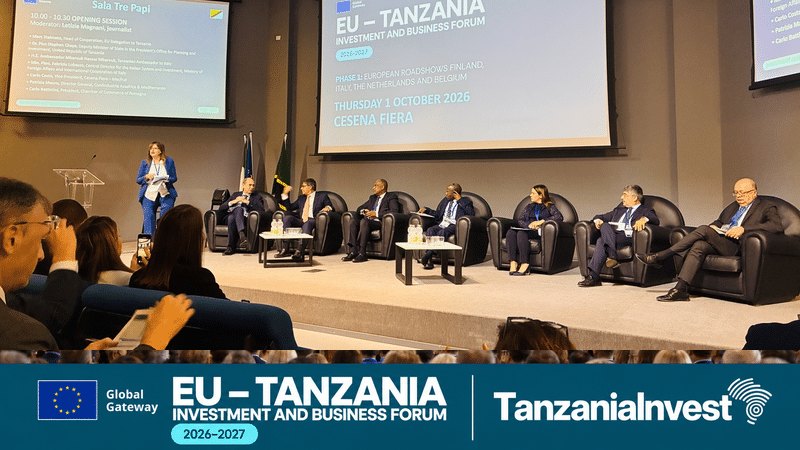
EU–Tanzania Roadshow Continues in Italy With Rice, Cashew, Coffee and Renewable Energy Investment Pitches in Cesena

At the Cesena stop of the EU–Tanzania roadshow, Tanzanian agencies presented investment opportunities in rice, cashew and coffee processing, renewable energy, power transmission and digital infrastructure. Italy’s Ministry of Foreign Affairs cited USD 8.6 billion in foreign investment registered in Tanzania in the last year, up 56%, while EU and Italian institutions outlined grants, guarantees, export credit and blended finance.
EU-Tanzania Roadshow 2026-2027 Helsinki day 2 critical minerals visit
Read More

Tanzanian Delegation Visits EU’s Only Nickel Smelter, Metso Research Center, and Nokia on Day Two of EU-Tanzania Roadshow in Finland

On 29 September 2026, the second day of the EU-Tanzania roadshow in Finland, the Tanzanian delegation visited Metso's Pori Research Center, where around 180 experts work on mineral processing, hydrometallurgy, battery materials, and smelting, and Boliden's Harjavalta site, home to the only nickel smelter in the EU. The digital track included visits to Nokia, the Finnish Information Security Cluster, and technology company Gofore, with talks on digital sovereignty, digital public infrastructure, and Tanzania's move to a cashless economy.
EU-Tanzania Investment & Business Forum 2026-2027 Helsinki day 1
Read More

EU–Tanzania Roadshow Opens in Helsinki With Mineral and Digital Investment Pitches

At the EU-Tanzania roadshow in Helsinki, the EU and Finland said they want to invest in Tanzania's critical minerals and digital economy, backed by a new EUR 156 million EU package and by Finnish financiers Finnvera and Finnfund, which confirmed they are open to Tanzanian deals. Tanzania offered European companies entry into graphite, nickel and rare earths processing, including at a former gold mine converted into a mineral processing zone, as well as into data centres, submarine cables and broadband, backed by TZS 7 trillion in planned public spending.