
Ministry of Transport Updates First 100 Days of Sixth Phase Government Second Term: Achievements Include TAZARA Rehabilitation Deal, 838,000 Rail Passengers and New Infrastructure

Tanzania’s Ministry of Transport outlined achievements recorded during the first 100 days of the government’s second term, including transport of more than 838,000 rail passengers and over 85,000 tonnes of cargo. The update also confirms the signing of the Tanzania-Zambia Railway (TAZARA) rehabilitation agreement set to start in June 2026, and the launch of a vessel with capacity for 1,200 passengers and 400 tonnes of cargo.
Tanzania Transport Minister Mbarawa 100 days Update

Tanzania’s Ministry of Transport has outlined key transport sector achievements recorded during the first 100 days of the Sixth Phase Government’s second term.

These include the signing of the Tanzania-Zambia Railway (TAZARA) rehabilitation agreement, expansion of rail services, and progress in port, maritime, and aviation infrastructure in Tanzania.

The Minister for Transport, Prof. Makame Mbarawa, announced the developments on February 1, 2026, in Dodoma, stating that the government had completed procedures to revive TAZARA.

Tanzania Investment Guide 2026 Free Edition

Prof. Mbarawa added that services on the Standard Gauge Railway (SGR) and Meter Gauge Railway (MGR) had improved, with more than 838,000 passengers and over 85,000 tonnes of cargo transported during the reporting period.

The construction of the SGR line from Dar es Salaam to Mwanza is ongoing, with the Dar es Salaam to Dodoma section already providing services.

The government also received two locomotives and 50 freight wagons to strengthen railway operations, and the Tanzania Railways Corporation (TRC) had started operating without government salary subsidies, while the establishment of the TANRAIL subsidiary company aims to increase revenue and operational efficiency in the railway sector.

In the port sector, the government has started preparations for the expansion of the Port of Dar es Salaam and the construction of the Bagamoyo Port, which Prof. Mbarawa said has contributed to increased revenues for the Tanzania Ports Authority (TPA) and the Tanzania Revenue Authority (TRA) by hundreds of billions of Tanzanian shillings.

In maritime transport, the government launched the MV New Mwanza vessel, which has a capacity to carry 1,200 passengers and 400 tonnes of cargo.
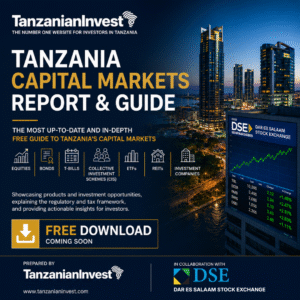
TanzaniaInvest Capital Markets Report Banner

The government has also procured rescue boats and an ambulance boat for operations on Lake Victoria to improve safety and emergency response services.

In the aviation sector, the government completed construction of the VIP terminal building at Julius Nyerere International Airport and introduced new international routes through Air Tanzania Company Limited, which he said is strengthening Tanzania’s connectivity to global markets.

Prof. Mbarawa said the achievements were the result of leadership under President Samia Suluhu Hassan and pledged continued investment in transport infrastructure to support economic development and improve livelihoods.

Want to know more about Transport in Tanzania? Our free overview of the Tanzania Business and Investment Guide 2026 covers Transport, plus key sectors and investment opportunities. The complete 141-page edition includes policies, taxation, key regulations, full macroeconomic data, and sources, and is also available at no cost upon completion of a short form.

Download Free OverviewGet the Full Edition for Free

Related Posts
Tanzania Khamis Mussa Omar World Bank Anna Bjerde
Read More

Tanzania and World Bank Map Central Corridor Investment Opportunities in Agriculture, Logistics, Mining, and Tourism

Tanzania and the World Bank are mapping Central Corridor investment opportunities in agriculture, mining, tourism, transport, and logistics, with a possible extension to Rwanda, while UNDP prepares investor-ready projects for a June 2027 investment conference and seeks Asian Infrastructure Investment Bank financing. The World Bank named job creation its top priority and discussed shifting small business lending from collateral to cash-flow assessment, while Tanzania pursues a 40% value addition target through agriculture, livestock, and minerals.
EU-Tanzania Investment & Business Forum 2026-2027 Helsinki day 1
Read More

Tanzania Pitched a 68-Project, USD 30.1 Billion Pipeline at the EU–Tanzania Roadshow in Finland, Italy, the Netherlands and Belgium Ahead of the Early 2027 Dar es Salaam Forum

The EU-Tanzania roadshow 2026 took Tanzanian ministers and agencies to Helsinki, Cesena, The Hague, Rotterdam, and Antwerp between 28 September and 6 October, pitching critical minerals, agribusiness, renewable energy, digital, and port and rail projects from a 68-project, USD 30.1 billion pipeline. The roadshow leads to a high-level EU-Tanzania Investment and Business Forum in Dar es Salaam planned for early 2027.
EU-Tanzania Roadshow 2026 APM Terminals at Maasvlakte Rotterdam
Read More

EU–Tanzania Roadshow Ends With Rotterdam and Antwerp Port Visits as Tanzania Pitches Port, Rail and Logistics Opportunities to European Companies

The EU-Tanzania roadshow ended in Antwerp on 6 October 2026 after port visits in Rotterdam, with Tanzania's port and rail authorities pitching openings for terminal operators, EPC contractors, private rail operators and digital rolling stock tracking, while rail operator Vecturis, minerals logistics group Polytra, heavy lifting company Sarens and marine data company GEOxyz outlined their plans in Tanzania. The EU said it will join the World Bank and the EIB, which has a formal financing request, in supporting the Dar es Salaam port expansion, and offered Global Gateway guarantees, equity and feasibility funding for company projects screened by member states.
EU-Tanzania Roadshow 2026 The Hague day 1 opening Mkumbo
Read More

EU–Tanzania Roadshow Reaches The Hague With Coffee, Cashew, Critical Minerals, and Port Investment Pitches

The EU-Tanzania roadshow reached The Hague on 5 October 2026 for its final leg, where Tanzania pitched coffee and cashew processing, wheat and edible oils, critical minerals, the new Bagamoyo and Mwambani ports on the mainland, Zanzibar's Mangapwani port hub, four dry ports, and two new lines of the standard gauge railway network to around 90 businesses. Agriculture emerged as the priority sector for European and Dutch investors, with the best opportunities in food production and value addition, backed by Dutch expertise as the world's second-largest agricultural exporter.