


New Dubai-Kilimanjaro Direct Flight

Dubai-Kilimanjaro Tanzania Direct flight

Dubai-based low-cost airline flydubai announced the start of flights from Dubai to Kilimanjaro from 29th October 2017.

Kilimanjaro becomes the airline’s 3rd destination in Tanzania along with Dar es Salaam and Zanzibar.

Only a few international carriers operate to Kilimanjaro and flydubai will be the first airline to provide direct air links from the UAE.

Tanzania Investment Guide 2026 Free Edition

The airport is the major gateway to the Kilimanjaro region, a main international tourism destination that includes Mount Kilimanjaro, Arusha National Park, Ngorongoro Crater and Serengeti National Park.

flydubai will serve Kilimanjaro with six flights a week, three of which are via a stop in the capital, Dar es Salaam.

In addition, the carrier will increase direct flights to Zanzibar from three to eight flights a week, bringing the total number of flights to Tanzania to 14 flights a week.

Commenting on the launch of flights, Ghaith Al Ghaith, Chief Executive Officer of flydubai, said: “With the addition of the service to Kilimanjaro and more direct flights to Zanzibar, flydubai will operate 14 flights a week, marking a 133% increase in capacity to the market compared to the previous year. This is a healthy indication of the rising popularity of Tanzania as a preferred tourist destination and we are happy to be connecting the market to Dubai.”

“We expect to see healthy flows of trade and tourism on this route from the GCC and Eastern Europe via our hub in Dubai,” said Sudhir Sreedharan, Senior Vice President Commercial (GCC, Subcontinent and Africa) of flydubai.

TanzaniaInvest Capital Markets Report Banner

The airline began operations to Tanzania in 2014 and has seen a 3.5% increase in passengers numbers traveling between the UAE and Africa in 2016 compared to 2015.

Want to know more about Tourism in Tanzania? Our free overview of the Tanzania Business and Investment Guide 2026 covers Tourism, plus key sectors and investment opportunities. The complete 141-page edition includes policies, taxation, key regulations, full macroeconomic data, and sources, and is also available at no cost upon completion of a short form.

Download Free OverviewGet the Full Edition for Free

Free Newsletter

Get our monthly update on business and investment in Tanzania.

Related Posts
Tanzania Tanga 17 PPP Investment Projects
Read More

17 PPP Projects Open in Tanga to Investors in Transport, Trade, Tourism, Livestock, Agriculture, and Mining

Seventeen Tanga PPP projects with title deeds are open to private investors in transport, trade, tourism, livestock, agriculture, and mining, led by the 595,785-square-metre Pongwe Dry Port. Councils can approve projects below USD 20 million without the national PPP Board, and the government can co-finance capital costs through viability gap funding.
Tanzania TANAPA revenue arrivals 2025-2026
Read More

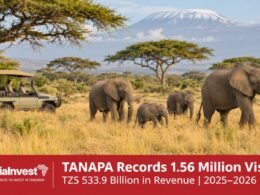
Tanzania Records 1,559,441 Visitors to its National Parks as Revenue Reaches TZS 533.9 Billion; Allocates 130 Investment Sites for New Lodges and Camps

The Tanzania National Parks Authority (TANAPA) recorded 1,559,441 visitors and TZS 533.9 billion (± USD 201.5 million) in revenue in 2025-2026, up from 788,940 visitors and TZS 174.7 billion in 2021-2022. To meet growing demand, TANAPA has allocated 130 investment sites for new lodges and camps, mainly in the Southern, Eastern and Western tourism circuits, after bed capacity rose from 575 in 2021 to 1,294 in 2026.
Tanzania Khamis Mussa Omar World Bank Anna Bjerde
Read More

Tanzania and World Bank Map Central Corridor Investment Opportunities in Agriculture, Logistics, Mining, and Tourism

Tanzania and the World Bank are mapping Central Corridor investment opportunities in agriculture, mining, tourism, transport, and logistics, with a possible extension to Rwanda, while UNDP prepares investor-ready projects for a June 2027 investment conference and seeks Asian Infrastructure Investment Bank financing. The World Bank named job creation its top priority and discussed shifting small business lending from collateral to cash-flow assessment, while Tanzania pursues a 40% value addition target through agriculture, livestock, and minerals.