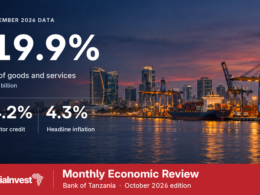




The Bank of Tanzania (BOT) released its Monthly Economic Review-July 2024 which covers key macroeconomic indicators for the year ending June 2024.
External Sector Performances
The external sector performances continued to improve as the global economy normalized from economic shocks, coupled with enhanced export performances and prudent import management policies amid favorable global commodity prices.
As a result, the current account deficit decreased to USD 2,501.3 million in June 2024, from USD 4,955.6 million in the corresponding period in 2023, the lowest since July 2023.

Foreign Exchange Reserves
Foreign exchange reserves improved to USD 5,345.5 million at the end of June 2024. This amount was sufficient to support 4.4 months of projected imports of goods and services, within the country and East African Community (EAC) benchmarks.
Exports
Exports of goods and services rose by 14.9% to USD 14,680.7 million during the year ending June 2024, owing to higher travel receipts and increased exports of gold, traditional goods, and horticultural products.
A notable export increase was observed in gold; services in particular travel (tourism), traditional goods, horticulture products, as well as fish and fish products.
Traditional Goods Exports
Traditional exports reached USD 1,066.3 million, marking a 41.8% increase from the amount recorded in the year ending June 2023. This increase was driven by higher export volumes of cashew nuts, cotton, and coffee, despite fluctuations in prices. Meanwhile, tobacco exports grew by 140% in the year to June 2024, attributed to increases in both volumes and price.
Non-traditional Goods and Mineral Exports
Non-traditional exports also improved, amounting to USD 6,371.6 million, up from USD 6,195.7 million in the year to June 2023. This increase was largely driven by gold exports (USD 3,121.8 million), which accounted for 49% of non-traditional exports, as well as by horticultural products, fish and fish products, and oil seeds.

During the period, horticultural exports increased to USD 415.4 million from USD 294.1 million a year earlier, largely due to increased exports of vegetables.
Oil seed exports grew by 26.4%, reaching USD 295.3 million in the year ending June 2024.
Service and Tourism Receipts
Service receipts reached USD 6,811.3 million in the year to June 2024, an increase of 25.5% from the levels recorded in the year ending June 2023.
The outturn is mainly driven by travel receipts, which accounted for 53.5% of total service receipts, followed by transport, mainly from freight charges.
The performance of service receipts is, by and large, associated with a rise in tourist arrivals, the number of which increased to 1,994,242 in June 2024 from 1,638,846 in June 2023.
Imports
Imports of goods and services decreased to USD 16,027.9 million during the year ending June 2024, from USD 16,980.4 million in the previous year. The decrease was mainly associated with moderation in global commodity prices and freight costs.
Meanwhile, service payments fell by 11.5% to USD 2,242.5 million, largely due to lower freight costs for imported goods, which constituted 53.2% of the total service payments made annually.
Throughout the year, the primary income account recorded a deficit, reaching USD 1,743.7 million in June 2024, up by 24.3% from the previous year. The outturn resulted from interest payments on foreign debts.
Monthly, the deficit expanded to USD 181.1 million in June 2024 from USD 132.6 million in June 2023. The surplus in the secondary income account decreased to USD 588.6 million for the year ending June 2024, down from USD 647.4 million in the previous year. The monthly surplus also fell to USD 45 million from USD 102.7 million in June 2023.
Want to know more about Tourism in Tanzania? Our free overview of the Tanzania Business and Investment Guide 2026 covers Tourism, plus key sectors and investment opportunities. The complete 141-page edition includes policies, taxation, key regulations, full macroeconomic data, and sources, and is also available at no cost upon completion of a short form.
Download Free OverviewGet the Full Edition for Free