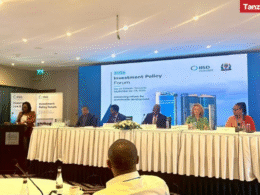




On 29th October 2024, the “Tanzania-Russia Business and Investment Forum” took place in Dar es Salaam, marking a pivotal step in the economic relations between Tanzania and Russia.
Organized by the Tanzania Private Sector Foundation (TPSF), the Tanzania Investment Center (TIC), and the Tanzanian Embassy in Moscow, the event provided a platform to explore investment opportunities in critical sectors and deepen bilateral economic ties.
The forum was scheduled to coincide with the visit of Russia’s Minister of Development and Economy, underscoring the shared commitment to enhancing trade relations and investment in key sectors including construction, tourism, mining, agriculture, energy, infrastructure, education, and healthcare.

In her opening remarks, Tanzania’s Permanent Secretary of the President’s Office for Planning and Investment, Dr. Tausi Mbaga Kida, highlighted the forum as a strategic opportunity for both countries to leverage mutual benefits.
Kida emphasized the role of the recently established Joint Intergovernmental Russia-Tanzania Commission on Trade and Economic Cooperation as instrumental in facilitating economic collaboration.
“This forum is a bridge to strengthen our relations by allowing businesses and governments from both Tanzania and Russia to explore shared economic interests,” added Kida.
On his part, the Tanzanian Ambassador to Russia, Frederick Kibuta, underscored the longstanding friendship between the two nations and urged Russian investors to capitalize on Tanzania’s stable political environment and its strategic location in East Africa.
Kibuta reiterated Tanzania’s commitment to fostering a supportive business environment for foreign investors, stressing that Tanzania offers extensive opportunities in multiple sectors for those seeking to invest.

On his part, Tanzania’s Minister for Planning and Investment, Prof. Kitila Mkumbo, expressed Tanzania’s readiness to attract Russian investments, particularly in agriculture, manufacturing, and tourism.
Mkumbo highlighted the importance of the recent trade and economic cooperation agreement, which he described as marking the beginning of a new phase in Tanzania-Russia relations.
He encouraged Russian businesses to take advantage of the country’s economic climate, promising a welcoming and conducive environment for growth and expansion.
Tanzania’s Minister of Natural Resources and Tourism, Pindi Chana invited Russian businesses to explore opportunities in Tanzania’s tourism sector.
Chana highlighted Tanzania’s 21 national parks, including the renowned Mount Kilimanjaro, and its scenic coastal beaches as prime areas for investment.
She emphasized that the tourism sector offers lucrative opportunities for Russian businesses looking to participate in one of Africa’s most attractive destinations.
TIC’s Manager of Investment Promotion (Foreign), Daudi Riganda presented a detailed overview of investment opportunities in Tanzania, especially in agriculture, tourism, mining, and pharmaceuticals.
Riganda emphasized the government’s commitment to supporting investors with tax incentives, streamlined processes, and a stable regulatory framework.
He called for attention to Tanzania’s investor-friendly environment, which he believes offers a unique opportunity for Russian companies looking to establish a foothold in East Africa.
James Maziku, the Director of Investment Promotion and Facilitation at the Tanzania Export Processing Zones Authority (EPZA), shared specific opportunities available through the Export Processing Zone (EPZ) and Special Economic Zone (SEZ) Schemes.
Maziku highlighted the Bagamoyo SEZ, which is centered around an ultra-modern port project, offering investment potential in a portside industrial zone designed to facilitate manufacturing and global exports.
Additionally, Maziku discussed the Kwala SEZ, a 100-acre area located 70 kilometers from Dar es Salaam, focused on trade logistics and manufacturing, and the Kigoma SEZ, positioned to leverage Lake Tanganyika as a trade route to neighboring countries such as the Democratic Republic of Congo, Burundi, Rwanda, and Zambia, with direct connections to Dar es Salaam through the standard gauge railway.
Furthermore, he noted ongoing discussions with a Russian company interested in establishing a tire manufacturing facility in Tanzania, either through an acquisition or new investment.
The representative from TANTRADE addressed the untapped potential in trade between Tanzania and Russia pointing out that while current trade trends favor Russia, there is considerable room to diversify and expand trade relations.
He identified promising export opportunities from Tanzania to Russia, which include high-demand products like coffee, black tea, hides, and skins, and import opportunitiesfrom Russia to Tanzania, which currently include essential products such as fertilizers, machinery, and chemicals.
The representative from the Zanzibar Investment Promotion Authority (ZIPA) highlighted the Mangapwani project, which is a strategic government initiative aimed at transforming Zanzibar into a regional logistics hub.
He encouraged Russian businesses to invest in manufacturing, fishing, and other areas, noting that the Mangapwani project offers a wide range of investment incentives and lower capital requirements to attract international investors.
The Immediate Past Chairman of the Confederation of Tanzania Industries (CTI) Dr. Nyantahe emphasized the well-organized structure of Tanzania’s private sector highlighting the establishment of sector associations, a National Business Council, and a strong partnership with the government, all aimed at streamlining business operations and addressing concerns.
Nyantahe stresses the importance of industrialization for adding value to various sectors, including tourism, and welcomes Russian investment, assuring them of a supportive and organized business environment.
In his closing remarks, TIC’s Chairman Dr. Bilinith Mahenge invited Russian investors to take full advantage of Tanzania’s attractive investment incentives, which include tax holidays and free profit repatriation, and highlighted the recent publication of a Russian-language book, Tanzania Opportunities, as a valuable resource for Russian investors interested in exploring Tanzania’s economic landscape.
On his part, the Tanzanian Ambassador to Russia, Frederick Ibrahim Kibuta emphasized the importance of strengthening economic and trade relations between Tanzania and Russia.
Kibuta highlighted the need for increased investment and business engagement from Russia in Tanzania, recognizing the potential for mutual benefit.
He underscored Tanzania’s commitment to creating a favorable business environment and invited Russian businesses to engage with the Tanzanian Embassy in Moscow for further collaboration.
From the Russian side, the Minister of Development and Economy expressed optimism about the burgeoning partnership between Tanzania and Russia, citing strong interest in Tanzania’s agriculture, mining, and infrastructure sectors.
He highlighted that the forum would pave the way for greater collaboration between Russian and Tanzanian businesses, emphasizing the role of forums like these in establishing long-lasting economic partnerships.
On his part, Andrey Nikitchenko, a representative from VTB Bank, presented potential infrastructure projects that could facilitate trade between Russia and East Africa.
He showcased a proposed initiative for the development of a new railway infrastructure that would connect Russia with the Indian Ocean, providing a significant boost to trade logistics and enhancing connectivity across the region.
Andrey Maslov from the Higher School of Economics (Russia) presented a handbook titled: Tanzania Opportunities and Risks which aims to analyze the Tanzanian economy for a Russian audience.
Andrey emphasized the potential of Tanzania as an investment destination for Russian businesses, particularly in the energy sector, with a focus on the growth of the Tanzanian banking system and the untapped potential of the tourism industry.
Want to know more about the Economy in Tanzania? Our free overview of the Tanzania Business and Investment Guide 2026 covers the Economy, plus key sectors and investment opportunities. The complete 141-page edition includes policies, taxation, key regulations, full macroeconomic data, and sources, and is also available at no cost upon completion of a short form.
Download Free OverviewGet the Full Edition for Free