
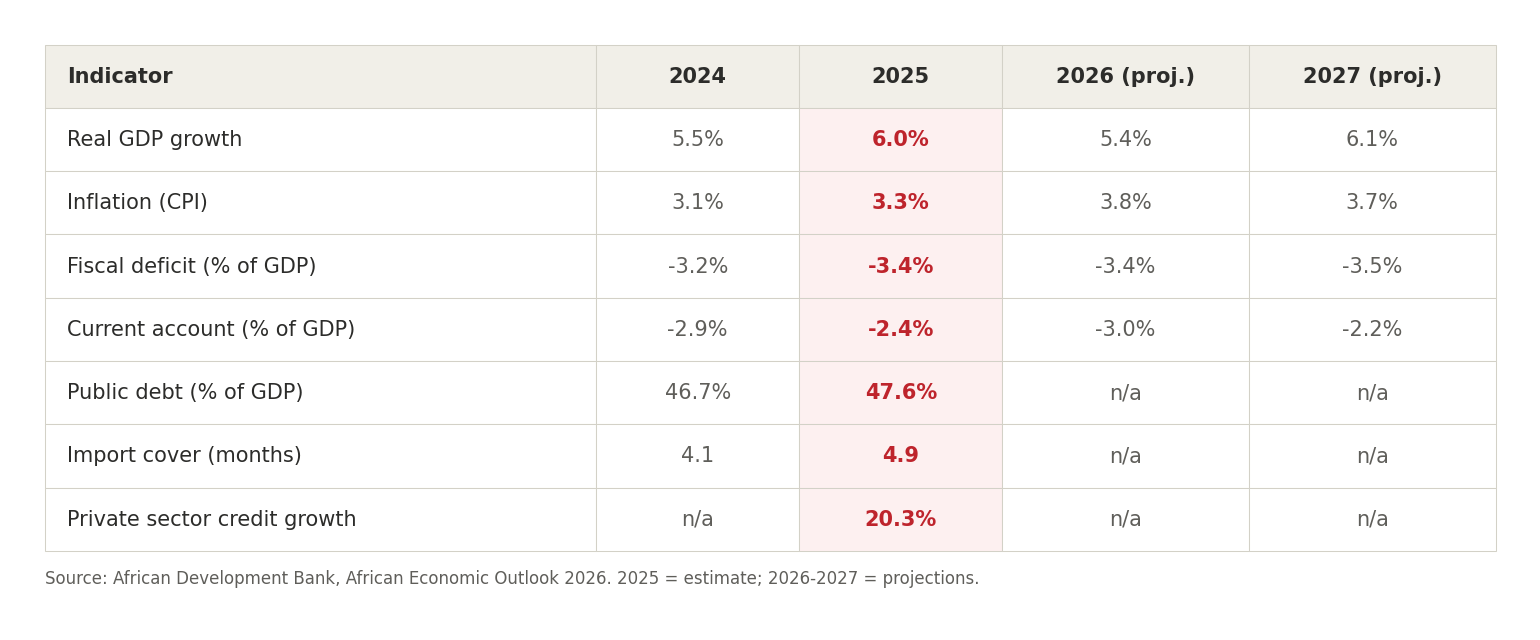
Tanzania’s economy expanded at 6.0% in 2025, up from 5.5% in 2024, according to the African Economic Outlook 2026 released by the African Development Bank (AfDB) in May 2026.
The African Economic Outlook is the AfDB’s flagship annual publication, providing macroeconomic analysis and projections for all 54 African countries.
The report, titled “Mobilizing Africa’s Development Financing at Scale in a Fragmented World,” identifies Tanzania among only six East African economies—alongside Djibouti, Ethiopia, Rwanda, South Sudan, and Uganda—expected to sustain GDP growth above 5.0% in both 2026 and 2027.

Growth in 2025 was driven by agriculture, mining, and construction on the supply side, and by investment and consumption on the demand side.
The AfDB projects Tanzania’s growth to moderate to 5.4% in 2026, primarily due to the effects of the Middle East conflict on supply chains and energy prices, before recovering to 6.1% in 2027 on the back of infrastructure investment and improvements to the business environment.
Inflation remained contained, rising marginally from 3.1% in 2024 to 3.3% in 2025, staying within the Bank of Tanzania’s target range.
The Tanzanian shilling depreciated by just 1.3% in 2025, a marked improvement from 6.3% in 2024, supported by prudent monetary policy and favorable global conditions.
International reserves rose to 4.9 months of import cover in 2025, up from 4.1 months in 2024.

The banking sector performed strongly: private sector credit expanded by 20.3% in 2025, and non-performing loans declined from 4.4% in 2024 to 3.1% in 2025.
The fiscal deficit widened from 3.2% of GDP in 2024 to 3.4% in 2025, driven by election-related and infrastructure spending.
Public debt increased from 46.7% of GDP in 2023 to 47.6% in 2024 but the AfDB assesses it as sustainable, with moderate risk of debt distress.
The current account deficit narrowed from 2.9% of GDP in 2024 to 2.4% in 2025, supported by lower oil prices, higher gold and agricultural exports, and strong tourism earnings.
Inflation is projected to rise slightly to 3.8% in 2026 and 3.7% in 2027 due to global supply chain disruptions, but is expected to remain within the central bank’s target.
The fiscal deficit is projected at 3.4% of GDP in 2026 and 3.5% in 2027, with improved revenue performance and better spending management.
The current account deficit is projected to widen to 3.0% of GDP in 2026 before moderating to 2.2% in 2027, supported by strong non-traditional export performance.
Downside risks cited by the AfDB include the ongoing Middle East conflict, which could raise oil and food prices and disrupt trade supply chains, climate change vulnerabilities, and lingering socio-political tensions.
Tanzania Main Macroeconomic Indicators 2024-2026
Private Investment and Infrastructure
In 2023–24, Tanzania ranked among Africa’s top five countries by number of private infrastructure projects reaching financial closure, closing 8 projects—equal to Senegal and behind only South Africa (20 projects) and Egypt (9 projects).
The AfDB also highlighted its support for a USD 3.2 billion central rail corridor linking Tanzania, the Democratic Republic of Congo, and Burundi as an example of how corridor-based financing structures can mobilize capital across connected assets.
Tanzania has also benefited from blended finance, including de-risking instruments applied to the Standard Gauge Railway syndication, though the AfDB notes that scaling these efforts remains crucial.
Development Finance and Revenue Mobilization
Tanzania’s gross financing needs are estimated at 8.7% of GDP in 2024/25 and are expected to stabilize at 6.3% of GDP in the medium term.
Domestic revenue improved to 16.1% of GDP but remains below regional peers due to a narrow tax base, high informality, limited access to capital markets, and governance risks.
The AfDB identifies key priorities for scaling development financing as: enhancing resource mobilization in the minerals sector, expanding public-private partnerships beyond infrastructure, and leveraging innovative financial instruments.
Formalization through digitalization, private sector-led growth, and improving the business environment to attract non-traditional partners are identified as key drivers.
The financial sector is described as stable but underdeveloped, hindered by low financial literacy and limited financial intermediation.
The Bank of Tanzania’s agenda to modernize payments infrastructure, expand financial inclusion, and facilitate cross-border flows is noted positively, though the AfDB flags that constraints persist.
Tanzania also recorded an improvement in fiscal transparency over the past decade, with its Open Budget Survey score increasing by at least 10 points between 2012 and 2023—one of 10 African countries to achieve that milestone.
An AfDB-supported Tanzania Institutional Support Project for DRM and Natural Resource Governance (2017–25) is highlighted in the report as a successful intervention: it raised the country’s tax-to-GDP ratio from 12.4% to 13.1%, improved port efficiency through the upgraded Tanzania Customs Integrated System (TANCIS)—which increased container scanning capacity fivefold from around 200 to more than 1,000 containers per day—and helped raise the share of foreign direct investment in natural resources from 38% to 58.9%, exceeding the project’s targets.
Nine major natural resource contracts were successfully negotiated under the project.
Social Context
Extreme poverty declined from 41% in 2020 to 35% in 2025, though inequality remains high, with a Gini coefficient of 0.44.
Youth unemployment is estimated at 10.0%, reflecting limited economic opportunities.
The government’s priorities in addressing these challenges include promoting agricultural value chains, investing in human capital, and strengthening social protection.
Regional Perspective: East and Southern Africa
Tanzania’s 6.0% growth in 2025 outpaces the continental average of 4.4% recorded across Africa as a whole, and keeps it firmly within the group of East Africa’s top performers.
East Africa is the fastest-growing region on the continent, with regional GDP growth estimated at 6.6% in 2025.
The AfDB projects this to decelerate to 5.9% in 2026, due to elevated energy and fertilizer prices linked to Middle East supply chain disruptions.
Over 75% of the region’s refined petroleum products and at least 30% of fertilizer imports originate from the Gulf, making East Africa highly exposed to price shocks and reduced supply. Regional growth is then projected to rebound to 6.4% in 2027.
Within East Africa, six countries are expected to sustain GDP growth above 5.0% in both 2026 and 2027: Djibouti, Ethiopia, Rwanda, South Sudan, Tanzania, and Uganda. Tanzania’s projected 5.4% in 2026 and 6.1% in 2027 place it solidly within this group.
Uganda was the strongest performer among Tanzania’s immediate peers in 2025, growing at 6.7%, driven by services and industry. However, Uganda carries a significantly higher fiscal deficit of 6.1% of GDP and public debt of 52.7% of GDP, compared to Tanzania’s 3.4% deficit and 47.6% debt ratio, making Tanzania’s growth profile more fiscally balanced.
Rwanda and Ethiopia are also projected above 5.0% in both years, driven by agriculture, services, exports, and ongoing infrastructure programs.
Compared to Southern Africa, Tanzania’s performance is markedly stronger. South Africa, the region’s largest economy, grew at an estimated 1.2% in 2025, held back by structural constraints including energy shortages, high unemployment, and weak private investment. Tanzania’s growth rate is approximately five times higher.
Tanzania’s inflation at 3.3% in 2025 also compares favorably with several Southern African peers facing higher or more volatile price levels.
On private infrastructure investment, Tanzania closed 8 projects in 2023-24, placing it third in Africa by number of deals, behind South Africa (20) and Egypt (9), and equal to Senegal.
This positions Tanzania well above most African economies, the majority of which closed only 1 or 2 projects in the same period.
Want to know more about the Economy in Tanzania? Our free overview of the Tanzania Business and Investment Guide 2026 covers the Economy, plus key sectors and investment opportunities. The complete 141-page edition includes policies, taxation, key regulations, full macroeconomic data, and sources, and is also available at no cost upon completion of a short form.
Download Free OverviewGet the Full Edition for Free