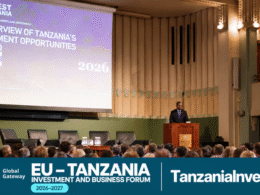

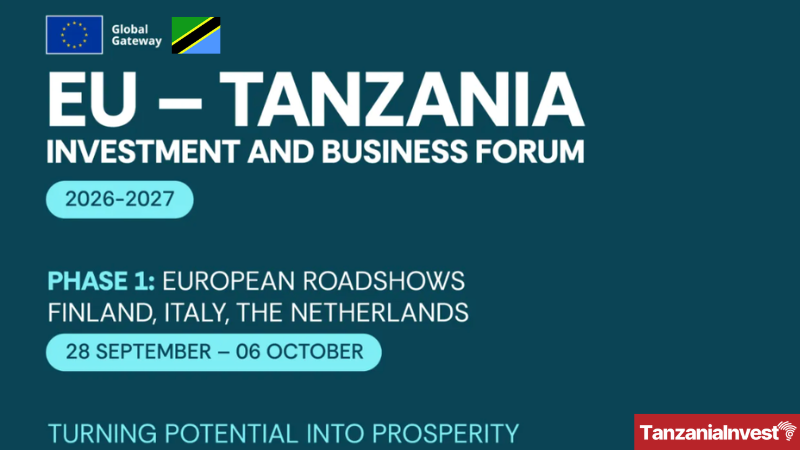
Tanzania and the European Union briefed the private sector in Dar es Salaam on 18 August 2026 on three thematic investment roadshows to Finland, Italy and the Netherlands between 28 September and 6 October 2026.
The roadshows are built around a national pipeline of 68 projects worth a combined USD 30.1 billion, of which USD 29.1 billion remains investable after contracted works are accounted for.
The information session was held at the Julius Nyerere International Convention Centre (JNICC) in Dar es Salaam on 19th August 2026 and was organised by the Department of Economic Diplomacy at Tanzania’s Ministry of Foreign Affairs and East African Cooperation.

The roadshows will focus on investment opportunities in agriculture and agribusiness, critical mineral value chains, and digital innovation and fintech, with renewable energy and transport and logistics featured as cross-cutting enabling sectors across all three legs.
The national pipeline behind the roadshows comprises 68 named projects and project portfolios across five sectors, three of them priority sectors and two enabling, with each European leg carrying roughly 25 named opportunities split ten-ten-five between the two priority sectors and the enabling sector.
Tanzania’s pitch to European investors rests on being among the five fastest-growing economies in Africa, holding more than 40 commercially significant mineral types, counting more than 55 million registered mobile-money accounts, and having nearly doubled its GDP over the past decade to close to USD 90 billion.
The country also positions itself as a regional logistics hub, serving six landlocked neighbouring countries through its expanding transport corridors and ports.
Finland: Helsinki, 28–29 September 2026

The first roadshow will take place at Pörssitalo in central Helsinki on 28 and 29 September 2026, focusing on critical minerals and mining technology, ICT and digitalisation, and renewable energy as an enabling sector.
Finland will showcase its integrated lithium value chain through the Keliber project, which covers activities from mining to the production of battery-grade lithium hydroxide, alongside its expertise in mineral exploration, processing, circular economy solutions and industrial digitalisation.
The EU’s Critical Raw Materials Act, which caps dependence on any single third country at 65% and targets 40% of EU processing capacity by 2030, underpins the commercial logic of the Helsinki leg by requiring Europe to diversify its mineral sourcing and processing base.
Tanzania will present its graphite deposits at Mahenge, Nachu, Lindi Jumbo and Epanko as candidates for European battery-anode supply chains, alongside nickel, copper and cobalt at Kabanga with the associated Kahama refinery, rare earths at Ngualla, and helium in the Rukwa Basin.
The second day of the Helsinki leg is reserved for site visits to Finnish minerals operations and technology providers, giving delegates a first-hand look at the country’s mining and processing capacity.
Italy: Cesena, Emilia-Romagna, 1–2 October 2026
The second roadshow will take place at the Cesena Fiera Congress Centre in Emilia-Romagna on 1 and 2 October 2026, focusing on agri-food, agricultural mechanisation and digital innovation.
Cesena hosts Macfrut, a leading international fruit and vegetable trade fair, and sits near the Emilia-Romagna Data Valley and the Bologna Tecnopolo, giving the leg a base in both agricultural and digital expertise.
Coffee will be a central theme, with about 40% of Tanzania’s crop already exported to Europe and Italy standing as the largest Arabica-roasting market on the continent, while rice production of 2.1 million MT and rising also features.
The EU-TCB geo-localisation programme has extended EU Deforestation Regulation (EUDR) traceability readiness to roughly half of Tanzania’s coffee farmers, while cashew and rice remain outside the regulation’s scope.
Italy’s engagement is linked to the Mattei Plan for Africa, under which Tanzania has been a focus country since January 2025.
The Plan is a EUR 5.5 billion strategic initiative launched to shift relations from traditional aid to a non-predatory, investment-driven partnership focused on energy, infrastructure, and agriculture, to boost local economic development
A commercial relationship is already in place, built on Italian export credit agency financing for the Standard Gauge Railway (SGR) Lots 1 to 4 and a rail memorandum of understanding that FS Engineering is finalising with the Tanzania Railways Corporation (TRC).
Netherlands and Belgium: The Hague, 5–6 October 2026
The third roadshow will take place in The Hague on 5 and 6 October 2026, with a field visit to the Port of Antwerp in Belgium, focusing on agriculture, horticulture, coffee, cashew, and transport and logistics.
Agriculture accounts for about 23.7% of Tanzania’s GDP and employs roughly 60% of the population, underpinning the leg’s focus on strengthening value chains and export logistics to European markets.
The Belgian and Dutch development agencies Enabel and the Netherlands Development Organisation (SNV) will run a dedicated session on the cashew and coffee value chains during the leg.
The Dar es Salaam port already involves cooperation between the EU, Enabel, UN-Habitat, TradeMark Africa and Port of Antwerp-Bruges International alongside the Tanzania Ports Authority (TPA), and delegates will visit the Port of Rotterdam and the Port of Antwerp to see comparable logistics operations in practice.
Registration and the Investment Wall
Companies register for the roadshows individually, in their own name, on the EU event platform at community.eu-africabusinessforum.eu/event/eu-tanzania-business-forum, a process separate from submitting a project for consideration on the Investment Wall.
Project proposals for the Investment Wall, the curated pipeline shown to European investors and financiers, are submitted through a separate form at research.net/r/JNPYYM8 by 1 September 2026, while all participating company profiles must be finalised on the matchmaking platform by 12 September 2026.
There is no participation fee for the roadshows, but companies cover their own travel and accommodation costs, with EU logistical support limited to the official 33-person delegation.
Registration is an expression of interest rather than a guarantee of participation, with final confirmation issued by email after a selection review.
Project Selection and Roadshow Targets
Submitted projects are assessed against two tests applied by a Pipeline Review Panel chaired by the Tanzania Investment and Special Economic Zones Authority (TISEZA).
The first test, bankability, covers a named sponsor, defined capital cost and structure, revenue path, regulatory and licensing status and a precise financing ask.
The second test, strategic relevance, covers alignment with EU and Tanzanian policy priorities, inclusion and sustainability, and the project’s replicability and scale.
The EU has outlined six ways European companies can engage with Tanzanian projects beyond direct equity, including offtake and trading agreements, technology supply, services and engineering procurement and construction (EPC) contracts, supply-chain integration, and joint ventures.
The roadshows’ organisers have set targets of more than 300 qualified European investors and companies engaged across the three legs and more than 250 structured business-to-business meetings.
They also aim for more than 30 credible expressions of interest, with 15 expected to reach due diligence within three months, and more than six memoranda of understanding or letters of intent signed on site.
They also aim to have more than 100 European investors confirmed to travel to Dar es Salaam for the 2027 edition of the Forum.
The Director of Investment Facilitation at TISEZA, James Maziku, said: “The success of these road shows will not be measured by the number of meetings held or presentations delivered. It will be measured by the partnerships and investment commitments secured and projects successfully implemented.”
He urged Tanzanian companies and project developers to submit commercially viable proposals supported by reliable financial information, clear ownership structures, realistic implementation plans and evidence of markets.
He added that successful investment promotion depends fundamentally on the quality of project preparation done well in advance of the roadshows.
The Director of Economic Diplomacy at MFAEAC, Ambassador John Ulanga, stated: “we are inviting you with pride that EU is collaborating with Tanzania to conduct an investment project show with an aim of one attracting investment but number two serving as a prelude to an activity that is going to happen in February next year which is EU Tanzania business forum.”
The Head of Cooperation and Chargé d’Affaires of the EU Delegation to Tanzania, Marc Stalmans, said that the EU had approved a new EUR 156 million set of actions for Tanzania based on mutual economic interests.
“It’s quite clear, we are back on business and we are here to re-establish an economical partnership with Tanzania,” Stalmans added.
The Deputy Head of Mission at the Embassy of Finland, Tomi Lounio, noted: “Our objective is concrete followup. We’re not looking simply for presentations or discussions that end when the seminar closes. We want to identify credible projects, connect the right partners and help move opportunities towards investment and implementation.”
The Deputy Head of Mission at the Embassy of Italy, David Lorenzini, explained: “Italy has a lot of experience in agribusiness more widely such as for instance safe storage systems, cold chain, transport of crops, adding value and then exporting the crops. So basically a lot of Italian investors are already looking to invest also in these sectors which are complimentary to the agriculture.”
He highlighted that Italy’s focus on agri-food, agricultural mechanisation, technological innovation and digital sustainability is aligned with Tanzania’s development priorities.
The Deputy Head of Mission at the Embassy of the Netherlands, Onno Koopmans, said: “I would like to emphasize that the goal of this road show is to transform partnership into tangible investment, and investments into jobs created.”
The EU-Tanzania Investment and Business Forum
The roadshows form the first movement of the second edition of the EU-Tanzania Investment and Business Forum, which follows the inaugural forum held in 2023.
They sit within the EU’s Global Gateway strategy, which aims to mobilise up to EUR 300 billion in investment worldwide between 2021 and 2027 for digital connectivity, clean energy, transport and supply-chain resilience.
Global Gateway is delivered through a “Team Europe” approach that coordinates the EU institutions, member states and their financial and development institutions rather than individual bilateral programmes, which is why Finland, Italy, the Netherlands and Belgium are hosting the three legs on behalf of the wider EU effort.
The roadshows are also sequenced with the Tanzania Mining Summit in November 2026 and Mining Indaba in Cape Town in February 2027, both aimed at keeping the national project pipeline visible to global mining capital ahead of the 2027 Dar es Salaam forum.
Want to know more about Trade in Tanzania? Our free overview of the Tanzania Business and Investment Guide 2026 covers Trade, plus key sectors and investment opportunities. The complete 141-page edition includes policies, taxation, key regulations, full macroeconomic data, and sources, and is also available at no cost upon completion of a short form.
Download Free OverviewGet the Full Edition for Free