The Minister of Finance, Hon. Dr. Mwigulu Lameck Nchemba, presented the guidelines for the Tanzanian national budget 2024/25 to the parliament in Dodoma on 6th November 2023.
The government plans to collect and utilize a total of TZS 47.424 trillion (about USD 19 billion) during the 2024-2025 period.
This is an increase of about 6.8% from TZS 44.4 trillion allocated in the 2023/24 national budget.

Domestic revenues are forecasted to reach TZS 34.436 trillion, accounting for 72.6% of the entire budget.
Development Partners are expected to contribute TZS 4.291 trillion, representing 9% of the budget.
The government’s borrowing strategy includes TZS 6.141 trillion from domestic markets and TZS 2.555 trillion from external markets.
The budget reflects the government’s response to economic trends, global economic conditions, and internal revenue enhancement strategies.
Allocations for public debt stand at TZS 12.101 trillion, salaries at TZS 11.774 trillion, and government operations at TZS 8.223 trillion.

Development programs and projects, including education and higher education loans, are earmarked TZS 15.325 trillion.
The budget takes into account the financing of public debt, salaries, operational costs of completed projects, local government elections, and the 2025 General Elections preparations.
The economic underpinnings include private sector investment growth, disaster resilience, global economic recovery, market stability, ongoing development projects, food sufficiency, and national peace and stability.
The budget projects Tanzania’s GDP growth at 5.2% for 2023, rising to 5.8% in 2024.
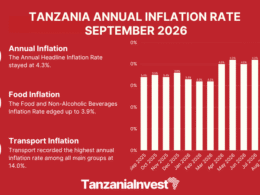
Inflation is expected to remain within a single-digit average of 3.0% to 7.0%, with tax revenue projected to reach 12.4% of GDP by 2024/25.
The budget deficit is forecasted to decrease to 2.2% of GDP in 2024/25 from an expected 2.7% in 2023/24.
Foreign currency reserves are projected to cover over four months of import needs, indicating an improvement in social welfare indicators.
The parliament’s discussion on the Budget Guidelines Proposal for the Government for the fiscal year 2024/25 is scheduled for a five-day session that started on 6th November 2023.
Want to know more about the Economy in Tanzania? Our free overview of the Tanzania Business and Investment Guide 2026 covers the Economy, plus key sectors and investment opportunities. The complete 141-page edition includes policies, taxation, key regulations, full macroeconomic data, and sources, and is also available at no cost upon completion of a short form.
Download Free OverviewGet the Full Edition for Free