


The International Monetary Fund (IMF) Executive Board has completed the second review of Tanzania’s Extended Credit Facility (ECF) Arrangement, leading to an immediate disbursement of approximately USD 150.5 million for budget support.
This decision follows the approval of the ECF Arrangement in July 2022, which provided Tanzania with a total access of about USD 1,046.4 million.
The recent disbursement brings Tanzania’s total access under the arrangement to approximately USD 455.3 million.

The ECF Arrangement aims to support Tanzania’s economic recovery, maintain macro-financial stability, and promote sustainable and inclusive growth.
Tanzania’s economic reform program, under the ECF Arrangement, is largely on track, with most end-June 2023 quantitative performance criteria and indicative targets met.
The program focuses on strengthening fiscal space, enhancing the monetary policy framework, strengthening financial sector supervision, and advancing structural reforms.
Economic growth in Tanzania is expected to pick up from 2023, despite facing challenges from the global economic environment.
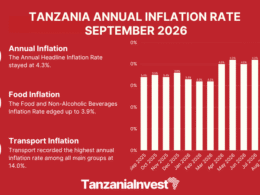
Inflation has moderated and is within the target range of the Bank of Tanzania.

However, the fiscal deficit was wider than expected in FY2022/23, mainly due to shortfalls in revenue collections.
Mr. Li, Deputy Managing Director and Acting Chair of the IMF, stated, “Tanzania’s ECF-supported program focuses on strengthening the economic recovery, preserving macroeconomic stability, and supporting sustainable and inclusive growth.”
He emphasized the importance of fiscal consolidation, enhancing domestic revenue mobilization, and improving spending efficiency.
Mr. Li also highlighted the need for a coordinated macroeconomic policy response to address foreign exchange market pressures.
The ECF Arrangement for Tanzania was approved to support the country’s efforts in economic recovery and stability.
It represents a significant commitment by the Tanzanian authorities to implement reforms aimed at achieving sustainable and inclusive growth.
Want to know more about the Economy in Tanzania? Our free overview of the Tanzania Business and Investment Guide 2026 covers the Economy, plus key sectors and investment opportunities. The complete 141-page edition includes policies, taxation, key regulations, full macroeconomic data, and sources, and is also available at no cost upon completion of a short form.
Download Free OverviewGet the Full Edition for Free