

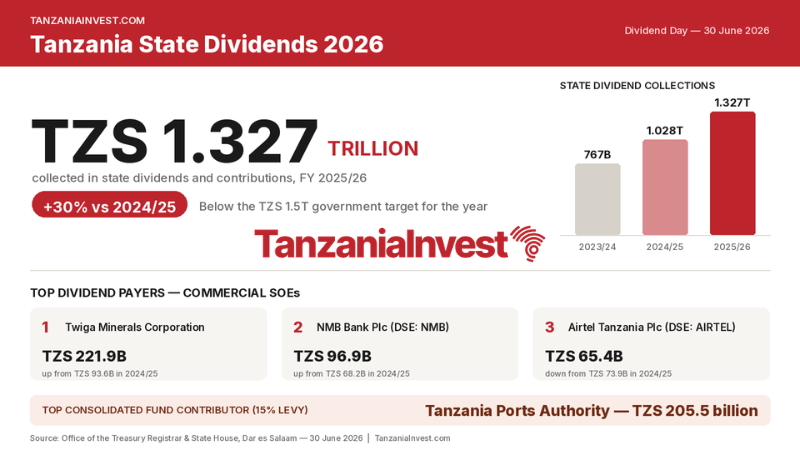
Tanzania collected TZS 1.327 trillion in state dividends and contributions from state-owned enterprises and minority-held companies in the 2025/26 financial year, a 30% increase from the TZS 1.028 trillion collected in 2024/25, though below the TZS 1.5 trillion target the government had set for the year.
The Office of the Treasury Registrar (OTR) presented the figure to President Samia Suluhu Hassan at the 2026 Dividend Day ceremony held at State House in Dar es Salaam on 30th June 2026.
The event was themed “Results-Based Public Investment: A Pillar for a Competitive Economy and Sustainable Development Towards Vision 2050.”

The OTR oversees 308 public institutions and companies in which the government holds shares, with a combined investment portfolio worth TZS 92.3 trillion, up from TZS 86.29 trillion in 2024 and TZS 65 trillion in 2020.
Fourteen of the 308 institutions were recognised for outstanding performance in dividend payments and contributions to the Government Consolidated Fund.
Of the TZS 1.327 trillion collected, TZS 800.5 billion (60%) came from dividends paid by profit-making commercial public corporations and companies.
TZS 406 billion (30%) came from the statutory 15% levy on gross revenue paid by non-commercial public institutions.
The remaining TZS 121.5 billion (10%) came from other investment-related income, including investment returns and other contributions.

This composition differs from 2024/25, when dividends accounted for 59% of total collections, the 15% gross-revenue levy for 35%, and other sources for 6%.
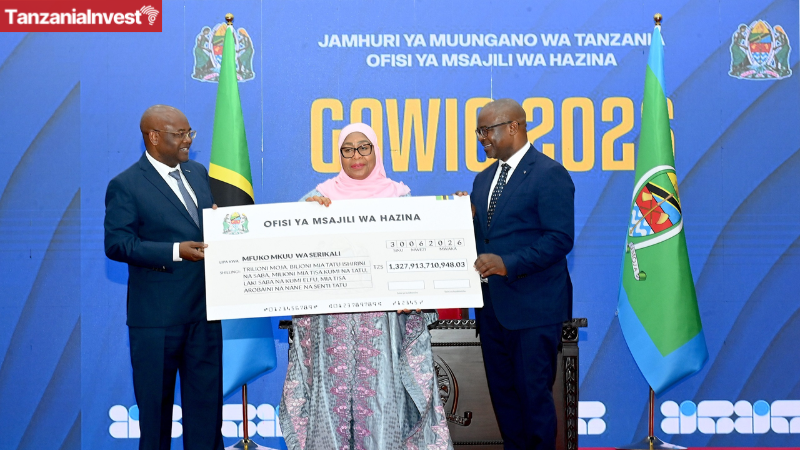
Treasury Registrar Nehemiah Mchechu said the TZS 1.327 trillion collected as of 29 June 2026 represents an increase of approximately TZS 300 billion over the TZS 1.028 trillion presented to the President in 2024/25.
Among commercial state-owned enterprises, the number paying dividends of TZS 10 billion or more rose from six to ten year-on-year, with total dividends from this group increasing from TZS 267 billion to TZS 481.5 billion.
The top three dividend payers were Twiga Minerals Corporation (TZS 221.9 billion), NMB Bank Plc (DSE: NMB) (TZS 96.9 billion), and Airtel Tanzania Plc (DSE: AIRTEL) (TZS 65.4 billion).
Twiga Minerals more than doubled its dividend from the TZS 93.6 billion it paid in 2024/25, when it was already the top payer.
NMB Bank’s dividend rose from TZS 68.2 billion in 2024/25, while Airtel Tanzania’s dividend declined from TZS 73.9 billion over the same period.
Among institutions contributing to the Government Consolidated Fund through the 15% statutory levy, the number paying TZS 10 billion or more rose from seven to eleven, with total contributions from this group increasing from TZS 305 billion to TZS 431.4 billion.
The leading contributors in this category were the Tanzania Ports Authority (TZS 205.5 billion), the National Identification Authority (TZS 61 billion), and the Tanzania Communications Regulatory Authority (TZS 42.8 billion).
The Tanzania Ports Authority’s contribution rose from TZS 181.1 billion in 2024/25, and NIDA’s contribution increased from TZS 38.8 billion over the same period.
The TZS 1.327 trillion result falls short of the TZS 1.5 trillion target President Samia set for 2025/26 during last year’s Dividend Day ceremony, though it still marks a second consecutive year of growth following the 68% increase recorded in 2024/25.
President Samia said institutions should be assessed on the productivity of their investments, the quality of service delivery, financial sustainability, and their contribution to the national economy, not on dividend size alone.
“We cannot build a competitive economy with institutions that operate by routine. We need institutions that are measured by results, not by statistics alone,” she said.
She added that institutions which failed to pay dividends, paid less than expected, or recorded a decline compared to the previous year should be evaluated to determine the reasons and appropriate corrective measures.
On the outlook for the new National Development Vision 2050, which took effect on 1 July 2026, President Samia said: “The implementation of Dira 2050 requires institutions that are capable of competing. Institutions that continue to underperform must be fixed so that we move forward together.”
Minister of State for Planning and Investment Prof. Kitila Mkumbo attributed the results to the government’s ongoing reform agenda.
“We are witnessing the positive impact of her reform agenda through the 4Rs philosophy, not only in public institutions but also in the private sector,” Mkumbo said.
Treasury Registrar Mchechu said the increase reflects ongoing operational, managerial, and administrative reforms aimed at enhancing productivity, accountability, and efficiency across public institutions.
“These results demonstrate that efforts to strengthen the management of public assets and ensure that government investments generate greater value for the nation are continuing to produce positive outcomes,” he said.
President Samia also received a Special Award titled “Champion of Reforms in Strengthening Public Enterprise Governance for Inclusive Development and National Prosperity – Dividend Day 2026,” in recognition of her leadership in public investment management.
Dividend Day was institutionalised in 2023 as an annual mechanism to assess the financial performance of Tanzania’s state-owned enterprises and minority-held companies and benchmark their contributions to national revenue.
The OTR manages government ownership through two categories: Public and Statutory Corporations (PSCs), where the state holds majority or full ownership, and Minority Interests (MIs), where it holds partial shares, with both held in trust for the President.
Government dividend collections have grown steadily since the mechanism was introduced, rising from TZS 767 billion in 2023/24 to TZS 1.028 trillion in 2024/25 and TZS 1.327 trillion in 2025/26, a trajectory that has yet to reach the TZS 1.5 trillion the government targeted for this year.
Want to know more about the Economy in Tanzania? Our free overview of the Tanzania Business and Investment Guide 2026 covers the Economy, plus key sectors and investment opportunities. The complete 141-page edition includes policies, taxation, key regulations, full macroeconomic data, and sources, and is also available at no cost upon completion of a short form.
Download Free OverviewGet the Full Edition for Free