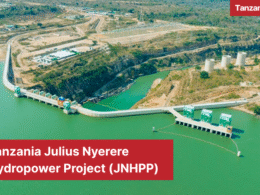


On 25th February 2024, Tanzania’s Deputy Prime Minister and Minister of Energy, Dr. Doto Biteko, announced the operational commencement of the Julius Nyerere Hydropower Plant (JNHPP).
The project, with a capacity of 2,115 megawatts, has initiated operations by injecting 235 megawatts into Tanzania’s national grid.
Dr. Biteko explained that new power injection significantly improves the country’s electricity supply, reducing shortages by over 85%.

He also revealed ongoing plans to further boost power generation. By March 2024, an additional 235 megawatts will be added to the grid, bringing the total injected capacity by JNHPP to 470 megawatts and providing a surplus of 70 megawatts for the country.
Dr. Biteko also acknowledged the Fifth Phase Government under the late Dr. John Pombe Magufuli for initiating the project in 2018.
He emphasized that the project’s implementation does not diminish the Ministry of Energy and its institutions’ focus on other projects.
Efforts continue to develop new projects, including the Rumakali (222MW) and Ruhudji (358MW) hydropower projects, the geothermal projects in Ngozi and Kiejo-Mbaka, and the Kishapu solar power project (150MW).
For his part, Tanzania’s Minister of Water, Mr. Jumaa Aweso, provided insights into the water management aspects of the JNHPP, highlighting efforts to optimize reservoir levels for electricity generation while maintaining ecological balance.

The Regional Commissioner of Pwani, Abubakar Kunenge, underscored the strategic importance of the JNHPP in driving industrialization and economic growth in the region.
With a projected capacity of 2,115 megawatts, JNHPP is the biggest hydroelectric project in both Tanzania and all of Africa and will be able to produce 5,920 GWh of power annually.
Want to know more about Energy in Tanzania? Our free overview of the Tanzania Business and Investment Guide 2026 covers Energy, plus key sectors and investment opportunities. The complete 141-page edition includes policies, taxation, key regulations, full macroeconomic data, and sources, and is also available at no cost upon completion of a short form.
Download Free OverviewGet the Full Edition for Free