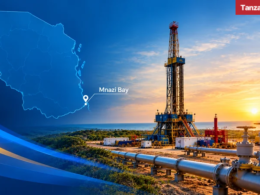




Wentworth Resources Limited (OSE:WRL), a Norwegian energy company focused in Tanzania and Mozambique, has recently announced that a first gross payment of USD 3.8 million has been received from Tanzania Petroleum Development Corporation (TPDC) for sales gas volumes to the Tanzanian new transnational pipeline in October, 2015.
Wentworth, one of the exploration partners together with French Maurel & Prom Group of the Mnazi Bay concession in Mtwara in Tanzania’s southern coastal region, delivered to Madimba Processing Centre, the 532 km pipeline from Mtwara to Dar es Salaam and the Kinyerezi Gas Receiving Facility, a total of 1,032 million square cubic feet (mmscf) at a rate of 33 mmscf per day in last October.
The production volume came from the operation of three out of five wells at Mnazi Bay which are operated under a restricted flow basis but that are expected to reach the 80 mmscf when all wells are fully operated by Q1-2016.

The first payment is the result of a gas supply agreement signed in September, 2014 between the Government of Tanzania and both exploration partners that aimed at double the country’s power generation capacity to 3,000 Mw by 2016 according to Reuters.
The agreement establishes the option for Gas Supply Limited Company (GASCO), the state-run operator of the Madimba Processing Centre, to raise the demand of gas to a maximum of 130 mmcf per day for a period up to 17 years at a locked price of USD 3.00 per million British Thermal Unit (BTU) or USD 3.07 per thousand cubic feet.
Wentworth and Maurel & Prom are satisfied with the pipeline system work and are confident that their existing wells will meet future demand at higher daily delivery rates to support cost reduction and improving reliability of power generation in the country, explained Wentworth Managing Director Geoff Bury.
Mnazi Bay’s partnership is meant to shift the current power generation sector from hydro to gas fired power plants due to recent longer droughts that are hitting the country and constraining water availability for power generation.
Currently in Tanzania 37.4% of the energy generated comes from hydro plants while 31% comes from gas fired ones according to Tanzanian Energy and Water Regulatory Authority (EWURA).

According to the Wall Street Journal, Tanzania is planning to use its now 55 trillion cubic feet natural gas reserves to boost its electricity sector and be less-dependent from oil imports, a movement that would help the country to save USD 1 billion on crude imports a year.
Want to know more about Energy in Tanzania? Our free overview of the Tanzania Business and Investment Guide 2026 covers Energy, plus key sectors and investment opportunities. The complete 141-page edition includes policies, taxation, key regulations, full macroeconomic data, and sources, and is also available at no cost upon completion of a short form.
Download Free OverviewGet the Full Edition for Free