

Inflation
Inflation in Tanzania in 2026
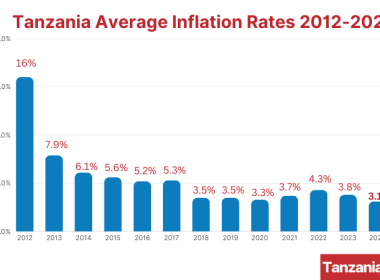
Tanzania's inflation rate has declined significantly over the past decade, falling from a peak of 16% in 2012 to a record low of 3.1% in 2024, before rising to 4.2% in May 2026, driven by a sharp surge in transport and fuel costs.
Tanzania Inflation Rate Trends January–May 2026
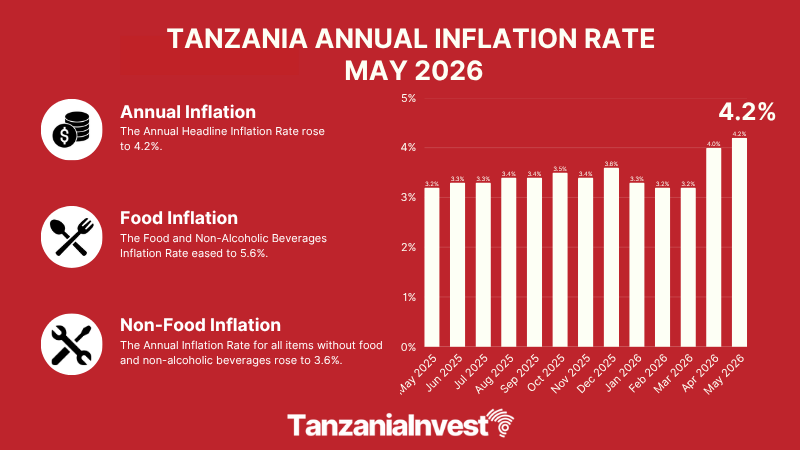
Tanzania's inflation rate remained stable in the first quarter of 2026, holding between 3.2% and 3.3%, before accelerating sharply to 4.0% in April and 4.2% in May 2026, driven by fuel price increases that pushed transport inflation to 11.9%.
In January 2026, annual headline inflation stood at 3.3%, with food inflation at 5.7%, driven by price increases in fresh cassava, Irish potatoes, and finger millet grains.
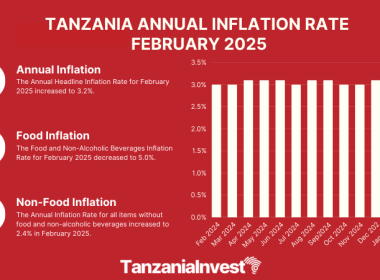
In February 2026, headline inflation eased to 3.2%, as food inflation held at 5.7% while non-food inflation declined slightly to 2.1%.
In March 2026, headline inflation remained at 3.2%, with food inflation easing to 5.5% from 5.7% the prior month. Core inflation edged up marginally to 2.2%.
April 2026 marked a sharp acceleration, with headline inflation jumping to 4.0% from 3.2% in March. Transport inflation reached 9.2%, driven by fuel price increases, while food inflation rose to 5.7%.
In May 2026, headline inflation rose further to 4.2%, the highest rate recorded in the January 2025 to May 2026 period. Transport inflation surged to 11.9% year-on-year, with diesel prices up 13.8% and petrol up 10.4% on a monthly basis. Food inflation eased slightly to 5.6%, while core inflation rose to 3.4%, signaling broadening price pressures beyond volatile food and energy categories. The IMF projects Tanzania's inflation at 4.7% for the full year 2026.
Tanzania Inflation Rate in 2025
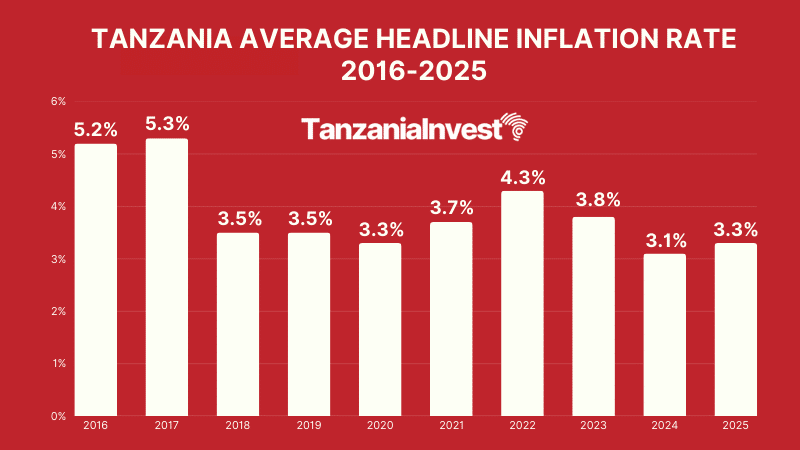
In 2025, Tanzania's average annual headline inflation was 3.3%, up from 3.1% recorded in 2024.
Monthly headline inflation fluctuated between 3.1% in January 2025 and 3.6% in December 2025, remaining within the Bank of Tanzania (BOT) target range of 3% to 5% throughout the year.
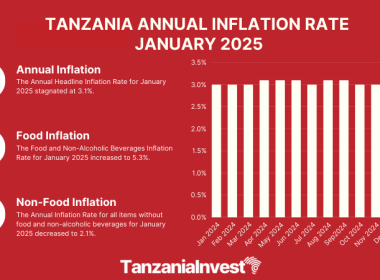
Inflation held at 3.1% in January, rose to 3.2% in February and 3.3% in March, before easing back to 3.2% in April and May. It then edged up through the second half of the year: 3.3% in June, 3.3% in July, 3.4% in August, 3.4% in September, 3.5% in October, 3.4% in November, and 3.6% in December.
Food inflation was the primary driver of price pressures throughout the year, averaging above 5% for most months, before declining sharply to 2.1% as a full-year average due to strong agricultural output supported by government interventions.
Core inflation increased to 3.4% in 2025 from 2.3% observed in 2024, reflecting rising underlying price pressures outside volatile food and energy categories.
Tanzania Inflation Rate in 2024
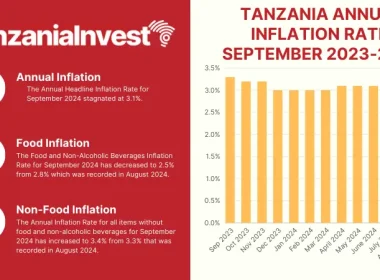
In 2024, Tanzania's average annual inflation was 3.1%, significantly lower than the 3.8% recorded in 2023, 4.4% in 2022, and 3.7% in 2021.
The decrease in the average annual headline inflation rate in 2024 was mainly contributed by the decrease in inflation for food items between 2023 and 2024, since the group has the largest share (28.2%) in the CPI basket. The annual average inflation rate for food items decreased to 2.1% in 2024 from 6.8% recorded in 2023.
Strategic interventions carried out by the Government in the agriculture sector resulted in increased food production, improved food supply, and enhanced availability and affordability of food.
However, core inflation increased to 3.4% in 2024 from 2.3% observed in 2023.
The overall index went up to 116.87 in December 2024 from 113.34 recorded in December 2023.
Bank of Tanzania Monetary Policy and Inflation Target
The objective of the Bank of Tanzania (BOT) monetary policy is an inflation rate of 5% in the medium term, consistent with the East African Community (EAC) and Southern African Development Community (SADC) convergence criteria of a ceiling of 8% and a range of 3–7%, respectively.
This inflation target is considered appropriate to support the economy's sustainable growth.
In January 2024, BOT announced a transition to an interest rate-based monetary policy, moving away from the previous focus on controlling the money supply and aligning Tanzania's economic management with regional practices and international standards.
In April 2026, the BOT Monetary Policy Committee (MPC) maintained the Central Bank Rate (CBR) at 5.75% for Q2 2026, citing a cautious policy stance to balance inflation risks against economic growth in the context of geopolitical tensions in the Middle East, while also noting that inflation is expected to remain within the 3% to 5% target range in Q2 2026. Read more: BOT Q2 2026 Monetary Policy.
Latest update: June 2026
Sources: Bank of Tanzania (BOT), National Bureau of Statistics (NBS), International Monetary Fund (IMF).
Want to know more about Inflation in Tanzania? Our free overview of the Tanzania Business and Investment Guide 2026 covers Inflation, plus key sectors and investment opportunities. The complete 141-page edition includes policies, taxation, key regulations, full macroeconomic data, and sources, and is also available at no cost upon completion of a short form.
Download Free OverviewGet the Full Edition for Free