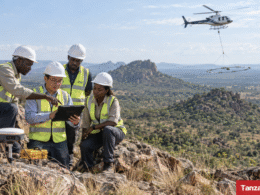




Noble Helium Limited (ASX:NHE) has recently confirmed exceptional helium concentrations at its Mbelele prospect within the North Rukwa Project in Tanzania.
Laboratory testing has revealed helium concentrations of 2.46%, a figure that significantly surpasses global averages and marks a promising development for the helium industry.
The Mbelele prospect’s lab results have not only confirmed the high helium concentrations but have also indicated a substantial increase in the net reservoir size.

The full section net reservoir at Mbelele-1 has expanded over threefold to 148 meters, and nearly doubled to 271 meters at Mbelele-2, following a comprehensive whole wellbore petrophysics analysis.
Additionally, the presence of hydrogen shows, up to 1,500 times the background level, has been consistently observed for the upper 350 meters of Mbelele-2, presenting a potential new avenue for exploration alongside helium.
Noble Helium’s Chairman, Mr. Shaun Scott, highlighted the significance of these findings, stating that the Mbelele structure hosts very good helium concentrations within thick, porous, permeable, and stacked reservoirs.
The company is now focused on pursuing low-cost testing, production, and development technologies to capitalize on this opportunity.
The results are particularly notable when compared to global helium concentrations, with Mbelele’s 2.46% concentration being more than seven times higher than the United States average of 0.35%. This places the North Rukwa Project in a favorable position relative to other helium projects worldwide.

The company has secured funding to complete all required appraisal work, which includes the additional appraisal of the Mbelele structure to sample and flow-test the gas cap and conduct a pilot program to test the helium-enriched fluids in the deeper reservoirs.
The unexpected discovery of significant hydrogen potential adds another layer of value to the project, with plans to sample and test this aspect as part of the appraisal program.
The next steps for Noble Helium include upgrading resource estimates and testing the potential gas cap at Mbelele-1 and flow testing Lake Beds reservoirs encountered in both Mbelele-1 and Mbelele-2. These efforts will inform updates to reservoir models and resource estimates, crucial for the company’s early monetization strategy.
Collaboration with the University of Queensland Centre for Natural Gas aims to apply very low-cost drilling technologies for an ultra-low-cost flow testing system, enabling comprehensive analysis in real-time to shorten project timelines.
In parallel, commercial negotiations are ongoing to secure a leased plant and offtake agreement, further advancing the project toward production.
The Rukwa Helium Project
Rukwa is a large-scale, high-grade, primary helium project covering an area of approximately 3,590 km2 in southwestern Tanzania with the potential to become a strategic asset in resolving a supply-constrained market.
The North Rukwa project boasts a potential helium resource of 176 billion cubic feet, making this the largest known primary helium resource in the world, and positioning this Tanzanian region as a potential major source of helium globally.
Helium is indispensable in various applications, from hospital MRI machines to components in electronics and space missions.
Want to know more about Mining in Tanzania? Our free overview of the Tanzania Business and Investment Guide 2026 covers Mining, plus key sectors and investment opportunities. The complete 141-page edition includes policies, taxation, key regulations, full macroeconomic data, and sources, and is also available at no cost upon completion of a short form.
Download Free OverviewGet the Full Edition for Free