
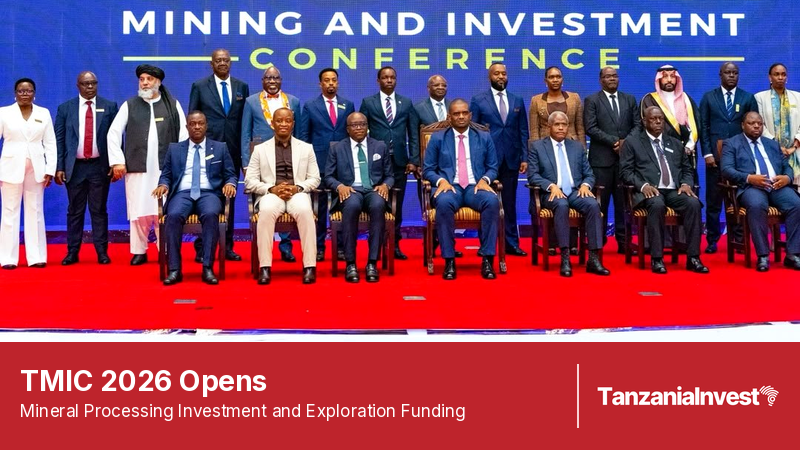
The Tanzania mining conference 2026 opened with the Government inviting local and foreign investors to invest across the mineral value-addition chain, including gold refining, nickel and copper processing, heavy mineral sands and ferro-niobium.
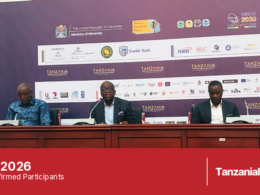
The Vice President of Tanzania, Deogratius Ndejembi, officially opened the seventh Tanzania Mining and Investment Conference (TMIC) on 19 November 2026 at the Julius Nyerere International Convention Centre (JNICC) in Dar es Salaam, on behalf of the President, Samia Suluhu Hassan.
The conference, organised by the Ministry of Minerals and the Tanzania Chamber of Mines (TCM) under the theme “Value-Added Minerals: The Engine of Industrialization and Economic Growth”, runs until 21 November and recorded its highest registered attendance in seven editions, with more than 1,700 participants, according to the Minister for Minerals, Anthony Mavunde.

Table of Contents
- Mining Revenue and Exploration Funding
- Gold Refining, Nickel and Copper Processing, Heavy Mineral Sands, Niobium, Salt and Gemstone Plants
- Nickel Project and Warning Against Idle Licences
- Gold Incentives, Central Bank Purchases, and Sengerema Mine
- Small-Scale Miners: Bank Lending, Survey Services, and Power Supply
- Local Content and Youth and Women Inclusion
- Afternoon Sessions on Gold Mining and Critical Minerals
Mining Revenue and Exploration Funding
Mavunde said the mining sector contributes 10.3% of GDP, with mineral exports of USD 5.40 billion this year and revenue paid into the Government’s consolidated fund of TZS 1.393 trillion (± USD 528 million) in 2025/26, compared with TZS 161 billion (± USD 61 million) a decade earlier.
Collections of TZS 555 billion (± USD 210 million) by the morning of 19 November reached 115% of the TZS 483 billion (± USD 183 million) expected for the first four months of 2026/27, against an annual target of TZS 1.4 trillion (± USD 530 million).
Geological mapping covers 97% of the country, geochemical surveys 24% and high-resolution airborne geophysical surveys only 16%, Mavunde noted, while Ndejembi said the Government has approved allocating 10% of mining revenue to the Mineral Survey Fund to finance exploration.
Gold Refining, Nickel and Copper Processing, Heavy Mineral Sands, Niobium, Salt and Gemstone Plants
Ndejembi urged local and foreign investors to invest across the entire mineral value-addition chain, including modern technology, and said the Government will cooperate with any investor setting up plants that process Tanzanian minerals into final products.
Mavunde presented the plants built under the Mining Act, Chapter 123, which Ndejembi said the Government will keep enforcing. “Not a single stone will leave the country without being processed, refined, or smelted,” Mavunde stressed.

He explained that Tanzania has eight gold refineries producing at 999.9 purity, with the Geita Gold Refinery in the final stage of accreditation by the London Bullion Market Association (LBMA), and 16 plants for processing nickel and copper are under construction nationwide.
A mineral separation plant at Tajiri in Pangani District, Tanga Region, will process heavy mineral sands from Madagascar, South Africa, Kigamboni, and Pangani, and Mavunde described it as the first large plant of its kind in Africa.
Tanzania plans to build the world’s fourth-largest ferro-niobium smelter in Bonde la Songwe ward, Mbeya Rural District, where the relocation of Songwe prison to make way for mining is in its final stages.
A salt refinery has been completed at Nangurukuru in Kilwa District, Lindi Region, and TZS 33 billion (± USD 12.5 million) from the President is funding twin buildings at Njiro in Arusha to train young Tanzanians in gemstone cutting and polishing.
Nickel Project and Warning Against Idle Licences
Ndejembi said the Government and investors will soon sign the agreement for the nickel project, where negotiations are progressing well, while the strategic graphite, niobium and helium projects have also yet to start production.
During a recent visit to Namtumbo District in Ruvuma Region, he found that the company licensed to develop a major uranium mine had taken no steps to begin development.
“When the time comes, the Government will not hesitate to take action against investors who sit on licences without developing them,” he said.
Gold Incentives, Central Bank Purchases, and Sengerema Mine
Tanzania produces about 67 tonnes of gold a year, and the Government cut the royalty on gold refined in the country from 6% to 4% while removing the inspection fee and value added tax (VAT) for miners selling through local mineral markets, Ndejembi explained.
Under the amended Mining Act, at least 20% of gold produced is bought by the Bank of Tanzania (BoT) at the world market price through local refineries, which yielded about 28 tonnes worth TZS 9.76 trillion (± USD 3.70 billion) between November 2024 and July 2026, he added.
Mavunde reported that the BoT started buying gold on 1 October 2024 and now holds 39.6 tonnes in reserves, placing Tanzania among the top five African central banks by gold holdings.
He also announced that the Sengerema gold mine, the first new gold mine in 17 years, will pour its first gold at the end of January 2027.
Small-Scale Miners: Bank Lending, Survey Services, and Power Supply
Ndejembi noted that small-scale mining generates more than 40% of the Government’s mineral revenue, and that the Government supports it by allocating mining areas and providing preliminary exploration and drilling services through the State Mining Corporation (STAMICO) and the Geological Survey of Tanzania (GST).
He urged financial institutions, including CRDB Bank PLC (DSE: CRDB) and NMB Bank PLC (DSE: NMB), to treat lending to small-scale miners as a commercial opportunity.
More than 350 small-scale mines are now connected to the national grid, and large substations are under construction at Ibadakuli in Shinyanga Region and Iganjo in Mbeya Region to supply mining areas in the Lake Zone and Chunya.
Local Content and Youth and Women Inclusion
Mavunde reported that 18,974 Tanzanians are employed in the formal mining sector and more than seven million work along the mineral value chain, while Regulation 13A reserves certain goods and services for Tanzanians, with the Government targeting 90% of the TZS 5.2 trillion (± USD 1.97 billion) that mines spend on procurement staying in the country.
Ndejembi directed the Ministry of Minerals and sector players to include youth and women in exploration, mining, value addition and trading, with the gemological centre and other training institutions offering value-addition training, especially in gemstones.
Afternoon Sessions on Gold Mining and Critical Minerals
The afternoon was scheduled for parallel sessions on gold mining and on critical minerals, including graphite, rare earths and battery metals, alongside investment matchmaking meetings by appointment.
Want to know more about Mining in Tanzania? Our free overview of the Tanzania Business and Investment Guide 2026 covers Mining, plus key sectors and investment opportunities. The complete 141-page edition includes policies, taxation, key regulations, full macroeconomic data, and sources, and is also available at no cost upon completion of a short form.
Download Free OverviewGet the Full Edition for Free