Mobile Money
Mobile money subscriptions in Tanzania reached 76.5 million in December 2025, with mobile payment transactions climbing to 6,306,767,827 in 2025, up from 3,737,202,434 in 2024, a 68.7% year-on-year jump.
Mobile money is the dominant segment of Tanzania's financial technology space, having evolved beyond simple person-to-person transfers to integrate merchant payments, utility bills, cross-border remittances, digital loans, savings, investments, and insurance.
Adoption is now near-universal among adults, with mobile money penetration reaching nearly 90% in 2023 and formal financial service usage rising to 76% in the same year, up from 65% in 2017.
Contents
Mobile Money Subscriptions and Penetration
Active mobile money subscriptions reached 63.21 million in 2024, up 17.46% from 51.72 million in 2023[5].
By December 2025, mobile money subscriptions had climbed further to 76.5 million.
The mobile money market is highly competitive, but concentrated: the three largest players control 89% of the market.
This concentration reflects a competitive dynamic between incumbent mobile network operators, with interoperability, introduced in 2014, allowing customers to transact seamlessly across all platforms.
Mobile money penetration reached nearly 90% of the adult population in 2023, dwarfing traditional bank account ownership, which stood at just 22% in the same year[1].
Mobile Payment Transaction Volumes and Values
Mobile payment transactions grew 26.73% in volume between 2023 and 2024, rising from 5,061.20 million to 6,413.94 million.
The value of these transactions grew even faster, by 28.54%, jumping from TZS 154,705.77 billion to TZS 198,859.29 billion[5].
In 2025, the total number of mobile money transactions reached 6,306,767,827, up sharply from 3,737,202,434 in 2024, a 68.7% increase.
The value of mobile payments reached TZS 177,107.5 million in the year ending 30 June 2025, up 27.1% from the previous financial year[9].
Growth in the average number of mobile money subscribers was cited as one of the drivers of the wider ICT sector's 10.4% growth rate in the first nine months of 2025[46, 162].
Role in Financial Inclusion
Mobile money is the single most important driver of financial inclusion in Tanzania, particularly in rural areas historically underserved by traditional banking.
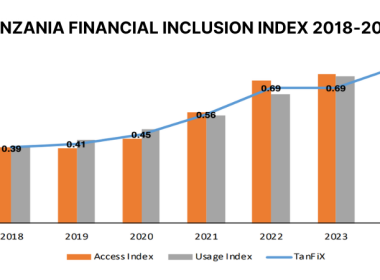
The Tanzania Financial Inclusion Index (TanFiX) rose to 0.81 in 2024, up from 0.69 (also reported as 0.72) in 2023[17, 119].
This gain reflects expanded access points, particularly mobile money and banking agents, microfinance institutions, and community microfinance groups, supported by improved ICT infrastructure, national identification interoperability, and rural electrification.
Formal financial service usage increased to 76% in 2023, up from 65% in 2017, with high adoption of digital financial services as the leading factor.
The evolution of mobile money from basic transfers to a full suite of digital financial products, including microloans (introduced from 2013), savings, merchant and utility payments, and cross-border remittances, has been central to this transformation.
Integration with Capital Markets and Government Services
Mobile money platforms are increasingly serving as the rails for capital market participation and public sector payments.
The full integration of the Dar es Salaam Stock Exchange application into the country's largest mobile money platform drove a 397% increase in mobile trading registrations, with mobile-driven turnover accounting for 24.3% of total equity trading[7].
On the government side, the Government Electronic Payment Gateway (GePG) enables businesses and individuals to pay official fees conveniently via mobile money, banks, or bank agents.
This integration significantly reduces face-to-face interactions between officials and businesses, limiting opportunities for corruption while streamlining license and permit payments.
Foreign Direct Investment Linkages
Mobile money has been a key driver of foreign investment into Tanzania's information and communication sector.
In 2023, FDI inflows into information and communication activities more than doubled to USD 198 million, driven by the growing demand for internet services and mobile money transfers[4].
Information and communication was among the top sectors accounting for 82.4% of total FDI in that year.
Policy Framework
Mobile money's expansion is anchored in a supportive regulatory environment overseen by the Bank of Tanzania, with full interoperability across networks in place since 2014.
National Financial Inclusion Framework (NFIF)
The NFIF supports the implementation of national development plans, including Tanzania Development Vision 2050, the National Five-Year Development Plans, and the Financial Sector Development Master Plan 2020/21 to 2029/30.
It aims to ensure that all adults and businesses have access to and use a broad range of affordable and high-quality financial products and services.
Specific interventions target women, youth, MSMEs, smallholder farmers, fishers, and persons with disabilities, with mobile money and banking agents identified as core access channels.
Credit Data and MSME Access to Finance
Financial sector reform proposals under the government's MKUMBI II agenda include expanding credit scoring data sources to incorporate mobile money and utility payment records.
This positions mobile money transaction histories as a formal input into credit assessment, unlocking lending to previously undocumented borrowers.
The reforms also enable movable assets, invoices, and contracts to serve as collateral, complementing the digital credit footprint.
Investment Opportunities
The scale of transactional throughput, TZS 198,859.29 billion in 2024, combined with sustained double-digit growth in both volume and value, positions mobile money as one of the most attractive fintech verticals in East Africa.
Opportunities exist in digital banking, mobile payments, microfinance, and insurance services, with regulatory reforms actively supporting foreign investment in the financial sector.
Emerging layers on top of mobile money infrastructure include digital loans, digital investments, and microinsurance, alongside advanced applications leveraging blockchain and artificial intelligence highlighted by the Financial Sector Deepening Trust (FSDT).
Cross-border remittance corridors present a significant growth axis, as mobile money platforms increasingly handle international transfers previously routed through traditional remittance operators.
The integration of mobile money with capital markets, evidenced by the 397% surge in mobile trading registrations, opens opportunities for wealth-tech and retail brokerage products designed for a mass market moving from cash to digital.
Credit-scoring platforms that convert mobile money transaction histories into lendable risk profiles represent a further high-growth entry point, particularly for MSME-focused digital lenders.
Last Update: May 2026
References
- https://www.fsdt.or.tz/wp-content/uploads/2023/07/FinScope-Tanzania-2023-Full-Report-Insights-that-Drive-Innovation.pdf (Guide reference #16)
- https://www.bot.go.tz/Publications/Regular/Annual%20Report/en/2026022607584561.pdf (Guide reference #17)
- https://www.bot.go.tz/Publications/Regular/Quarterly%20statistical%20Bulletin/en/2026022607540099.pdf (Guide reference #46)
- https://www.bot.go.tz/Publications/Other/Tanzania%20Investment/en/2025022811524146.pdf (Guide reference #51)
- https://www.bot.go.tz/Publications/Regular/Financial%20Stability/en/2025072310063848.pdf (Guide reference #106)
- https://www.bot.go.tz/Publications/Regular/Annual%20Report/sw/2025082509110518.pdf (Guide reference #119)
- https://dse.co.tz/storage/securities/DSE/financial_statement/Annual/PZFznv6PcCqY3s7h7hyLGLmHKoxcxu11OXxjL4pf.pdf (Guide reference #122)
- https://www.nbs.go.tz/uploads/statistics/documents/en-1769069714-Highlights%20on%20the%20Third%20Quarter%20GDP%202025.pdf (Guide reference #162)
- https://www.bot.go.tz/Publications/Regular/Annual%20Report/en/2025122912344593.pdf (Guide reference #166)
Want to know more about Mobile Money in Tanzania? Our free overview of the Tanzania Business and Investment Guide 2026 covers Mobile Money, plus key sectors and investment opportunities. The complete 141-page edition includes policies, taxation, key regulations, full macroeconomic data, and sources, and is also available at no cost upon completion of a short form.
Download Free OverviewGet the Full Edition for Free