

The International Finance Corporation (IFC), a member of the World Bank Group, together with the Mastercard Foundation, launched on 4th October 2018 in Dar es Salaam the Digital Financial Services (DFS) for Agriculture Handbook to support the expansion of financial inclusion to smallholder farmers and agricultural value chain actors in Sub-Saharan Africa.
The handbook is intended to provide information and guidance to financial service providers, including microfinance institutions, banks, mobile network operators, fintechs, and payment service providers, on how to apply DFS in agriculture.
IFC explains that financial inclusion has expanded dramatically in the region over the past 10 years due to the rapid evolution of mobile money and agent banking.

But access to formal financial services remains limited in rural areas and in the agricultural sector that contributes to about 18% of GDP across Sub-Saharan Africa but only receives an estimated 1% of bank lending in the region.
Riadh Naouar, IFC Manager for Financial Institutions Group Advisory in Sub-Saharan Africa, said “This handbook will help financial services providers better understand smallholder farmers and other actors in the agricultural value chains, and how to develop and launch sustainable financial services for them. Digital services can help farmers better access inputs, weather updates, pricing information, and markets.”
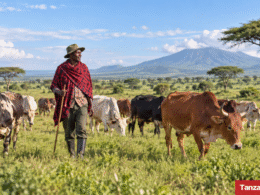
Tanzania Agriculture
Agriculture us Tanzania’s economic mainstay, contributing about 30% to its GDP and 67% to total employment.
In 2015 the Tanzania Agriculture Development Bank (TADB) was established to contribute to the development of agriculture in the country through mobilizing financial resources and supporting smallholder farmers with low-interest loans.
In June 2018 the President of Tanzania Hon. John Magufuli launched the Agricultural Development Plan Plan Second Sector Phase Two (ASDP II).

The five-year plan is one of the key instruments that the government uses to meet Tanzania Development Vision (TDV) 2025 and will be implemented until 2023 for a total investment of TZS13.8 trillion.
Want to know more about Agriculture in Tanzania? Our free overview of the Tanzania Business and Investment Guide 2026 covers Agriculture, plus key sectors and investment opportunities. The complete 141-page edition includes policies, taxation, key regulations, full macroeconomic data, and sources, and is also available at no cost upon completion of a short form.
Download Free OverviewGet the Full Edition for Free