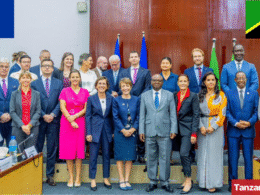




On 4th September 2024, the President of Tanzania, H.E. Dr. Samia Suluhu Hassan, met with the President of the People’s Republic of China, H.E. Xi Jinping, at the Great Hall of the People in Beijing.
The meeting underscored the importance of the longstanding relationship between Tanzania and China, with both leaders reaffirming their commitment to further strengthening cooperation across various sectors.
President Samia emphasized the need to maintain and enhance collaboration under China’s Belt and Road Initiative (BRI), highlighting its potential to bring tangible benefits to the people of both countries.

President Samia also called upon Chinese private-sector investors to explore opportunities in Tanzania, particularly in the development of renewable energy sources, and infrastructure, while President Xi Jinping expressed China’s readiness to deepen its strategic partnership with Tanzania, describing the country as a model of cooperation between developing nations.
In the meeting, the two leaders also discussed further exchanges in governmental expertise and training programs aimed at enhancing bilateral relations.
On the topic of the Forum on China-Africa Cooperation (FOCAC), President Samia expressed optimism that the upcoming summit would further strengthen the friendly relations between Africa and China while promoting industrialization and modern agriculture across the continent.
Following the discussions, President Samia, President Xi Jinping, and the President of Zambia, H.E. Hakainde Hichilema, witnessed the signing of a Memorandum of Understanding (MOU) between Tanzania, Zambia, and China for the improvement of the Tanzania-Zambia Railway (TAZARA).
President Samia also held talks with H.E. Wang Huning, the Chairman of the National Committee of the Chinese People’s Political Consultative Conference (CPPCC), during her visit to Beijing.

Tanzania-China Trade and Investments
Trade between Tanzania and China has grown significantly over the past few decades. China is currently one of Tanzania’s largest trading partners. According to 2021 data, the bilateral trade volume reached over USD 6 billion, with Tanzania exporting goods such as agricultural products, minerals, and leather to China, while importing a wide range of Chinese products, including machinery, electronics, textiles, and construction materials.
China has also been a leading foreign investor in Tanzania, with Chinese companies actively involved in a variety of sectors, including infrastructure, construction, manufacturing, agriculture, and energy.
Want to know more about Trade in Tanzania? Our free overview of the Tanzania Business and Investment Guide 2026 covers Trade, plus key sectors and investment opportunities. The complete 141-page edition includes policies, taxation, key regulations, full macroeconomic data, and sources, and is also available at no cost upon completion of a short form.
Download Free OverviewGet the Full Edition for Free